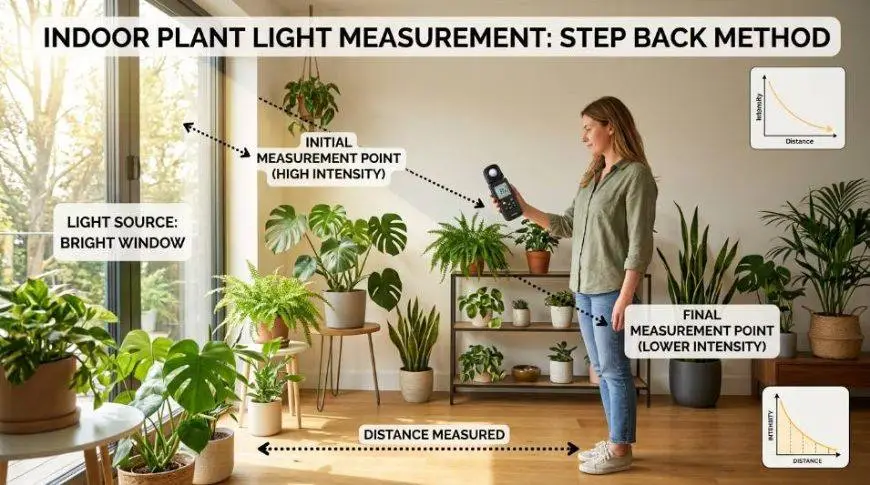
Houseplants typically need 100–1,000 foot-candles of light 6–8 hours from a window or 12–16 hours from a grow light depending on species. Snake plants thrive at 75 foot-candles; citrus trees need 1,000+. Learn how to measure light for indoor plants and match your home’s light levels to the right plants.
Why “Bright Indirect Light” Doesn’t Actually Tell You Anything About Light for Indoor Plants
Every plant tag, every care blog, every nursery employee says the same three words bright indirect light. It’s on the label of your pothos, your monstera, your fiddle leaf fig. The problem is that this phrase isn’t a measurement, it’s a feeling.
A few reasons this phrase fails plant owners:
- Human eyes adjust automatically. A room that feels “plenty bright” to you might be delivering a fraction of the light a plant actually needs.
- It gives no number to check against. As a result, you can’t compare “bright indirect” to anything, so you can’t diagnose a problem.
- It ignores duration. In fact, light intensity and how many hours it lasts both matter, yet the phrase covers neither properly.
That’s where foot-candles come in. Foot-candles (FC) are a real, measurable unit of light intensity. Once you know roughly how many foot-candles a spot in your home provides, you can finally stop guessing and match plants more accurately accuracy.
This guide covers:
- What foot-candles mean and how to measure them without special equipment
- Which plants belong in which light category
- How window direction changes everything
- Why the same spot gives different light in January than in July, and here’s what changes
- How to read warning signs when light is wrong
- How to set up grow lights correctly if natural light isn’t enough
Understanding Light Intensity: The Foundation of Light for Indoor Plants
What Is a Foot-Candle, Actually?
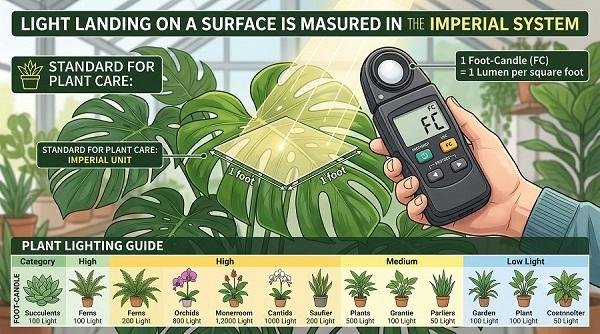
A foot-candle is the amount of light that lands on a one-square-foot surface placed one foot away from a single candle. It sounds old-fashioned because it is the unit dates back to 19th-century lighting science, but it’s still the standard measurement used by horticulturists, greenhouse growers, and university extension offices.
Three units you’ll come across, and what each one actually tells you:
- Foot-candles (FC): Light landing on a surface, measured in the imperial system. This is the standard for plant care.
- Lux: The metric equivalent of foot-candles. One foot-candle equals roughly 10.76 lux.
- Lumens: Total light output from a source, not the light actually reaching your plant. Useful for comparing bulbs, not for describing what a plant receives.
How to Measure Light for Indoor Plants in Your Home (Without Buying Anything)
You don’t need a $200 meter to get a useful reading. Here are three methods, ranked from most precise to most accessible:
- A light meter app. Several free and low-cost smartphone apps use your phone’s camera sensor to estimate lux, which you can convert to foot-candles by dividing by roughly 10.76. Not lab-grade accurate, but consistent enough to compare rooms.
- The camera manual-mode trick. If your phone or camera has a manual mode, you can estimate foot-candles using the exposure settings needed to correctly expose a plain white card.
- The shadow test — no tools required. Hold your hand about a foot above a piece of white paper, in the exact spot where your plant sits, and check the shadow it casts.
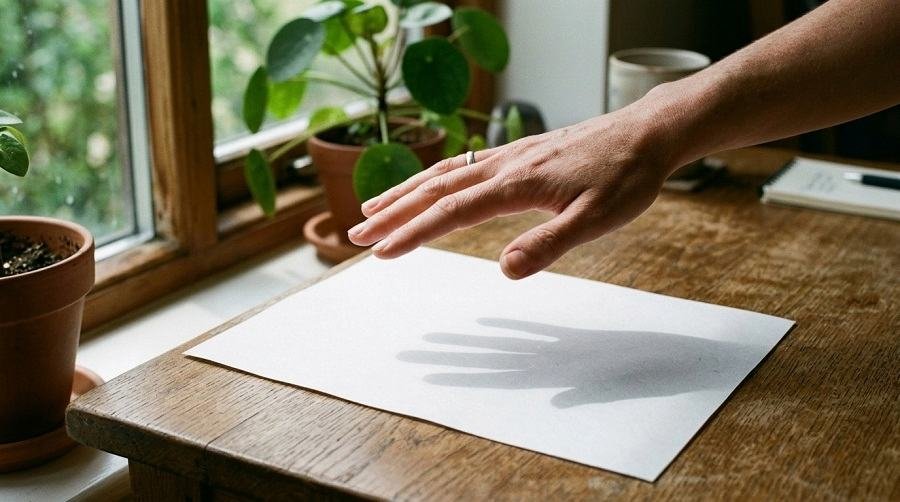
Use this table to translate the shadow test into a light category:
| Shadow Quality | Approximate Light Level | Light Category |
| Sharp, dark, well-defined edges | 1,000+ FC | Direct sunlight |
| Clearly visible but slightly soft edges | 500–1,000 FC | High light |
| Visible but fuzzy, no crisp edge | 100–500 FC | Medium-bright light |
| Faint outline, hard to make out | 25–100 FC | Low light |
| No visible shadow at all | Under 25 FC | Very low/ambient light |
A few tips for using this test properly:
- Run it at different times of day — light changes constantly, and one reading won’t tell the whole story.
- Test the exact spot the plant sits, not a nearby area that looks similar.
- Repeat it across seasons, since the same window can shift categories between summer and winter.
Light for Indoor Plants: Intensity Categories Explained
Once you have a rough foot-candle estimate, match it to one of these five categories. Most guides only list four — but plenty of homes have spots that fall below even “low light,” and pretending those spots can support a healthy plant is one of the most common reasons houseplants fail.
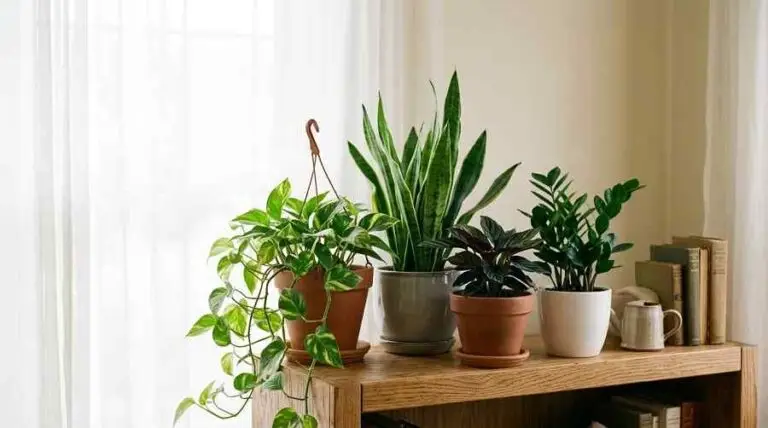
- Very Low / Ambient Light (under 25 FC): Interior hallways, windowless bathrooms, desks far from any window. Pothos and ZZ plants can hang on longest here, but “hang on” isn’t the same as thrive.
- Low Light (25–100 FC): A few feet back from a north-facing window, or a room with small or heavily obstructed windows.
- Medium-Bright Light (100–500 FC): Close to an east-facing window, or a few feet from a south or west window with a sheer curtain.
- High Light (500–1,000 FC): Right beside an unobstructed south or west-facing window.
- Direct Sunlight (1,000+ FC): Full, unfiltered sun hitting the plant directly for several hours, typically a south-facing window with a clear view of the sky.
According to horticultural guidance published by university extension programs, including the University of Maryland Extension, these ranges are the standard reference points used across the industry.
Light for Indoor Plants: Plant Matching Chart
Here’s where theory turns into a shopping list. Below are the same four core categories, expanded with more plants, a difficulty rating, and a note on how light level affects watering.
Low Light for Indoor Plants (25–100 FC)
| Plant | Difficulty | Watering Note | Common Mistake |
| ZZ plant | Very easy | Let soil dry out fully between waterings | Overwatering, low light means the plant uses water slowly |
| Snake plant | Very easy | Water sparingly, even less in winter | Root rot is the #1 killer |
| Cast iron plant | Easy | Tolerant of irregular watering | Assuming it needs more care than it does |
| Peace lily | Moderate | Likes consistent moisture, droops when thirsty | Confusing “droopy” with “needs more light” |
| Pothos | Very easy | Dry out slightly between waterings | Leggy vines mistaken for normal growth |
| Philodendron | Easy | Similar to pothos | Placing too far from any light source at all |
Medium-Bright Light for Indoor Plants (100–500 FC)
| Plant | Difficulty | Watering Note | Common Mistake |
| Chinese evergreen | Easy | Even moisture, avoid soggy soil | Placing in low light and expecting variegation to hold |
| Rubber plant | Moderate | Let top inch of soil dry out | Not rotating the plant, causing lopsided growth |
| Dracaena | Easy | Sensitive to fluoride in tap water | Using softened or fluoridated water |
| African violet | Moderate | Water from the bottom, avoid wetting leaves | Direct sun causing leaf scorch |
| Calathea | Harder | Wants consistent humidity and moisture | Treating it like a low-light plant |
| Monstera | Moderate | Dry out slightly between waterings | Assuming it wants low light because it’s marketed as “easy” |
High Light for Indoor Plants (500–1,000 FC)
| Plant | Difficulty | Watering Note | Common Mistake |
| Croton | Moderate | Consistent moisture, dislikes drafts | Not enough light causes it to drop its vivid color |
| Hibiscus | Moderate | Likes moist soil, heavy feeder | Underestimating how much light it needs indoors |
| Jade plant | Easy | Let soil dry fully, succulent-type watering | Too little light causes stretched, weak growth |
| Hoya | Easy | Dry out between waterings | Placed too far from a bright window to bloom |
| Bird of paradise | Harder | Regular watering, likes humidity | Expecting it to thrive in medium light |
| Fiddle leaf fig | Harder | Consistent watering schedule, dislikes being moved | Low light plus overwatering is a common deadly combination |
Direct Sunlight: High Light for Indoor Plants (1,000+ FC)
| Plant | Difficulty | Watering Note | Common Mistake |
| Citrus (lemon, lime, calamondin) | Harder | Deep but infrequent watering | Indoor citrus usually suffers from too little light, not too much |
| Succulents | Easy | Minimal watering, well-draining soil | Placed in low light “because it’s easy,” causing stretching |
| Cacti | Very easy | Water rarely, especially in winter | Same as succulents |
| Gardenia | Harder | Consistent moisture, acidic soil | Inconsistent light causing bud drop |
The light-water connection in short:
- Lower light slows photosynthesis.
- Slower photosynthesis means the plant uses water more slowly.
- A plant in low light watered on a “bright light” schedule is far more likely to develop root rot.
Room-by-Room, Window-Direction Light Map for Indoor Plants
This is the part most articles skip, even though window direction is the single biggest factor in how much light a plant actually receives.
Note: directions below assume a home in the Northern Hemisphere. In the Southern Hemisphere, flip north and south.
North-Facing Windows
- Never receive direct sun ,light is soft, even, and consistent all day.
- Typically the weakest of the four directions, often low to medium range even at the glass.
- A spot three feet back can drop into “very low light.”
- Best matches: snake plants, ZZ plants, pothos, cast iron plants.
South-Facing Windows
- The brightest windows in a Northern Hemisphere home, with direct sun for much of the day.
- Right at the glass, regularly exceeds 1,000 FC.
- Prime spot for citrus, succulents, and cacti.
- Highest risk of scorching in summer, when the sun angle is more intense.
- A sheer curtain can pull intensity down into the high-light range without losing much brightness.
East-Facing Windows
- Delivers direct sun only during cooler morning hours.
- One of the most forgiving spots in the house ,bright enough for most medium-to-high light plants.
- Rarely intense enough to scorch leaves.
- Best matches fiddle leaf figs, rubber plants, monsteras.
West-Facing Windows
- Gets direct sun in the afternoon, usually the hottest part of the day.
- Heat buildup from the glass can stress plants more than south windows in summer.
- Best matches: hoya, jade plant, croton plants that tolerate both heat and high light.
- May need to be pulled back a foot or two during peak summer months.
Interior Rooms With No Direct Window Access
- Anywhere six to eight feet from a window functions as very-low-light, almost regardless of direction.
- Even “low light” marketed plants still need some measurable light to stay healthy.
- A grow light isn’t optional here, it’s the only realistic path to a healthy plant.
| Window Direction | Light at the Glass | Light 3 ft Back | Light 6+ ft Back | Best Match |
| North | Low–Medium | Low | Very Low | Snake plant, ZZ, pothos |
| South | Direct (1,000+ FC) | High | Medium | Citrus, succulents, croton |
| East | High | Medium | Low | Monstera, rubber plant, fiddle leaf fig |
| West | Direct (1,000+ FC), hot | High | Medium | Hoya, jade, bird of paradise |
| Interior, no window | Very Low | — | — | Grow light required |
Seasonal Light Drift: The Variable in Light for Indoor Plants Almost Nobody Talks About
The amount of light a spot receives isn’t fixed, it changes with the seasons, sometimes dramatically.
In winter:
- The sun sits lower in the sky and days are shorter.
- A south-facing window can drop by half its summer intensity by December.
- A plant that was thriving in autumn can suddenly show low-light stress, even without moving.
In summer:
- The sun climbs higher and days stretch longer.
- Windows that felt comfortably bright in spring can turn intense enough to scorch leaves, especially south and west exposures.
Practical adjustments to make:
- Move light-hungry plants closer to south or west windows during shorter winter days.
- Pull sun-sensitive plants back, or add a sheer curtain, when summer sun angle intensifies.
- Expect growth to slow naturally in winter, partly light, partly the plant’s own seasonal dormancy.
- Relying on a grow light through winter to make up for shorter daylight is a normal, effective solution, not a sign of failure.
Signs of Incorrect Light for Indoor Plants
Your plant usually signals a lighting problem well before it becomes serious, if you know what to look for.
Signs of Too Little Light for Indoor Plants
- Leggy, stretched growth (etiolation) — the plant is literally growing toward whatever light it can find, stretching stems thin.
- Smaller new leaves — each new leaf coming in smaller than the last signals not enough energy to support full growth.
- Loss of variegation — variegated plants often revert to solid green, since more chlorophyll is needed to survive in low light.
- Slowed or stalled growth, beyond what’s normal for the season.
- Yellowing lower leaves, often confused with overwatering, though the two frequently happen together.
- Soil staying wet far longer than expected after watering.
Signs of Too Much Light for Indoor Plants
- Scorched, bleached, or crispy brown patches, usually on the side facing the light directly.
- Leaf curling or cupping — a defense mechanism to reduce surface area exposed to intense light.
- Faded or washed-out leaf color, which often shows up before actual scorching does.
- Drooping despite adequate soil moisture — commonly mistaken for a watering problem.
Quick Diagnostic Table
| Symptom | Could Also Be | How to Tell the Difference |
| Yellow lower leaves | Overwatering | Soggy soil = water issue; dry soil + weak light = light issue |
| Drooping leaves | Underwatering, root rot | Dry soil = water; wet soil + wilting = root rot; moist soil + sunny spot = light/heat stress |
| Brown, crispy leaf tips | Low humidity, fluoride in water | Isolated to tips only = humidity/water; whole leaf sections = light |
| Small new leaves | Nutrient deficiency, low light | If fertilizing regularly and light is weak, it’s almost always light |
| Leggy stems | Normal growth habit for the species | Compare against how the plant naturally grows |
Using Grow Lights for Indoor Plants
When You Actually Need One
A grow light is genuinely the right call when:
- A plant is in an interior room with no meaningful window access.
- Winter daylight hours drop too low to sustain healthy growth.
- You’re trying to grow a high-light plant, like citrus or succulents, somewhere that can’t naturally hit 1,000+ FC.
Choosing the Right Grow Light for Indoor Plants
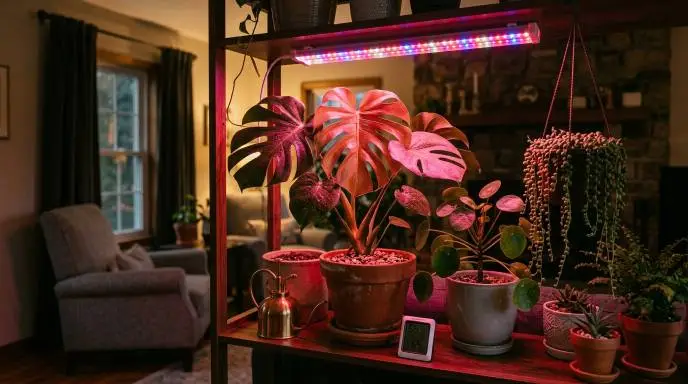
- Pick full-spectrum white LEDs for foliage plants, they mimic the balance of wavelengths found in natural daylight.
- Check the color temperature. Look for 5,000K to 6,500K, which reads as a crisp, daylight-like white.
- Look for PPFD or PAR ratings if you want a more precise metric than foot-candles. These measure the specific wavelengths plants actually use for photosynthesis.
Placement and Duration
- Place grow lights roughly 12 to 24 inches from foliage plants, closer for lower-output lights, farther for stronger ones.
- Always check the manufacturer’s specific guidance, since output varies widely between products.
- Run the light 12 to 16 hours a day, since artificial light is typically less intense than direct sun and needs more time to deliver the same total light.
- Give plants at least 8 hours of uninterrupted darkness. Plants use darkness for respiration and internal energy processing that can’t happen properly under constant light.
- Use a simple outlet timer so the light cycle stays consistent every day.
Common Grow Light Mistakes
- Wrong spectrum — pure red-and-blue lights work, but make it hard to visually check on plant health.
- Too close — leaves pressed against a grow light can scorch just like direct sun.
- Too far — a light placed several feet away may look like it’s helping without providing enough usable light.
- No timer — inconsistent light cycles stress plants more than a slightly-too-short but consistent schedule.
The Light Budget: A Simple Way to Think About All of This
Think of your plant’s daily light needs as a budget, a total amount of light energy it needs over 24 hours, made up of two variables multiplied together:
Light Budget = Foot-Candles × Hours of Exposure
This is exactly why grow lights run 12 to 16 hours while natural sunlight only needs 6 to 8 hours, artificial light is almost always lower in intensity, so it needs more time to deliver the same total budget.
If a plant isn’t getting enough light, you have three real options:
- Increase intensity — move it closer to a window or a stronger light source.
- Increase duration — extend grow light hours, or supplement natural light with a few extra hours of artificial light.
- Do both — the most reliable fix for genuinely difficult spots, like windowless offices or deep interior rooms.
Thinking in terms of a daily budget, rather than a single number to meet or fail, makes it much easier to solve a spot that isn’t working.
Summary Table
| Light Category | FC Range | Natural Light Hours Needed | Grow Light Hours Needed | Example Plants | Best Window Match |
| Very Low / Ambient | Under 25 FC | Not sufficient alone | 12–16 hrs | Pothos, ZZ (survival only) | None — interior room |
| Low | 25–100 FC | 6–8 hrs | 12–16 hrs | Snake plant, ZZ, cast iron plant, peace lily | North-facing |
| Medium-Bright | 100–500 FC | 6–8 hrs | 12–16 hrs | Chinese evergreen, rubber plant, dracaena, monstera | East-facing |
| High | 500–1,000 FC | 6–8 hrs | 12–16 hrs | Croton, hibiscus, jade, hoya, fiddle leaf fig | South/west-facing |
| Direct Sun | 1,000+ FC | 6–8 hrs direct | Rarely achievable indoors | Citrus, succulents, cacti, gardenia | South-facing, unobstructed |
Frequently Asked Questions
How do I know if my plant is getting enough light without a meter?
Try the shadow test: hold your hand a foot above a white sheet of paper in the plant’s spot and check how sharp the shadow is. Combine that with watching for signs of low light, stretched growth or fading variegation, over a few weeks.
Can a plant get too much indirect light?
Not really. Indirect light is already diffused or bounced off a surface, keeping its intensity well below scorching levels. What people call “too much indirect light” is usually a few hours of direct sun sneaking in unaccounted for.
Do I need a grow light if my apartment has windows?
Not necessarily. If plants sit within a few feet of a bright, unobstructed window and show no stretched growth or fading color, natural light is likely enough. Grow lights help more in winter, in interior rooms, or for high-light plants your windows can’t satisfy year-round.
How many foot-candles is a typical living room?
It varies by window size, direction, and distance from the seating area to the glass, but most living rooms fall in the low-to-medium-bright range a few feet back from the windows.
Can I use regular LED bulbs instead of grow lights?
Standard household LEDs help a little, but they’re generally less intense and often lack the full spectrum plants use efficiently. They work as a supplement, not a substitute, for a proper grow light in a low-light room.
How long does it take to see light-stress symptoms improve?
Existing damage, like scorched or stretched leaves, won’t reverse. New growth should show improvement within a few weeks, about how long it takes a plant to put out its next round of leaves.
Putting It All Together
Getting light right isn’t about memorizing one rule. A few closing points to keep in mind:
- Intensity, duration, direction, and season all interact to determine what a plant actually receives.
- A spot that’s perfect for a fiddle leaf fig in October might be too dim by January.
- A window that felt gentle in spring can scorch leaves by July.
- Thinking in foot-candles and light budgets, instead of vague phrases like “bright indirect light,” turns guesswork into a system you can rely on.
Now that you know how to measure light accurately, combine this knowledge with proper watering, soil selection, and fertilizing to help your plants thrive. Our Complete Beginner’s Guide to Indoor Plant Care brings all of these essentials together in one place.
2 Comments