Table of Contents
- A Quick Story Before We Get Into It
- Why Your Room’s Light Level Isn’t What It Looks Like
- Breaking Down Your Room’s Light Level: Low, Medium, and Bright
- Three Ways to Test Your Room’s Light Level
- A Room-by-Room Guide to Your Room’s Light Level
- Common Mistakes People Make When Judging Their Room’s Light Level
- What to Do Once You Know Your Room’s Light Level
- Frequently Asked Questions About Your Room’s Light Level
- Bringing It Back to Where We Started
Your room’s light level comes down to three quick checks:
- Low light – you can’t comfortably read a book without a lamp on, roughly 25–100 foot-candles (270–1,000 lux)
- Medium light – you can see soft, visible shadows on the floor during the day, roughly 100–500 foot-candles (1,000–5,400 lux)
- Bright light – direct sun hits the same spot for several hours and casts a sharp, dark shadow, roughly 500–1,000+ foot-candles (5,400–10,700+ lux)
That’s the quick version. But if you’ve ever killed a plant that was supposedly “impossible to kill,” you already know the quick version isn’t enough. Keep reading, because figuring out your room’s light level for real depends on your window direction, the season, and honestly, how your eyes are tricking you right now.
A Quick Story Before We Get Into It
A friend of mine moved into a new apartment last spring. Her living room had one big window, and she was thrilled. Finally, a “bright” spot for the fiddle leaf fig she’d been wanting for years. She bought the plant, set it three feet back from the window, and waited.
Six weeks later, the leaves were drooping and turning yellow at the edges. She was convinced she’d overwatered it. She hadn’t. Her window faced north, and a building shaded half of it for most of the afternoon. What looked bright to her felt like a well-lit room. To the plant, it was closer to a dim hallway.
That gap between what a room looks like and what a plant experiences is the entire reason this topic trips people up. So before we get into the testing methods, let’s clear that up first.
Why Your Room’s Light Level Isn’t What It Looks Like
Your eyes lie to you here, and it’s not really your fault. Here’s what’s actually happening:
- Human eyes have pupils that dilate automatically to let in more light in dim conditions
- Within a few minutes of walking into a shaded room, your pupils widen, and the space feels perfectly lit
- The actual amount of light hasn’t changed at all; only your perception of it has
Plants don’t get that adjustment. Consider the difference:
- A leaf either receives enough photons to fuel photosynthesis, or it doesn’t
- There’s no biological dimmer switch making a dim room “feel” bright to a snake plant the way it does to you
- This is why so many people swear their room is “pretty bright,” then get confused when their plants disagree
The room isn’t lying. Your eyes are just really good at compensating, and that compensation hides your room’s light level until you actually measure it.
Breaking Down Your Room’s Light Level: Low, Medium, and Bright
Before testing your own space, it helps to know what you’re actually testing for. Here’s what each category means in practice, not just in numbers.
1. Low light
- Range: Roughly 25 to 100 foot-candles (about 270 to 1,000 lux)
- Where you’ll find it: North-facing windows in winter, interior rooms with no direct window access, hallways, and spots several feet away from any window
- What it looks like: Shadows are faint or barely there, and you’d struggle to comfortably read a book without turning on a lamp
One thing most guides skip: a room lit only by a warm incandescent bulb at night still counts as low light for a plant, even though it looks perfectly lit to you after sunset. Artificial ambient lighting from lamps rarely comes close to what a plant needs unless you’re using an actual grow light positioned close to the leaves.
2. Medium light
- Range: Roughly 100 to 500 foot-candles (about 1,000 to 5,400 lux)
- Where you’ll find it: Unshaded north-facing windows in summer, or east- and west-facing windows with some obstruction like a curtain, tree, or neighboring building
- What it looks like: Soft, visible shadows appear during the day, usually in the middle of a room or near a side window rather than directly in front of it
A rough rule of thumb: most medium-light spots sit within three to six feet of an unobstructed window. Once you’re further back than that, you’re usually drifting into low-light territory.
3. Bright light
- Range: Roughly 500 to 1,000+ foot-candles (about 5,400 to 10,700+ lux)
- Where you’ll find it: South- or southwest-facing windows, especially with direct or lightly filtered sun
- What it looks like: Dark, sharp-edged shadows appear where the sun hits directly for several hours
Here’s where a lot of people get confused: bright light and direct sun aren’t automatically the same thing.
- Bright indirect light means the room gets strong, unobstructed daylight, but the sun’s direct rays aren’t hitting the leaves themselves, maybe because of a sheer curtain or because the plant sits just to the side of the window
- Direct sun means the actual sun is falling on the plant
Most houseplants that tags describe as needing “bright light” actually want bright indirect, not several hours of direct rays, which can scorch leaves on tropical plants that evolved under a forest canopy.
Three Ways to Test Your Room’s Light Level
You don’t need to pick just one of these. Start with the fastest, and work your way down the list if you want more confidence in the result.
1. The shadow test (about 30 seconds, no tools needed)
This is the fastest way to get a rough read on any spot in your home.
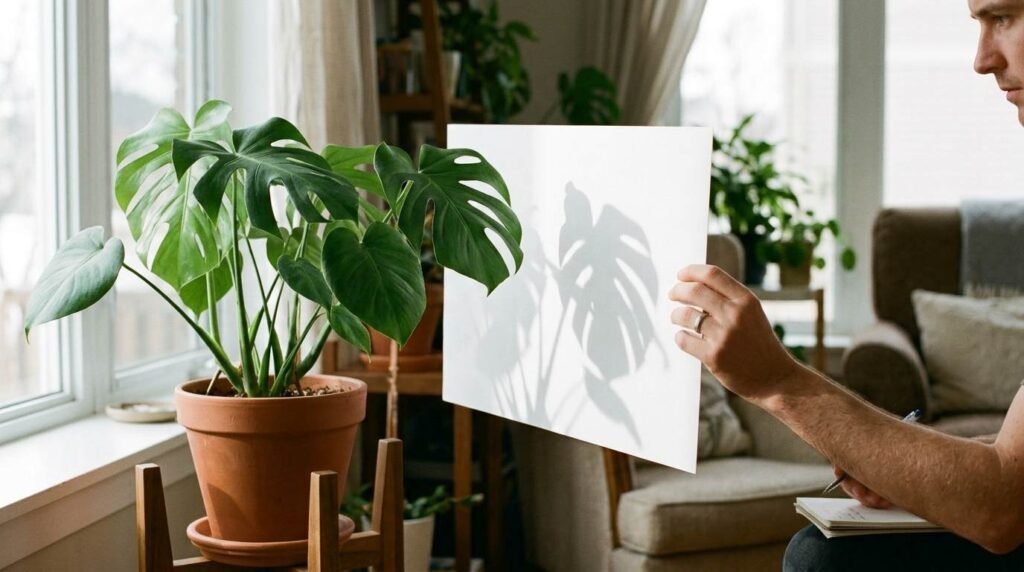
- Hold your hand about a foot above a piece of white paper, around midday
- Look closely at the shadow it casts
- A sharp, dark outline means bright light
- A soft, fuzzy outline means medium light
- A faint shadow, or none at all, means low light
Do this test two or three times across the day, morning, midday, and afternoon, since the same spot can shift categories as the sun moves. A window that looks bright at noon might be dim by 4 p.m., depending on which direction it faces.
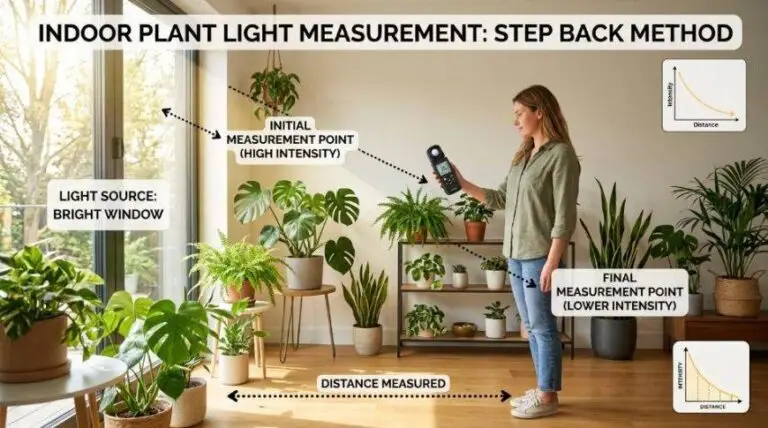
2. The phone light meter test (about 2 minutes, most useful for beginners)
Most articles skip this one, but it’s genuinely one of the easiest ways to get an actual number for your room’s light level instead of guessing.
- Use a free lux meter app on your phone. Most phones have a built-in light sensor that can help measure light.
- Hold your phone where the plant would sit
- Read the lux number the app gives you
- Convert it to foot-candles with this formula: Lux ÷ 10.76 = foot-candles
So a reading of 1,500 lux works out to roughly 139 foot-candles, which lands squarely in medium light. Phone sensors aren’t lab-grade equipment, and readings can vary a bit between apps and phone models, but for the purpose of deciding where to put a houseplant, they’re more than accurate enough.
3. The window direction and time-of-day method (about 5 minutes, most reliable long-term)
Window direction is the most reliable long-term indicator, because unlike a single shadow test, it accounts for how light changes across the year.
- North-facing: Generally the dimmest exposure in the Northern Hemisphere, though it can shift to medium light in summer when the sun sits higher in the sky
- South-facing: Usually the brightest exposure in the Northern Hemisphere, often receiving direct sun for a good portion of the day
- East-facing: Gentler morning sun, typically landing in the medium to bright range depending on the season and how open the view is
- West-facing: Stronger afternoon sun, often bright, and sometimes intense enough to scorch delicate leaves in summer
One detail almost every guide leaves out: this only holds in the Northern Hemisphere.
- In the Southern Hemisphere, south-facing windows are the dimmest exposure
- North-facing windows are the brightest, because the sun tracks through the northern part of the sky instead
If your search results seem to contradict what you’re seeing in your own home, this is usually why.
A Room-by-Room Guide to Your Room’s Light Level
If you’d rather skip the testing altogether and just want a starting guess, here’s how most homes tend to break down. Test your own space to confirm, since layout and window size change everything.
| Room | Typical light level | Why |
| Bathroom | Low, unless it has a large window or skylight | Small windows, often frosted glass for privacy |
| Kitchen | Medium | The kitchen often has a window near the sink, but counters and cabinets can block some of the light |
| Bedroom | Varies the most | Curtains for privacy often cut light significantly, even with a large window |
| Home office | Often low | Desks are usually angled away from windows to reduce screen glare |
| Living room | Medium to bright | The living room often has the largest windows, but furniture can block some of the light |
Common Mistakes People Make When Judging Their Room’s Light Level
Even after learning the categories, it’s easy to misjudge your own space. A few patterns come up constantly:
- Testing only in the afternoon. Light shifts a lot across a single day, so one glance at 3 p.m. won’t tell you what’s happening at 10 a.m.
- Confusing “close to a window” with “bright.” Sheer curtains, window tinting, and even slightly dirty glass all cut down the light reaching a plant more than people expect.
- Forgetting the seasonal shift. A spot that gets bright light in July may only get medium or even low light by December because the sun sits lower in the sky and the days are shorter.
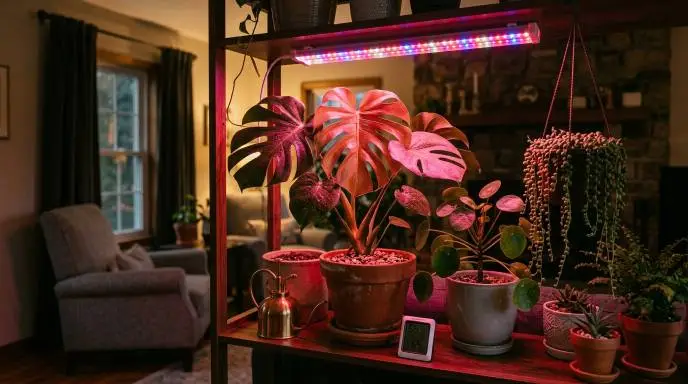
- Assuming a grow light instantly fixes everything. Grow lights only count as bright light if they’re the right wattage and positioned close enough to the leaves. A grow light sitting six feet away doing more for the room’s ambiance than the plant’s growth is a common and expensive mistake.
What to Do Once You Know Your Room’s Light Level
Once you’ve figured out your room’s category, the next step is matching it to the right plants, rather than guessing based on a nursery tag that assumes ideal conditions.
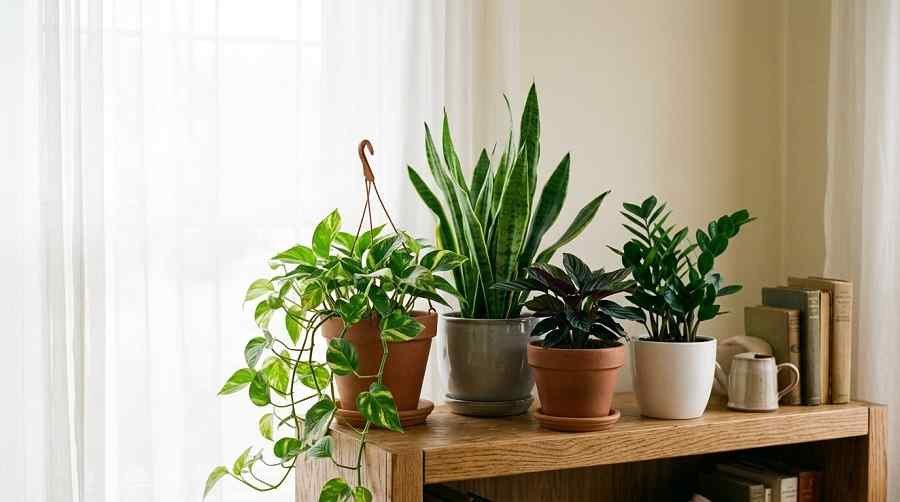
- Low light rooms work best with plants that tolerate dim spaces, such as snake plants or pothos
- Medium light gives you more flexibility, since most plants that tolerate a range of conditions will do well here
- Bright light is ideal for most houseplants, though you’ll want to watch for direct afternoon sun scorching leaves
Frequently Asked Questions About Your Room’s Light Level
Can a room be low light in winter but medium light in summer? Yes. The sun sits lower in the sky during winter, and days are shorter, so a spot that reads as medium light in July can easily drop to low light by January. Many people make the mistake of checking the light once and thinking it will stay the same throughout the year.
Do sheer curtains reduce light level significantly? They can. A thin sheer curtain typically softens direct sun into bright indirect light rather than blocking it heavily. Still, a thicker or lightly colored curtain can drop a bright spot down to medium fairly easily. Worth testing with the curtain in its usual position rather than pulled back.
Is a north-facing window ever considered bright light? Rarely, and mostly only in summer with an unusually large, unobstructed window. In most homes, a north-facing window sits in the low-to-medium range for most of the year.
Can I use my phone’s flashlight app instead of a light meter app? No, those measure completely different things. A flashlight app just turns on your camera’s LED. You need an app that reads your phone’s built-in ambient light sensor, usually labeled as a lux meter or light meter app in your app store.
How often should I retest my room’s light level? Once each season is a reasonable habit, especially if you’re growing plants that are sensitive to light changes. A quick shadow test takes seconds and can save you from watching a plant decline for weeks before you figure out why.
Bringing It Back to Where We Started
Remember my friend with the fiddle leaf fig? Once she realized her window wasn’t as bright as it looked, she moved the plant to a spot two feet closer to the glass and swapped it for a pothos in the original dim corner instead. Both plants are thriving now. Nothing about her apartment changed. She just stopped trusting her eyes and started testing the actual light.
That’s really the whole lesson here. Your room hasn’t changed since you moved in, but your understanding of its light level might, once you actually measure it instead of guessing. Once you know your real room’s light level, picking the right plant becomes a lot less like trial and error and a lot more like matching two things that were always meant to work together.
For indoor complete plant care Complete Beginner’s Guide to Indoor Plant Care.