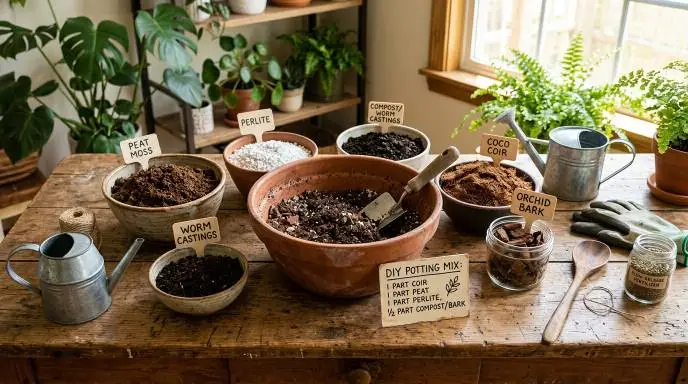
A reliable indoor potting mix is 4 parts coco coir (moisture retention), 2 parts perlite (drainage and air pockets), 1 part worm castings (nutrition), and an optional half part orchid bark for chunkiness. Mix these dry, moisten thoroughly, and let the batch rest for a few hours before potting. That’s the foundation, but the exact ratio should shift depending on whether you’re potting a thirsty fern or a cactus that hates wet feet, and that’s where most guides stop short.
If you’ve ever cracked open a bag of store-bought potting soil and found it compacted, soggy, or crawling with gnats a week later, you already know why so many houseplant owners eventually make their own mix. It costs less per pot, it lasts longer on the shelf, and once you understand what each ingredient actually does, you can build a mix suited to your exact plants instead of settling for a generic blend built for the widest possible audience.
Getting your potting mix right is just one piece of keeping your houseplants thrivin, if you’re new to plant care, our Complete Beginner’s Guide to Indoor Plant Care covers everything else you need to know, from watering schedules to light requirements.
This guide walks through the reasoning behind the recipe, not just the recipe itself, so you can adjust it confidently for whatever’s sitting on your windowsill.
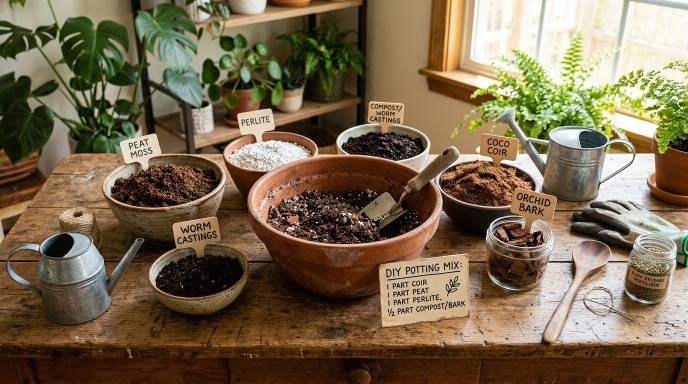
Why Make Your Own Indoor Potting Mix?
Before getting into ratios, it’s worth answering the question a lot of people skip: is this actually worth the effort compared to grabbing a bag at the store?
The Cost Math Usually Favors DIY
A bag of premium indoor potting mix typically runs somewhere between $12 and $20 for roughly 8 quarts, which works out to $1.50–$2.50 per quart. Buying coco coir bricks, perlite, and worm castings in bulk brings that down closer to $0.50–$0.90 per quart once you factor in that a single bag of perlite or a coir brick makes several batches. The savings become more noticeable the more plants you own someone with 3 or 4 houseplants might not notice much difference, but a collector with 30+ pots will feel it.
| Approach | Approx. Cost per Quart | Best For |
| Premium bagged mix | $1.50–$2.50 | Small collections, convenience |
| DIY bulk ingredients | $0.50–$0.90 | Larger collections, repeat potting |
You Control What Goes In
Bagged mixes vary a lot between brands, and not always in ways you can predict just by looking at the bag. Some run heavy on undecomposed bark that keeps shifting for months. Others use compost that wasn’t fully sterilized, which is a common source of the fungus gnats that show up a week or two after repotting. When you build the mix yourself, you know exactly what’s in it and can leave out anything that’s caused problems before.
You Can Customize for Each Plant
A snake plant and a fern have almost opposite soil needs, one wants to dry out fast, the other wants to stay lightly moist. A single bagged mix can’t do both well. Making your own means adjusting the ratio per plant rather than compromising across your whole collection. (Jump to the plant-specific ratios further down if that’s what brought you here.)
What Potting Mix Actually Needs to Do
Most articles list ingredients without explaining why they’re there, which makes it hard to substitute anything or troubleshoot when something goes wrong. A good mix has to handle three separate jobs at once, and every ingredient exists to serve one of them.
1. Hold Moisture (Without Staying Soggy)
Coco coir vs. peat moss — these are the two most common bases, and they behave similarly but aren’t identical. Coco coir is made from the fibrous husk of coconuts, a byproduct of the coconut industry, so it’s considered the more renewable option. It also rewets easily after drying out, whereas peat moss can become hydrophobic (water-repellent) if it dries completely, causing water to run straight down the inside of the pot instead of soaking in. Peat moss is slightly more acidic, which matters for a small number of plants that prefer lower pH.
For most houseplants, coco coir is the easier ingredient to work with day to day.
2. Create Air Pockets and Drainage
Perlite vs. pumice vs. horticultural charcoal — this is the piece that keeps roots from sitting in water, which is the single most common cause of houseplant death.
- Perlite is lightweight, white, volcanic glass that’s been heated until it pops (similar to popcorn). It’s cheap and widely available but can float to the surface over time and create dust when handled dry.
- Pumice does the same job but is denser, so it won’t float, and it’s less dusty. It costs more and can be harder to find locally.
- Horticultural charcoal adds drainage while also helping filter out impurities and reduce odor from overwatering, useful in mixes for plants that are prone to root rot.
3. Provide Nutrition
Worm castings vs. compost vs. slow-release fertilizer — potting mix on its own has almost no nutritional value once the organic matter breaks down, so something needs to feed the plant.
Worm castings are the easiest starting point for anyone new to this. They release nutrients gently and are very difficult to overdo, unlike synthetic fertilizer, which can burn roots if measured incorrectly. Compost works too, but homemade or unsterilized compost carries a higher risk of pests and pathogens, so bagged, sterilized compost is the safer choice if you go that route.
The Standard Indoor Potting Mix Recipe
This is the base recipe to start from before adjusting for a specific plant.
Ingredients
| Ingredient | Amount | Purpose |
| Coco coir (or peat moss) | 4 parts | Moisture-retaining base |
| Perlite (or pumice) | 2 parts | Drainage and aeration |
| Worm castings | 1 part | Slow-release nutrition |
| Orchid bark (optional) | ½ part | Adds structure, prevents compaction |
A “part” can be any consistent measurement a cup, a scoop, a bucket, as long as you use the same one for every ingredient. For a small batch, 4 cups coco coir, 2 cups perlite, 1 cup worm castings, and ½ cup orchid bark makes roughly enough for two to three medium (6-inch) pots.
Step-by-Step Instructions
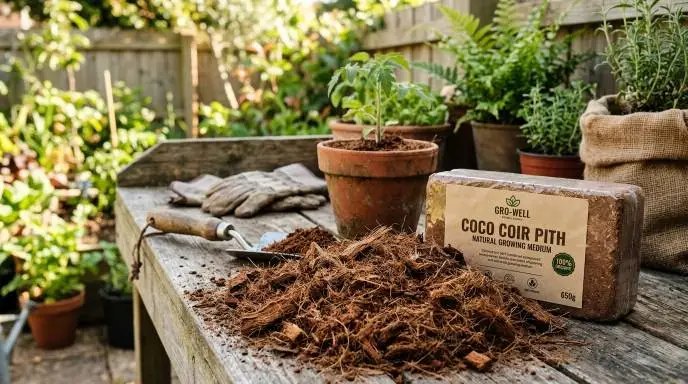
- Rehydrate the coir first if it’s compressed. Most coco coir is sold as a dry, compressed brick. Drop it into a large tub, pour in warm water (roughly 4–5 cups per standard brick), and wait 10–15 minutes. It will expand dramatically break it apart with your hands once it’s loose and fluffy.
- Measure everything using the same scoop. Consistency matters more than the exact unit. If the ratio calls for 4:2:1, stick with whatever container you’re using for all three measurements.
- Add the perlite gradually. If it’s dusty, lightly dampen it first (a spray bottle works well) this cuts down on airborne dust, which isn’t something you want to breathe in repeatedly.
- Mix in the worm castings last. Worm castings are fine and can clump if added too early; mixing them in last makes it easier to distribute evenly.
- Combine everything by hand or with a trowel in a large tub until the color and texture look consistent throughout, with no dry pockets or dense clumps.
- Let the mix rest for a few hours (or overnight) before potting. This gives the coir time to fully absorb moisture and settle, so you’re not planting into a mix that’s still shifting and compacting.
Potting Mix Ratios by Plant Type
The base recipe above works fine as an all-purpose mix, but plants with different root structures and native habitats do better with adjusted ratios. This is usually the part people are actually looking for once they realize a single formula doesn’t fit every pot.
Succulents & Cacti
These plants store water in their leaves and stems, so the soil’s job is to dry out fast and never stay wet.
- 2 parts coco coir or peat moss
- 2 parts perlite or pumice
- 1 part coarse sand
- Skip or minimize worm castings — succulents grow slowly and don’t need much feeding.
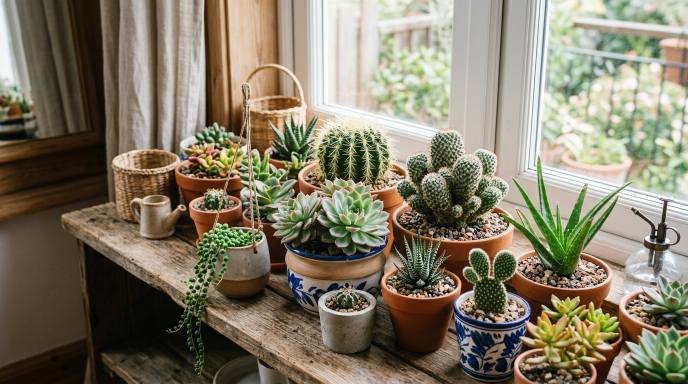
Succulents and cacti need a fast-draining mix because they’re often placed in bright, direct light — see our guide to measuring indoor light levels if you’re unsure how much your space is providing.
Aroids (Monstera, Pothos, Philodendron)
In their natural habitat, these plants grow in loose, chunky material — decomposing leaf litter and tree bark — with roots that want plenty of air contact.
- 3 parts coco coir
- 2 parts perlite
- 2 parts orchid bark
- 1 part worm castings
Ferns
Ferns are the exception to “well-draining is always best” — most varieties want consistent, light moisture and will crisp up if they dry out between waterings.
- 5 parts coco coir or peat moss
- 1 part perlite
- 1 part worm castings
Snake Plants & ZZ Plants
Both store water in thick rhizomes and are highly prone to root rot in mixes that hold too much moisture.
- 2 parts coco coir
- 2 parts perlite or pumice
- 1 part coarse sand or extra perlite
Orchids
Orchids (especially epiphytic types like phalaenopsis) don’t grow in soil at all in nature, they grow on trees, with roots exposed to air. A soil-based mix will suffocate and rot them.
- 4 parts orchid bark
- 1 part perlite
- 1 part charcoal
- No coir or peat as a base, this should be a bark-dominant, chunky mix, not a soil.
Common Mistakes When Making DIY Potting Mix
A homemade mix that isn’t working usually traces back to one of these.
- Using garden soil as a base. Garden soil is far denser than anything used indoors and compacts quickly in a pot, cutting off oxygen to the roots. It’s also more likely to carry pests. Keep garden soil outdoors.
- Skipping the perlite rinse or dampening step. Dry perlite creates fine dust that’s unpleasant to breathe and tends to float to the surface of the pot after watering, which can look like the mix is “separating” over time.
- Guessing at ratios instead of measuring. Eyeballing it tends to skew too heavy on whichever ingredient is easiest to scoop, which throws off drainage.
- Skipping sterilization on homemade compost. Compost from an outdoor bin can carry pests, weed seeds, or fungal spores. Store-bought, bagged compost is treated and safer for indoor use.
- Using the same mix for every plant. This is the most common one, a mix built for a fern will hold too much water for a cactus, and a fast-draining succulent mix will leave a fern chronically thirsty.
How to Store Leftover Potting Mix
Extra mix doesn’t need to go to waste. Store it in a sealed, airtight container or a heavy-duty resealable bag, kept somewhere dry and out of direct sunlight. Properly stored, it stays usable for several months to about a year.
Signs it’s no longer good to use:
- A sour or musty smell
- Visible mold, especially white or fuzzy patches
- Noticeable dampness inside a sealed container (means moisture got in and it should be dried out or discarded)
DIY Potting Mix vs. Store-Bought: Which Should You Choose?
| Factor | DIY Mix | Store-Bought Mix |
| Cost (large collection) | Lower over time | Higher over time |
| Cost (a few plants) | Similar or slightly higher upfront (buying bags of each ingredient) | Often more convenient |
| Customization | Full control per plant | One-size-fits-most |
| Time investment | Requires mixing and storage | Ready to use immediately |
| Consistency | Consistent once you have your ratios dialed in | Varies by brand and bag |
If you only own a handful of plants, a good bagged mix plus a bag of perlite mixed in for extra drainage is a reasonable middle ground. If you’re managing a larger collection or specific plants with particular needs, mixing your own pays off fairly quickly.
Frequently Asked Questions
What is the best homemade soil mix for indoor plants? For most common houseplants, a 4:2:1 ratio of coco coir, perlite, and worm castings covers the basics well. Adjust from there based on the specific plant’s water and drainage needs.
Can I use regular garden soil for indoor plants? It’s not recommended. Garden soil compacts too densely in a container, restricts oxygen to the roots, and can introduce pests that aren’t an issue outdoors.
How long does homemade potting mix last? Unused mix stored in a sealed, dry container typically stays good for several months up to about a year. Once it’s in a pot with a growing plant, the organic components (like worm castings) break down and typically need replenishing every 12–18 months through repotting or top-dressing.
Do I need to sterilize soil ingredients before mixing? Bagged coco coir, perlite, and store-bought worm castings are generally safe to use as-is. If you’re adding homemade compost or soil from outdoors, sterilizing it first (in an oven at a low temperature) reduces the risk of pests or pathogens.
What can I use instead of perlite? Pumice works as a direct substitute and won’t float the way perlite can. Coarse sand can also add drainage in smaller amounts, though it doesn’t add air pockets the way perlite and pumice do.
How much does it cost to make your own potting mix? Buying ingredients in bulk generally brings the cost down to roughly $0.50–$0.90 per quart, compared to $1.50–$2.50 per quart for premium bagged mixes, though the exact savings depend on local prices and how many batches you get out of each bag of ingredients.
Bringing It All Together
The short version: start with 4 parts coco coir, 2 parts perlite, and 1 part worm castings, then adjust the ratio based on what you’re actually potting. A fern wants more moisture retention, a succulent wants almost none, and an orchid barely wants soil at all. Once you understand what each ingredient is doing, holding water, creating air pockets, or feeding the plant, building the right mix for anything in your collection becomes a lot less like guesswork and a lot more like following a formula you already know.