Table of Contents
- What Bright Indirect Light Actually Means
- Bright Indirect Light vs. Every Other Light Type
- How to Test If a Spot Has Bright Indirect Light
- The Hand-Shadow Test
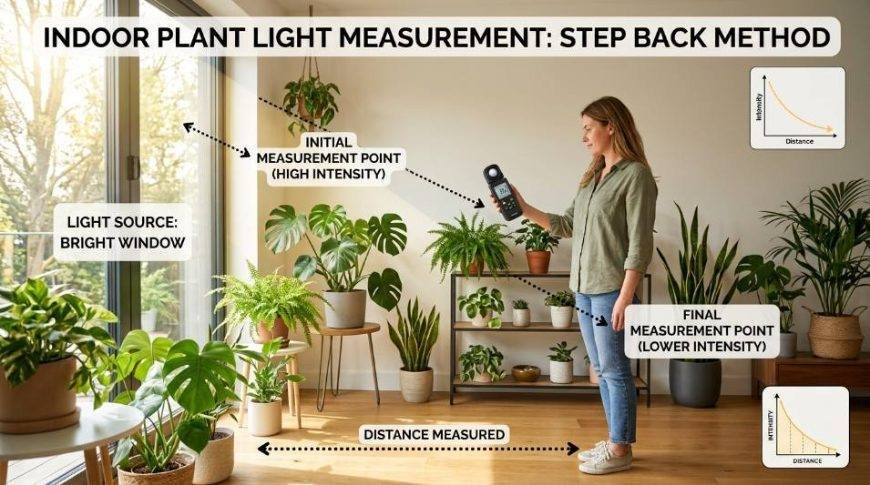
- The Step-Back Method
- Check More Than Once
- Where to Find It in Your Home
- Does Bright Indirect Light Change Throughout the Year?
- Common Mistakes People Make With “Bright Indirect Light”
- A Quick Story Worth Sharing
- Signs Your Plant Is Getting the Wrong Type of Light
- Frequently Asked Questions
- Final Thoughts
Bright indirect light means bright, filtered light with no direct sun on leaves. Learn what it means, how to test for it, and where to find it at home.
A Simple Comparison
Picture standing a few feet inside an open doorway on a sunny afternoon.
- It’s bright out there. You can see clearly, and the space around you feels lit up.
- But the sun isn’t beating directly on your face, because you’re standing just off to the side of where the beam actually falls.
That’s bright indirect light. Plenty of brightness, but no direct hit.

Bright Indirect Light vs. Every Other Light Type
Most articles explain one light type at a time. That makes it hard to tell them apart, since the descriptions all start to blur together. Here they are side by side.
| Light Type | Where You’ll Find It | What It Feels Like | Example Plants That Want It |
| Direct light | Placed right next to an uncurtained, south- or west-facing window. | Warm on your skin, sharp shadows on the floor | Succulents, cacti, most herbs |
| Bright indirect light | Walk back out of the patch of sunlight while staying in the surrounding bright light. | Bright and open, but no warmth on your skin from the sun | Pothos, Monstera, Peace Lily, Chinese Money Plant |
| Medium indirect light | Moving farther away from the window, or sitting near an east-facing window later in the day. | Comfortably lit, soft shadows | Philodendron, ZZ Plant |
| Low light | A room with small windows or windows facing north | Usable without a lamp, but clearly dim compared to a sunny room | Snake Plant, Cast Iron Plant, Pothos (tolerates it) |
Two things worth noticing here:
- Bright indirect and medium indirect often get lumped together, but the brightness level really does matter — a plant that wants bright indirect light will grow slowly and look pale if it’s stuck in a medium-light spot for months.
- Low light and indirect light are two completely different things. All bright indirect light is technically “indirect,” but not all indirect light is bright enough to count.
How to Test If a Spot Has Bright Indirect Light
Guessing rarely works here. A quick physical test settles it in under a minute.
The Hand-Shadow Test
- Hold your hand about a foot above where the plant would sit.
- Do this during the brightest part of the day, ideally mid-morning or early afternoon.
- Look at the shadow your hand casts.
Here’s how to read it:
- A sharp, clearly defined shadow — this spot is getting direct sun. Too intense for most bright-indirect-loving plants.
- A soft shadow with visible edges, but a bit blurry — this is the sweet spot. This is bright indirect light.
- Barely any shadow at all, or none — this is low light.
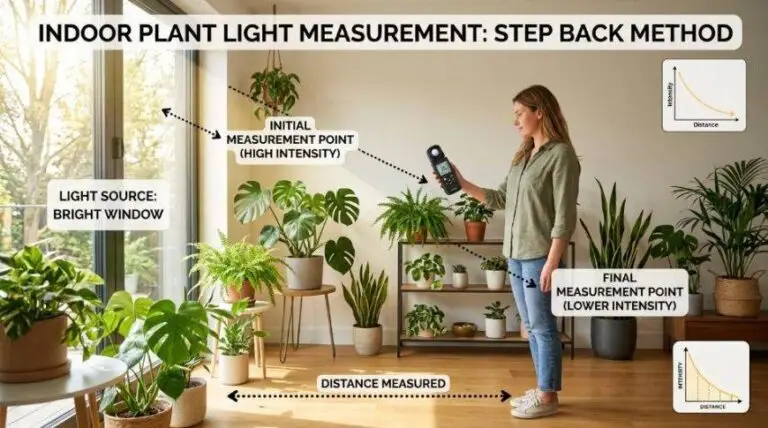
The Step-Back Method
This one comes straight from how professional growers judge a room, and it’s simpler than it sounds.
- Stand at the window during a sunny stretch of the day.
- Pay attention to where the direct sunlight hits the floor—you’ll notice a sharp, bright patch of light.
- Step back so you’re just outside that patch of direct sunlight, but remain in the well-lit area.
That spot, roughly, is where bright indirect light begins.
Check More Than Once
The lighting in a single spot can change significantly depending on the time of day.
- A window might get a hot direct beam at 8 am.
- The same window can settle into gentle indirect light by 2 pm.
- Test the same spot in the morning and again in the afternoon before deciding where to put a plant.
One check isn’t always enough to trust.
Where to Find Bright Indirect Light in Your Home
Window direction plays a bigger role in this than most people expect, and it depends on which hemisphere you’re in. The guidance below assumes a home in the Northern Hemisphere, which covers most readers searching this topic.
- East-facing windows — These usually offer some of the most reliable bright indirect light in a home. Morning sunlight is milder than the afternoon sun; by midday, the direct rays shift away from the window, leaving soft, bright light for the rest of the day.
- South-facing windows — These bring in the strongest light of any direction. Right against the glass, it’s direct sun. A few feet back, or behind a sheer curtain, it settles into bright indirect light. This is often the easiest direction to work with, since there’s usually plenty of light to spare even after stepping back.
- West-facing windows — Afternoon sun through a west window runs hot and intense. It usually needs more distance from the glass than a south window does, or a slightly heavier sheer curtain, before it counts as truly indirect.
- North-facing windows — These rarely produce bright indirect light at all. Most north-facing rooms fall into medium or low light instead. This is a distinction a lot of plant care advice glosses over, and it trips people up — a north window feels bright to the eye, but it’s usually not bright enough for plants that specifically want bright indirect conditions.
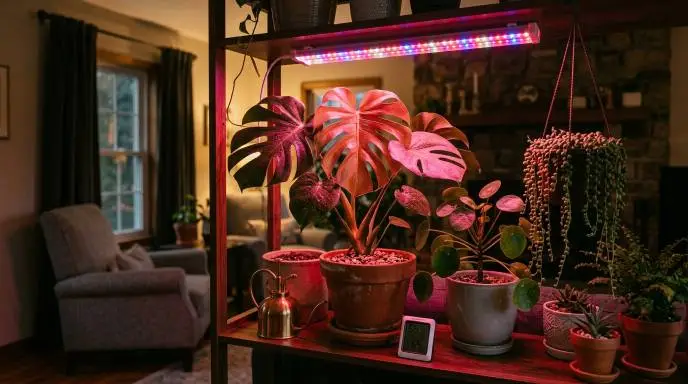
- No good window available? A grow light positioned a foot or two above the plant can replicate bright indirect conditions reasonably well. It’s not necessary for most homes, but it’s worth knowing the option exists for a windowless room or office.
Does Bright Indirect Light Change Throughout the Year?
Yes, and this is one of the most overlooked parts of the whole topic. A spot that qualifies as bright indirect light in July can quietly drop to low light by December.
A few reasons why:
- During the winter, the sun stays lower in the sky throughout the day. The angle it enters through a window changes, which changes how far the light reaches into a room and how strong it is once it gets there.
- Days are shorter. Fewer total hours of usable daylight means less light overall, even in a spot that hasn’t physically changed.
- Trees outside the window change with the seasons. A tree that shades a window all summer can drop its leaves in fall, suddenly letting in far more light than the same spot got a few months earlier — sometimes turning a low-light corner into a bright indirect one overnight.
Because of this:
- Recheck rooms with the hand-shadow test every few months instead of assuming a spot is fixed forever.
- A plant that was thriving in June might need to move closer to the window by December just to hold steady.
- This isn’t because anything went wrong — it’s because the room itself changed around it.
Common Mistakes People Make With “Bright Indirect Light”
Mistake 1: Assuming Anything “Near a Window” Counts
Being close to a window doesn’t automatically mean indirect light. If the plant sits directly in the path of the sun for even a few hours a day, that’s still direct exposure, regardless of how close or far it is from the glass.
Mistake 2: Confusing a Blackout Curtain With a Sheer Curtain
- A thick curtain blocks light almost entirely, which turns a bright spot into a dim one.
- A sheer or thin white curtain filters the light without cutting the brightness down much at all.
These are not interchangeable, even though both technically count as “a curtain.”
Mistake 3: Treating Bright Indirect and Low Light as the Same Thing
Both avoid direct sun, which is where the confusion starts. But brightness level still matters on its own. A plant that wants bright indirect light placed in a genuinely low-light room will:
- Grow slowly
- Drop leaves
- Stretch awkwardly toward whatever light it can find
This happens even though it’s technically not getting hit by direct sun.
Mistake 4: Ignoring Reflective Surfaces
Light-colored walls, mirrors, and glossy furniture can bounce light around a room and intensify a spot beyond what it looks like at first glance. A corner that seems dim to the eye can sometimes read as brighter once tested with the hand-shadow method, simply because of what’s reflecting light into it.
“Want to measure your light more precisely? Check out our foot-candle chart for indoor plants.”
A Quick Story Worth Sharing
A friend of mine once moved her Monstera to what she was sure was the perfect spot — right against a south-facing window, full sun pouring in all afternoon. Within a couple of weeks, several leaves had crispy brown patches, almost like they’d been burned.
Her first thought was underwatering, so she started watering more. The leaves kept getting worse.
The real issue wasn’t related to water at all. That window had zero filtering:
- No curtain
- No distance from the glass
- Nothing standing between the sun and the leaves
It was direct sun the entire time, not indirect. Once she moved the plant back about three feet and hung a thin white curtain over that window, the damage stopped completely, and the new leaves that grew in afterward came in fine.
It’s a small mix-up, but a common one. A spot can look perfect for a plant and still be the wrong kind of light entirely, and the fix is often smaller than people expect — a few feet of distance, or one thin curtain, is usually all it takes.
Signs Your Plant Is Getting the Wrong Type of Light
Too much direct light:
- Scorched or bleached patches on the leaves
- Crispy brown spots with a clearly defined edge, rather than spreading evenly
Not enough light (often mistaken for bright indirect, but actually low light):
- Pale or faded-looking leaves
- Slow growth, or no new growth for a long stretch
- Stems stretching or leaning noticeably toward the nearest window
These symptoms, along with full fixes for each, are covered in more depth in the main Indoor Plant Care Guide for Beginners, including a complete troubleshooting table for other common issues like overwatering and humidity stress.
Frequently Asked Questions
What does bright indirect light mean for houseplants? It means the room gets strong natural daylight, but the sun’s rays never land straight on the plant’s leaves. The light is filtered through a curtain, bounced off a wall, or simply reaches the plant from an angle that isn’t a direct line to the sun.
Is bright indirect light the same as low light? No. Both avoid direct sun, but bright indirect light still means the room is well-lit overall. Low light means the room has very little natural light to begin with, even without any direct sun involved.
Can I put a plant right next to a window and call it indirect light? Not automatically. If the plant sits directly in the sun’s path for part of the day, that’s direct light regardless of how close it is to the glass. Position and distance from the actual sunbeam matter more than proximity to the window itself.
Does a sheer curtain really create indirect light? Yes. A thin, sheer curtain filters and scatters direct sun without cutting the overall brightness down much, which is exactly what turns direct light into bright indirect light. A thick or blackout curtain does the opposite and creates low light instead.
What’s the easiest way to test if my room has bright indirect light? Hold a hand about a foot above the spot during the brightest part of the day. A soft, blurry-edged shadow means bright indirect light. A sharp shadow means direct sun. Barely any shadow means low light.
Do all plants need bright indirect light? No. It’s the preferred condition for many popular houseplants, like Monstera and Peace Lily, but plenty of other plants — snake plants and ZZ plants, for example — tolerate or even prefer lower light levels.
Final Thoughts
Bright indirect light comes down to two separate things:
- How much light a room actually has
- Whether that light travels straight from the sun to the leaf, or gets filtered along the way
Once both of those click, the term stops being confusing.
Test any spot before trusting it. A hand shadow and thirty seconds tell you more than a guess ever will, and it’s the fastest way to know if a plant is sitting in the right kind of light, at the right distance, before problems show up on the leaves.
Now that you understand bright indirect light, you’re one step closer to mastering the basics. For everything else — watering, humidity, soil, and more — head to our Complete Beginner’s Guide to Indoor Plant Care.”