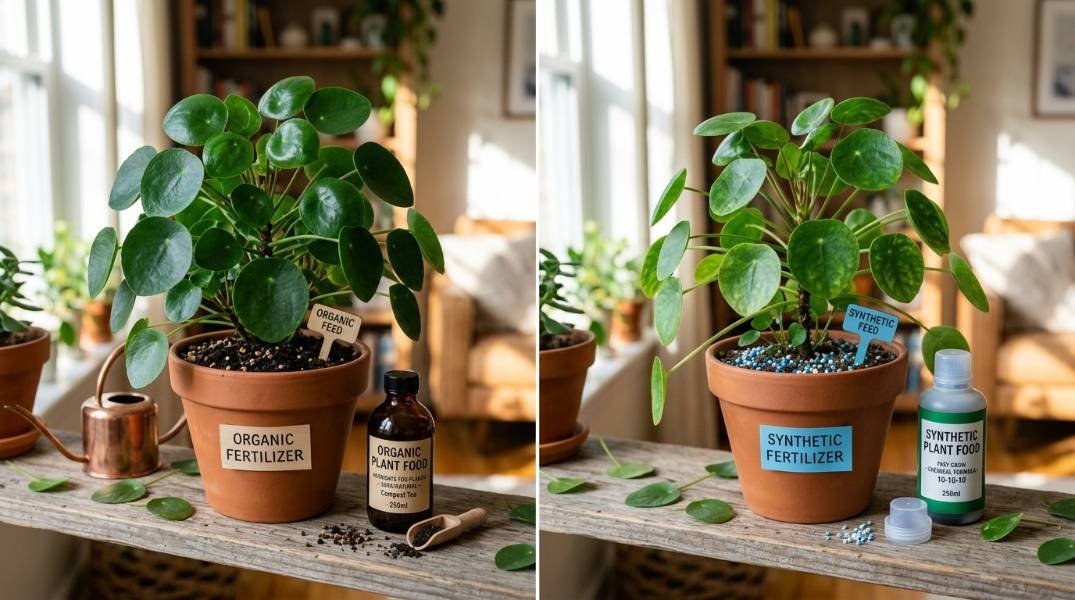
Synthetic vs organic fertilizer produces clearly different soils after 5–10 years. Continuous synthetic use often leaves soil with lower microbial activity, weaker structure, and greater reliance on external inputs. Consistent organic use builds higher organic matter, richer biology, better aggregation, and greater resilience. The divergence shows up in measurable soil tests, earthworm counts, and how the soil handles water and nutrients.
Years of watching gardens and reviewing long-term trial data confirm this pattern. One season of synthetic fertilizer can give impressive green growth. A decade of the same approach usually tells a different story about the soil itself.
I once took over a plot that had received only bagged synthetic fertilizer for nearly a decade. The soil looked fine on the surface but felt dense and lifeless under the shovel. Earthworms were scarce. After three seasons of compost, cover crops, and organic amendments, the same ground turned darker, softer, and full of life. That shift is what this article examines in detail.
If you’re brand new to plant care in general, our Complete Beginner’s Guide to Indoor Plant Care covers light, soil, and watering alongside fertilizing, so you’ve got the full picture in one place.
Quick Snapshot: Synthetic vs Organic Fertilizer After 5–10 Years
5–10 years with mostly synthetic fertilizer
- Microbial activity and diversity often decline relative to organic systems.
- Soil structure can weaken; compaction risk rises.
- Natural nutrient cycling slows, increasing dependence on added fertilizer.
- Higher potential for nutrient leaching during heavy rain.
5–10 years with consistent organic fertilizer and organic matter
- Microbial biomass and diversity increase.
- Stable organic matter (humus) builds.
- Aggregation improves; water infiltration and holding capacity rise.
- Lower leaching risk and greater long-term fertility buffer.
These patterns appear repeatedly in long-term field trials and soil monitoring.
How Synthetic vs Organic Fertilizer Interact with Soil
Synthetic fertilizers supply nutrients as soluble salts. Plants take them up quickly. The soil food web is largely bypassed. High salt concentrations can stress sensitive microbes, and no carbon is added to feed the biological community.
Organic fertilizers (compost, manure, bone meal, fish emulsion, and similar materials) contain nutrients bound in organic forms. Soil microbes must break them down before plants can use them. In the process, the microbes multiply, produce sticky substances that bind soil particles, and leave behind stable organic matter.
This single difference in delivery method drives most of the long-term outcomes. Synthetic fertilizer feeds the plant directly. Organic fertilizer feeds the soil that then feeds the plant.
Synthetic vs Organic Fertilizer Soil Health: Side-by-Side Summary
| Factor | Synthetic Fertilizer (5–10 yrs) | Organic Fertilizer (5–10 yrs) |
|---|---|---|
| Microbial activity | Declines significantly | Increases steadily |
| Soil structure | Compaction, hardpan | Improved porosity |
| Water retention | Decreases | Increases |
| Nutrient cycling | Dependent on inputs | Self-sustaining |
| Long-term cost | Rising input needs | Decreasing input needs |
| Runoff/leaching risk | Higher | Lower |
The Decade Timeline: What Changes Year by Year
Years 1–3
Synthetic programs usually deliver the fastest visible growth and highest early yields. Organic programs look slower because nutrients release gradually. Early microbial stress can begin under high rates of soluble fertilizer. Organic matter begins to accumulate with organic inputs.
Years 4–7
Differences become clearer. Synthetic-treated soil often shows slower gains (or losses) in organic matter, early signs of reduced aggregation, and a need for higher or more frequent applications to maintain the same growth. Organic-treated soil darkens, earthworm numbers rise, and water infiltration improves.
Years 8–10
The gap widens. Synthetic-heavy soil frequently shows lower biological activity indicators, greater risk of compaction, and clearer chemical dependency. Organic soil typically has higher organic matter content, stronger structure, and a more self-sustaining nutrient cycle.
Long-term trials such as the DOK experiment in Switzerland (running since 1978) show that systems receiving regular organic amendments maintain or increase soil organic carbon and biological quality, while pure mineral systems can lose carbon or show lower biological indicators over decades.
Microbial Life: The Hidden Difference
Meta-analyses comparing organic and conventional systems find that organic management commonly supports 32–84% higher microbial biomass carbon, higher microbial biomass nitrogen, and greater enzyme activity.
Organic amendments increase diversity and favor groups that break down complex organic materials. Continuous high rates of synthetic fertilizer can shift community composition, reduce certain beneficial groups, and in some cases lower overall biological activity relative to organic systems. Salt effects and the absence of carbon inputs contribute to these changes.

Earthworm populations also respond strongly. Multiple long-term comparisons show higher numbers and biomass under organic or manure-based systems than under pure synthetic fertilizer regimes.
Healthy microbial and earthworm communities improve nutrient cycling, disease suppression, and soil structure. Their decline under some synthetic-only programs is one of the clearest long-term differences.
Soil Structure, Humus, and Water Behavior
Organic matter is the foundation of good structure. As microbes process organic inputs, they produce glues that bind mineral particles into stable aggregates. These aggregates create pores for air and water movement.
After years of organic inputs, soil typically shows:
- Higher porosity.
- Better infiltration.
- Greater water-holding capacity.
- Reduced surface crusting and erosion risk.
Under long-term synthetic-only management with limited organic returns, organic matter can stagnate or decline in some systems. Aggregates weaken, compaction risk rises, and both drought and heavy-rain performance suffer.
Simple field checks reveal the difference: a shovel slides more easily into organic-amended soil, water soaks in faster, and the soil smells earthy rather than dusty or sour.
Nutrient Cycling and Chemical Dependency
In a biologically active soil, microbes continually mineralize nutrients from organic matter and make them available to plants. This natural cycle reduces the need for external inputs over time.
When synthetic fertilizer supplies most of the nutrients and little organic matter is returned, the microbial engine slows. Natural mineralization declines. Gardeners and farmers often find they need higher rates or more frequent applications to achieve the same results—a form of dependency.
Organic systems reverse this pattern. Higher microbial activity and rising organic matter create a larger nutrient reservoir that releases slowly. Many growers report being able to reduce external inputs after five or more years of consistent organic management while maintaining or improving plant performance.
Environmental Effects Over a Decade
Soluble synthetic nutrients are more mobile. During heavy rain or over-irrigation, they can move below the root zone or into surface water. Repeated seasons compound the losses.
Organic nutrients release more slowly, and the improved soil structure holds water and nutrients better. Leaching and runoff risks are generally lower.
Soil carbon trends also differ. While synthetic nitrogen can support higher plant biomass (and therefore residue returns) in some systems, organic amendments consistently add carbon directly and support the biological processes that stabilize it. Long-term organic or mixed systems frequently show higher soil organic carbon than pure mineral systems.
What Long-Term Soil Tests and Field Trials Show
University and research-station trials lasting decades provide the clearest evidence. The Swiss DOK trial after 42 years found higher soil organic carbon and stronger biological quality indicators under organic and biodynamic systems that received regular manure or compost compared with pure mineral fertilization.
Meta-analyses of microbial properties across many sites confirm higher microbial biomass and activity under organic or combined organic-mineral regimes than under mineral-only fertilizer.
Home gardeners see the same patterns on a smaller scale: darker color, more earthworms, better tilth, and more resilient plants after years of organic matter addition.
Can You Reverse Synthetic-Heavy Soil? A Practical Transition Plan
Damage is rarely permanent. Soil biology responds when conditions improve.
- Reduce synthetic rates gradually rather than stopping cold turkey.
- Add compost or well-rotted manure every season (1–2 inches worked into the topsoil or used as mulch).
- Grow cover crops or green manures whenever the ground is bare.
- Minimize tillage once organic matter starts rising.
- Consider microbial inoculants or compost tea as a short-term boost while the native community recovers.
- Test soil every 2–3 years for organic matter percentage and basic fertility.
Visible improvement often appears within one to three seasons. Stronger recovery typically takes five years or more of consistent organic inputs.
A Practical Hybrid Approach
Many successful growers use both. They maintain a strong organic-matter foundation (compost, cover crops, mulches) and apply targeted synthetic fertilizer only when a specific nutrient deficiency appears or when rapid early growth is needed in cold soil.
The key is keeping the biological and carbon base intact so the soil never becomes fully dependent on the bag.
How to Check the Difference in Your Own Garden
- Dig a hole and look at structure, color, and earthworm numbers.
- Time how long water takes to infiltrate.
- Send a sample for organic matter percentage and, if available, microbial biomass or respiration tests.
- Track the same measurements year after year.
These simple observations reveal more than any product label.
Frequently Asked Questions
Does synthetic fertilizer permanently damage soil?
Not permanently – but the damage compounds the longer it’s used. Microbial life and soil structure decline steadily over 5-10 years, though the process can be reversed with consistent organic input over several seasons.
How long does it take organic fertilizer to improve soil?
Visible improvements in structure and water retention often start within 1-2 years, but the full self-sustaining benefit typically builds over 3-5 years of consistent use.
Can you mix synthetic and organic fertilizer without long-term harm?
Yes, many growers use a hybrid approach – synthetic for quick nutrient boosts, organic for long-term soil building. The key is not relying on synthetic fertilizer exclusively, since that’s what drives microbial decline.
Is soil damage from synthetic fertilizer reversible?
In most cases, yes. With consistent compost application, reduced tilling, and cover cropping, soil biology can recover meaningfully within 2-4 years.
Key Takeaways
After 5–10 years, the choice between synthetic vs organic fertilizer shows up clearly in the soil itself. Synthetic programs can deliver fast results and high yields but often leave soil biologically quieter, structurally weaker, and more input-dependent. Organic programs build organic matter, microbial life, structure, and resilience.
The strongest long-term results come from prioritizing organic matter and soil biology while using soluble nutrients sparingly and strategically when needed. Soil that is alive and well-structured needs less help from the bag and performs better under stress.
Start with compost or cover crops this season. The difference compounds every year.
If you want to learn about indoor plant fertilization, see the guideline: How to Fertilize Indoor Plants the Right Way: The Foolproof Method That Prevents Root Burn