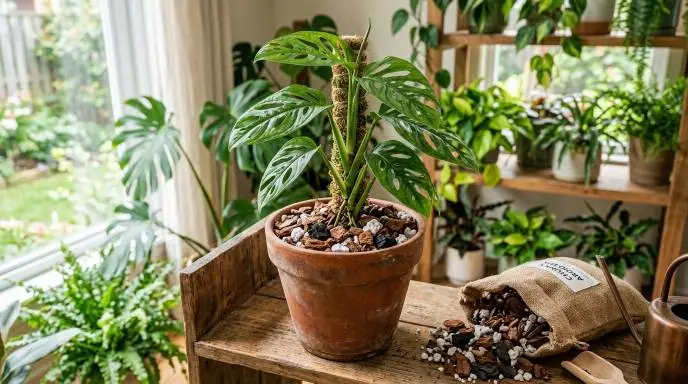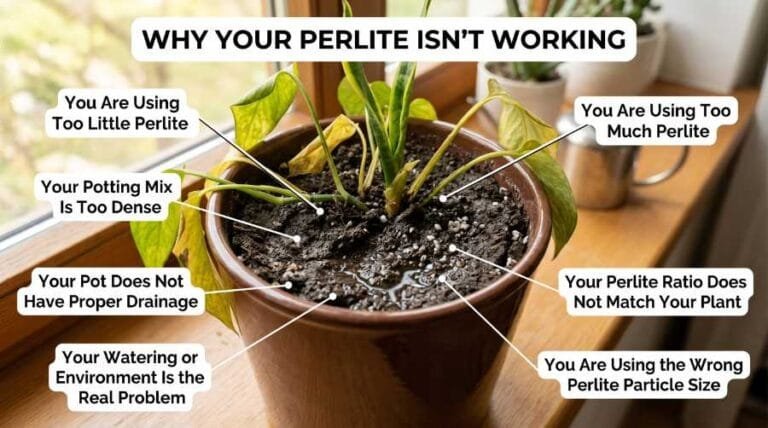
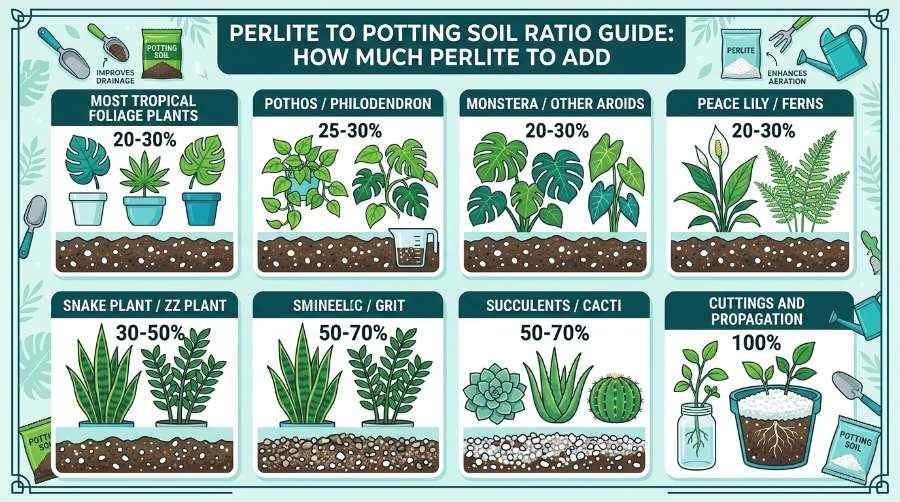
Most indoor plants do well with 20% to 30% perlite mixed into potting soil by volume. Succulents and cacti need more, usually 50% to 60%, since water needs to move through the mix fast instead of lingering around the roots. Aroids like Monstera, Pothos, and Philodendron generally fall between 20% and 35%, enough to open up air pockets without drying out too quickly. Moisture-loving plants like peace lilies and ferns need the least, closer to 15% to 25%. None of these numbers are fixed rules. The right amount depends on your plant’s moisture needs, what’s already in your base mix, your pot, and how often you water, which is why the sections below walk through how to adjust from here.
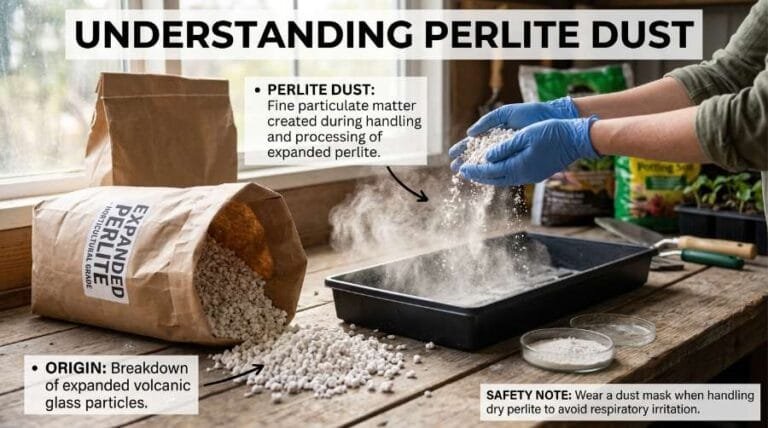
That’s really the point of this guide. Instead of memorizing one ratio, you’ll learn how to figure out the right one for your own plant, your own mix, and your own conditions. What is perlite dust? Want to know the basics? Follow this guideline: an explanation of perlite dust.
Perlite Ratio by Plant Type
Use this table to get a starting point, then adjust based on the sections below.
These are starting ranges, not fixed rules. Different plant care sources land on different numbers for the same plant, and that’s expected. What matters more than the exact percentage is understanding why a plant needs more or less air space, which the rest of this article walks through.
Why Perlite Changes a Potting Mix
Perlite is a lightweight, porous volcanic rock that’s been heated until it puffs up, similar to popcorn. Once mixed into soil, it does a few specific jobs:
- Increases air space: The small, irregular particles create gaps throughout the mix. Roots need oxygen just as much as they need water, and those gaps are where that oxygen reaches the root zone.
- Improves drainage: Coarse perlite creates channels that let excess water move down and out through the drainage hole faster, instead of pooling on a dense mix.
- Still holds some water: This surprises a lot of people. Perlite isn’t a material that repels water completely. Its porous surface and internal structure hold a thin layer of moisture, and how much depends on particle size. Finer perlite holds more water relative to its volume than coarse perlite does.
- Reduces compaction: Potting soil settles and packs down over time, especially with repeated watering. Perlite particles keep the mix from collapsing in on itself as tightly, which matters more in containers than in open garden soil.
- Doesn’t do everything: Perlite is one ingredient, not a complete fix. It won’t add nutrients, and it won’t fix a pot without drainage holes. Piling more perlite into a mix isn’t a substitute for the right base ingredients or a pot that actually drains.
Want to buy perlite potting mixes? Here are the 6 best potting mixes.
What This Looks Like in the Pot
Here’s a simple cross-section of what a well-balanced mix looks like versus a dense one, based on how the two types of mix actually behave when you water them.
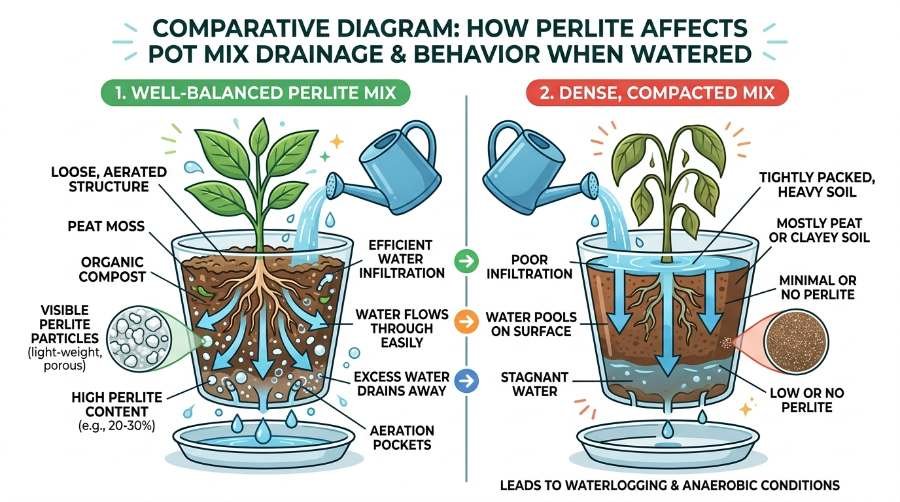
The dense mix on the left isn’t necessarily bad soil, it’s just missing the gaps that let air and excess water move through. That’s the entire job perlite is doing on the right.
The Most Important Rule: Check the Base Mix First
This is where most perlite advice goes wrong. A lot of guides hand out a fixed ratio like “add 25% perlite” without asking what you’re adding it to. Read this guide to know how to add perlite to potting soil.
Here’s why that matters:
- 30% perlite mixed into a dense, peat-heavy mix behaves very differently than 30% perlite mixed into a chunky mix that already has bark and coir in it
- The first mix might still hold too much water
- The second might end up draining almost too fast
Think of it as an equation:
Starting mix + perlite = final root-zone structure
Before deciding on a ratio, take a look at what’s already in your bag of potting soil or your current mix:
- How much organic matter is in it (peat, coco coir, compost)
- Whether it already contains bark or pumice
- Whether it already contains perlite
- Whether it has sand in it
- How the mix feels and drains right now
- The general particle size of the ingredients
A mix that’s already airy and chunky needs less added perlite than one that’s dense and fine-textured.
How to Choose the Right Perlite Ratio for Your Plant
Instead of picking a number and hoping, work through these five steps.
Step 1: Identify how your plant likes moisture. Broadly, plants fall into three groups: moisture-loving (peace lilies, ferns), moderate (most pothos and philodendrons), and drying-prone or drought-adapted (succulents, cacti, snake plants).
Step 2: Look at your current mix. Does it stay wet for many days after watering? Does water sit on the surface instead of soaking in? Does it dry out within a day or two? Does it already contain bark or perlite?
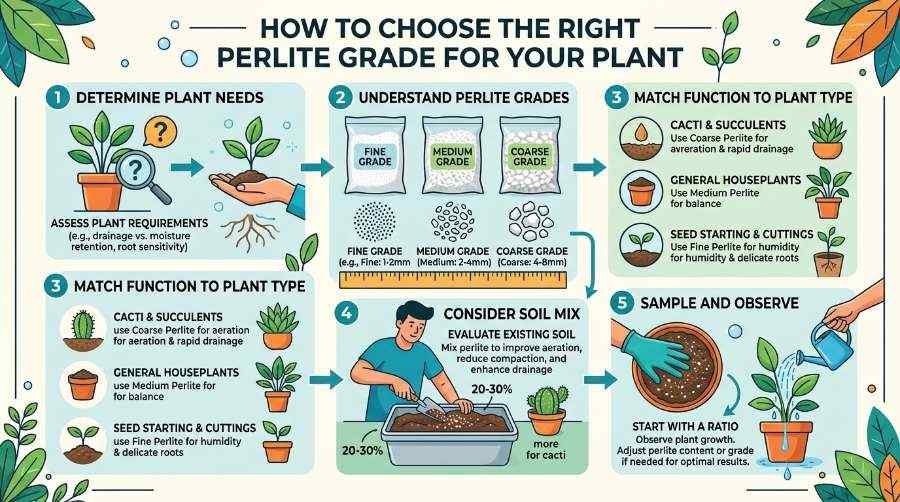
Step 3: Factor in your indoor environment. A humid bathroom, a dry heated apartment in winter, a bright south-facing window, and a dim corner all change how fast a mix dries, regardless of what’s in the pot.
Step 4: Consider the pot itself. Terracotta wicks moisture out through its walls and dries faster than plastic. Larger pots hold more moisture relative to root mass than small ones. A pot without drainage holes changes everything, no matter how much perlite you add.
Step 5: Adjust instead of following a fixed recipe. If your first mix stays soggy, add more perlite next time you repot. If it dries too fast, cut back. Treat the ratio as a starting point you refine, not a rule you follow exactly.
Perlite Ratio for Common Indoor Plants
Pothos and Philodendron
- Ratio: 25-30% perlite
- Why: These plants tolerate a range of conditions, but consistently soggy soil is one of the more common causes of root problems in both
- Adjust: if your mix stays wet more than a week after watering, lean toward the higher end of that range
Monstera
- Ratio: 20-30% perlite, often combined with orchid bark for extra chunkiness
- Why: overall root-zone structure matters more than one ingredient hitting a specific number
- Avoid: treating “50% perlite” as a fixed rule for this plant, it isn’t one
Anthurium
- Ratio: similar to Monstera, but weighted more toward bark than perlite alone
- Why: its epiphytic roots (roots adapted to growing on other plants rather than in dense soil) want plenty of air movement
- Adjust: a chunky structure using bark and perlite together outperforms perlite by itself
Peace Lily
- Ratio: 20-30% perlite
- Why: peace lilies prefer more consistent moisture than most aroids
- Avoid: too much drainage, which works against a plant that’s naturally tolerant of moist soil and less tolerant of drying out between waterings
Snake Plant and ZZ Plant
- Ratio: 30-50% perlite
- Why: both store water in their leaves and rhizomes, so preventing prolonged wetness matters more than holding moisture
Succulents
- Ratio: 50-70% perlite
- Why: indoor conditions make prolonged wetness a bigger risk than outdoors, since airflow and evaporation are usually lower inside a home
The Right Perlite Ratio for Succulents
Succulents get their own section because the search for this exact question is common, and the stakes are high. Overwatering, made worse by a mix that holds too much moisture, is one of the most frequent ways indoor succulents die.
A simple starting mix:
- Roughly equal parts potting mix and perlite, or about 50% soil to 50% perlite for extra-fast drainage
- Not the only workable formula. Some recommendations lean closer to two-thirds mineral material (perlite, pumice, coarse sand) and one-third organic potting mix, landing in a similar place
When to increase the mineral share:
- You live somewhere humid
- Your base mix is on the heavier or denser side
- The mix isn’t drying out within several days
- You water more often than the plant needs
- You’re using a large pot relative to the plant
When too much perlite backfires:
- In a very small pot
- In a low-humidity room
- With plants that still want some moisture retention (not all succulents are equally drought-tolerant)
- If you’re watering every day or two just to keep a succulent from wilting, the mix is likely too fast-draining for your conditions
The Right Perlite Ratio for Aroids
“Aroid mix” gets used loosely online, often as shorthand for “lots of perlite.” That’s not quite right.
- Perlite is a smaller, porous mineral particle that adds fine air pockets and a bit of water retention
- Bark is a larger, more structural particle that creates bigger air gaps and breaks down slowly over time
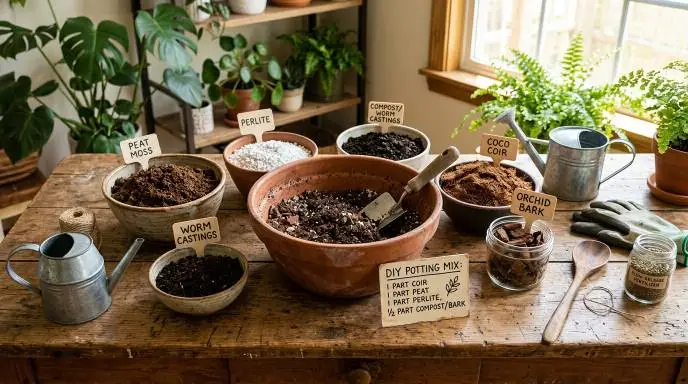
- A well-built aroid mix usually uses both, since they do different physical jobs
A starting formula:
- Base potting mix, roughly half
- Perlite, roughly a quarter
- Orchid bark, roughly a quarter
Adjust based on the plant:
- Monstera generally tolerates a chunkier, airier mix well
- Alocasia often prefers something slightly more moisture-retentive, since it’s more sensitive to drying out completely between waterings
- Anthurium leans toward bark-heavy structure over perlite alone
- If your base mix already contains a good amount of bark or pumice, you likely need less added perlite than a mix that’s just potting soil and coir
Perlite vs. Pumice: Which Should You Use?
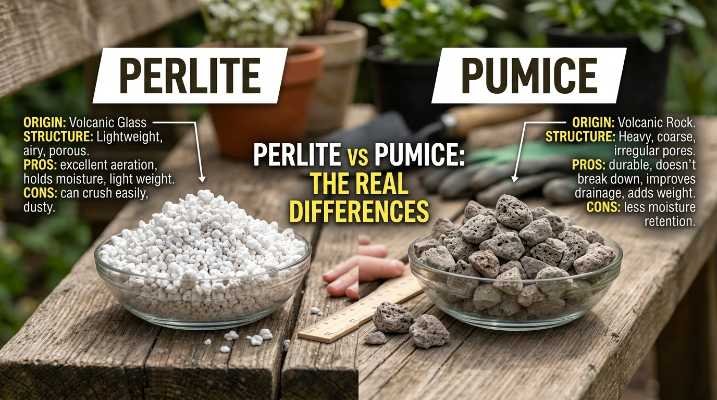
| Feature | Perlite | Pumice |
|---|---|---|
| Weight | Very light | Heavier |
| Aeration | High | High |
| Water behavior | Holds some moisture | Holds some moisture |
| Stability in the pot | Can float or migrate to the surface over time | More stable, stays put |
| Good for top-heavy plants | Less useful | Often better |
| Cost and availability | Usually easy to find | Depends on your region |
Neither one is automatically the better choice:
- Perlite is cheaper and more widely available in most places, which is why it shows up in more recipes
- Pumice tends to stay where you put it instead of working its way to the surface
- Pumice matters more for larger, top-heavy plants or long-term mixes you don’t want to keep refreshing
Perlite vs. Vermiculite
These two get confused often, but they do different things. Perlite’s main role in a potting mix is aeration and drainage. Vermiculite, by contrast, holds significantly more water and releases it more slowly, so it’s used more for moisture retention than air space.
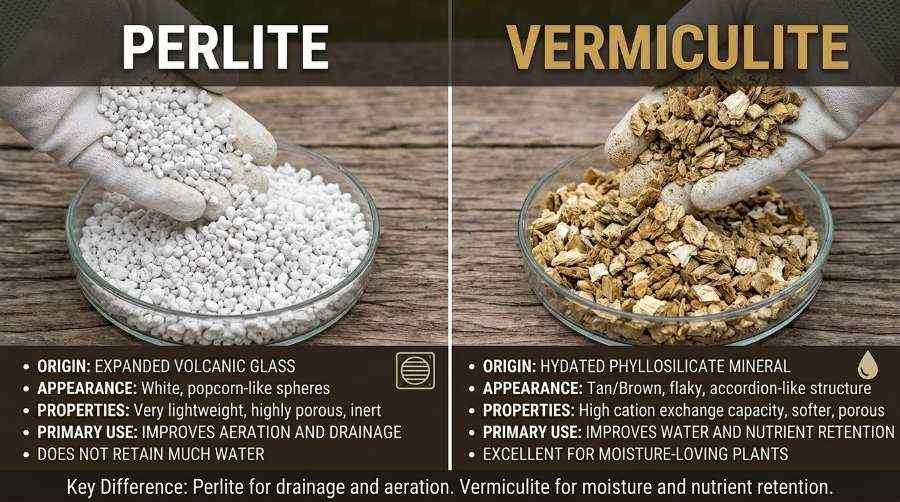
- Choose perlite when your plant needs faster drainage and more air around the roots, which covers most succulents, snake plants, and many aroids
- Vermiculite might make more sense when you’re growing something that wants consistent moisture, like certain ferns or seedlings that shouldn’t dry out
- Using both is common in seed-starting mixes, where growers want some water retention alongside some aeration
- For most established houseplants, one or the other tends to be enough, chosen based on whether the plant’s bigger risk is drying out or staying too wet
What Perlite Grade Should You Use?
Perlite comes in different particle sizes, and this changes how it behaves more than people expect:
- Fine perlite has smaller particles and holds relatively more water for its volume. It’s more common in seed-starting mixes.
- Medium perlite is the most commonly sold grade for general potting mixes, offering a middle ground between drainage and moisture retention.
- Coarse perlite has larger particles, drains faster, and holds less water. It’s a better fit for succulents, cacti, and aroids that want fast-draining, chunky conditions.
Here’s the part that trips people up: 30% coarse perlite and 30% fine perlite are not the same mix. The coarse version will drain and dry out noticeably faster. If a recipe you’ve seen online isn’t behaving the way you expected, checking the grade of perlite you used is a good place to start.
How to Calculate Perlite Ratio by Volume
Measure by volume, not weight, so the ratio stays consistent no matter what you’re mixing.
For a 1-liter batch at 25% perlite:
- 750 mL base mix
- 250 mL perlite
For a 2-liter batch at 25% perlite:
- 1.5 L base mix
- 0.5 L perlite
For a 5-liter batch at 25% perlite:
- 3.75 L base mix
- 1.25 L perlite
Quick Perlite Ratio Calculator
| Desired ratio | Base mix | Perlite |
|---|---|---|
| 20% | 800 mL | 200 mL |
| 25% | 750 mL | 250 mL |
| 30% | 700 mL | 300 mL |
| 40% | 600 mL | 400 mL |
| 50% | 500 mL | 500 mL |
Scale these numbers up or down for whatever container size you’re mixing in. A standard measuring cup or a reused yogurt container works fine as a scoop, as long as you use the same one for both ingredients.
How to Mix Perlite Into Potting Soil Correctly
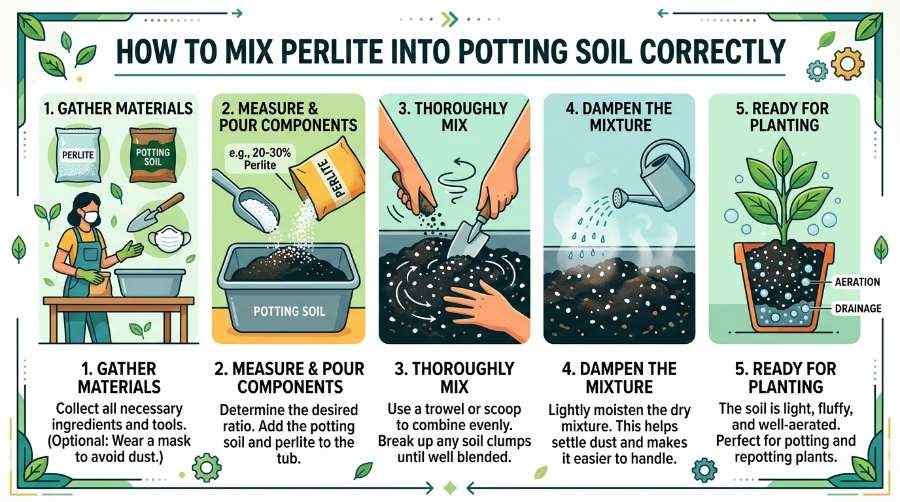
I learned the hard way that dry perlite dust is not something you want to breathe in. The first time I mixed a batch indoors without wetting it first, I ended up coughing in a cloud of fine dust for a good five minutes. Now I always mist it first.
- Lightly moisten the perlite before mixing, either with a spray bottle or by dampening it in a bag. This cuts down on airborne dust significantly.
- Measure your base mix into a container or onto a tarp.
- Measure the perlite separately using the same scoop or cup. Know details about how much perlite to add potting soil in this guide.
- Combine thoroughly, working the perlite through the base mix rather than just dumping it on top.
- Break apart any compacted clumps in the base mix as you go, since perlite mixed unevenly into clumped soil won’t do its job.
- Check the distribution by grabbing a handful from a few different spots. It should look and feel roughly consistent throughout.
- Pot your plant into the finished mix.
- Water thoroughly and watch how it drains the first time, since this tells you a lot about whether the ratio is working.
The Drainage Test After Mixing
Don’t stop at “water came out the bottom, so it’s fine.” A more useful test looks at four things:
- Water entry: does water soak into the surface within a few seconds, or does it sit and pool before slowly sinking in?
- Drainage: does excess water actually exit through the drainage hole within a reasonable time, or does it take a long while?
- Moisture persistence: stick a finger an inch or two down a day or two after watering. Is it still soggy, just damp, or already dry? Learn details about how to measure soil moisture.
- Texture after drying: once the mix dries out, does it stay loose and crumbly, or does it harden and pull away from the sides of the pot?
Fast drainage alone doesn’t mean the mix is right. The real goal is a balance between air, water, and support for the roots, which is why persistence and texture matter as much as speed.
How to Know You Used Too Much Perlite
Watch for these signs:
- The mix dries out within a day or two, even in a decent-sized pot
- The plant wilts often between waterings
- Water runs straight through without the mix seeming to absorb much
- Roots don’t stay consistently moist even right after watering
- You find yourself watering far more often than that plant should need
If this happens, the fix at the next repotting is to reduce the perlite percentage and lean more toward the base mix, or add in something with more moisture retention.
How to Know You Used Too Little Perlite
Watch for the opposite signs:
- The mix stays wet for many days after watering
- The surface stays visibly damp long after you’d expect it to dry
- Roots develop a sour smell, or you notice mushy, discolored roots when you check
- The mix compacts and feels dense rather than loose
- The plant shows recurring problems tied to overwatering, even when you’re not overwatering on purpose
Don’t just sprinkle more perlite on top of the existing soil. Perlite mixed only into the top inch doesn’t reach the root zone where it’s needed. The more reliable fix is repotting into a properly rebalanced mix.
Too Much vs. Too Little, Side by Side
| Too much perlite | Too little perlite | |
|---|---|---|
| Drying speed | Dries out in a day or two | Stays wet for many days |
| Watering feel | Water runs straight through | Water sits or pools on top |
| Root signs | Roots stay dry between waterings | Roots may smell sour or turn mushy |
| Texture when dry | Loose, crumbly, sometimes dusty | Hardens, pulls from the pot sides |
| Plant behavior | Frequent wilting, constant thirst | Slow growth, yellowing lower leaves |
| The fix | Reduce perlite, add moisture-retentive material | Repot into a rebalanced mix, don’t just top-dress |
Does More Perlite Always Mean Better Drainage?
No, and this is one of the more common misunderstandings about perlite. Drainage in a container depends on several things working together, not perlite percentage alone.
- The pot needs an actual drainage hole. No ratio of perlite fixes a pot without one.
- The base mix matters. Perlite added to a mix full of fine, compacted particles still has to work through that structure.
- Particle-size distribution matters, as covered above.
- Watering habits matter. Frequent shallow watering behaves differently than a deep soak every week or two.
- Environmental conditions, like humidity and airflow, affect how fast any mix dries regardless of what’s in it.
Loading a pot with 60% perlite doesn’t guarantee good drainage if the pot itself has no way for water to leave.
A Mix That Kept Failing Until I Actually Diagnosed It
My snake plant kept rotting at the base, so I blamed overwatering and reduced watering to once a month. But it didn’t help. When I finally took the plant out of its pot, I found that the bottom two inches of soil were still damp after three weeks and had become hard and compacted like clay. There was barely any perlite in the mix. I remixed the soil with about 40% coarse perlite and repotted the plant. After that, water drained through the mix within seconds.
Common Perlite Mistakes
| Mistake | Why it happens | How to fix it |
|---|---|---|
| Using one ratio for every plant | Recipes online get copied without adjusting for the specific plant | Match the ratio to the plant’s actual moisture needs, not a generic number |
| Adding perlite without checking the base mix | It’s easy to assume all bagged soil is the same density | Squeeze a handful first. If it’s already loose and chunky, you likely need less added perlite |
| Using fine perlite for plants that need fast drainage | Fine grade is often what’s cheapest or easiest to find locally | Look for medium or coarse grade for succulents and aroids specifically |
| Assuming perlite replaces drainage holes | Perlite genuinely does help drainage, so it’s easy to over-credit it | Check the pot itself. No ratio fixes a pot that can’t let water out |
| Using garden soil as the base | Garden soil is free and already on hand for a lot of people | Use a bagged potting mix as the base. Garden soil compacts in containers in a way that perlite alone can’t offset |
| Over-amending an already chunky mix | Adding “extra” perlite feels like it can’t hurt | Feel the current mix first. Piling more onto a mix that already drains fast can push it too far |
| Ignoring the pot and the room | Ratios get treated as universal instead of situational | Adjust for terracotta versus plastic, and for a dry apartment versus a humid bathroom |
| Assuming fast drainage always means healthy roots | Fast-draining feels like the “safe” choice after hearing about overwatering | Match drying speed to the plant. Some plants genuinely want more consistent moisture |
| Handling dry perlite carelessly | The dust isn’t obvious until you’re already breathing it | Mist it lightly before mixing, or work in a ventilated space |
Is Perlite Safe for All Indoor Plants?
Most houseplants tolerate horticultural perlite without any issue. It’s a widely used, inert mineral material, and the vast majority of common houseplants show no negative reaction to it.
There’s one nuance worth knowing:
- Some plants are more sensitive to fluoride, and perlite can occasionally carry trace amounts depending on the source
- Spider plants and dracaenas are two of the more commonly cited examples of plants that can show leaf-tip browning from fluoride sensitivity
- This is a minor consideration rather than a reason to avoid perlite altogether
- If you grow either of these and notice unexplained tip burn, it’s worth looking into as one possible factor among several (tap water fluoride and salt buildup are more commonly cited causes)
Want to know whether perlite dust is safe or unsafe? Follow this guide to learn the truth. Also learn about safe perlite handling practices in this article.
Perlite and Pot Choice: Why the Same Mix Can Behave Differently
The same potting mix dries out at different rates depending on the container:
- Terracotta is porous and lets moisture evaporate through the walls, so mixes dry faster than they would in a non-porous pot
- Plastic doesn’t let moisture escape through the sides, so the same mix stays wetter for longer
- Ceramic depends on whether it’s glazed or unglazed. Glazed ceramic behaves more like plastic. Unglazed behaves more like terracotta.
- Pot size changes things too. A large pot holds more soil volume relative to a small plant’s root system, so it tends to stay wet longer than a pot that’s properly sized. This is one of the more overlooked factors when a mix “isn’t working,” when the real issue is the plant being in too large a pot for how much water it can actually use.
Perlite Ratio Decision Tree
If you’d rather work through this as a quick path instead of reading every section, follow the diagram below from top to bottom.
                          START HERE
                             │
              How does your soil behave after watering?
                             │
        ┌────────────────────┴────────────────────┐
        │                                          │
   STAYS WET FOR                              DRIES OUT IN
   MANY DAYS                                  A DAY OR TWO
        │                                          │
        ▼                                          ▼
  Is the mix also                          Reduce perlite,
  compact or dense?                        or blend in more
        │                                  moisture-retentive
   ┌────┴────┐                             material
   │         │                                   │
  YES        NO                                  ▼
   │         │                          Recheck after the
   ▼         ▼                          next watering cycle
Increase   Check your
aeration,  watering habits,
switch to  pot type, and
chunkier   room humidity
mix        before adding
           more perlite
                             │
              What kind of plant is it?
                             │
        ┌────────────────────┼────────────────────┐
        │                    │                     │
   SUCCULENT/           AROID (Monstera,       MOISTURE-LOVING
   CACTUS               Pothos, etc.)          (peace lily, fern)
        │                    │                     │
        ▼                    ▼                     ▼
  50-60% perlite,      20-35% perlite,        15-25% perlite,
  mineral-heavy mix    combined with bark     stay on the
                        for air space          lower end
Frequently Asked Questions
What is the best perlite ratio for indoor plants?
For most tropical houseplants, 20% to 30% perlite by volume is a reasonable starting point, adjusted based on your base mix and conditions.
How much perlite should I add to potting soil?
Start with about a quarter of the total volume for average houseplants, then adjust up or down based on how the mix drains and dries after your first few waterings.
Is 50% perlite too much?
Not for succulents, cacti, or plants that need fast drainage. For a moisture-loving plant like a peace lily or fern, 50% would likely dry out too quickly.
What is the best perlite ratio for succulents?
Roughly 50% to 60% perlite, or an equal mix of potting soil and perlite, works well for most indoor succulents.
How much perlite should I use for Monstera?
Around 20% to 35%, often combined with orchid bark for a chunkier structure.
Is perlite good for aroids?
Yes, when combined with bark rather than used on its own. Perlite alone provides fine air pockets, while bark adds the larger structural gaps aroids benefit from.
Can I use perlite instead of pumice?
Generally yes, though pumice tends to stay in place better over time, while perlite can gradually float toward the surface.
Does perlite improve drainage?
Yes, by creating air channels in the mix, though drainage also depends on the pot having a drainage hole and the base mix not being overly dense.
Can too much perlite hurt plants?
Yes. A mix that’s too fast-draining can dry out before the roots absorb enough water, leading to more frequent wilting.
Should I mix perlite with cactus soil?
Many bagged cactus soils already contain some perlite or pumice, but adding a bit more is common if the bag still feels dense.
Should perlite be wet before mixing?
Lightly moistening it first significantly reduces airborne dust, which is worth doing for your own comfort while mixing.
Does perlite break down over time?
It breaks down very slowly compared to organic materials like bark or peat, which is part of why it stays effective in a mix for a long time.
The Bottom Line
There isn’t one correct perlite ratio that applies to every plant in every home. The goal is to add enough perlite to create the air space and drying behavior your plant actually needs, without adding so much that the mix dries out faster than the plant can use the water it gets.
As a general starting point:
- Moisture-loving plants: lower percentage, around 10-20%
- Average tropical houseplants: moderate percentage, around 20-30%
- Aroids: moderate perlite paired with bark for structure
- Succulents and cacti: higher mineral content, often 50% or more
- Already-chunky mixes: less added perlite than a dense, fine-textured mix
Use the cheat sheet as your starting point, then let the drainage test and your plant’s response guide any adjustments from there. I hope you now understand the key details about perlite. Getting the soil mix right prevents many problems. If your plant still shows signs of distress, How to Diagnose Indoor Plant Problems walks you through identifying the real cause. Know about root rot prevention with proper aeration in this guide. If you want to learn more about complete indoor plant care, read this guide.