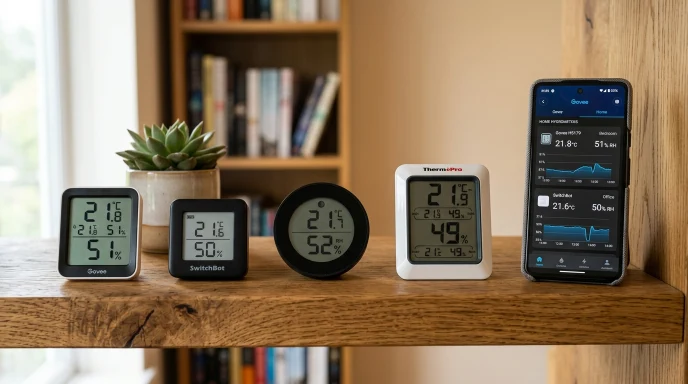
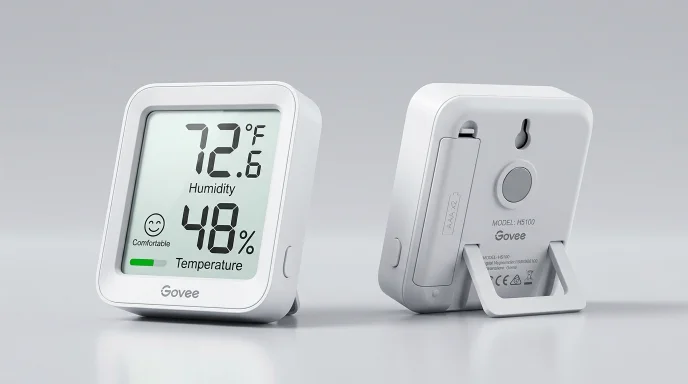
The Govee H5100 is a strong pick for most people in 2026. Its manufacturer specs list ±2% RH accuracy, a 2-second refresh rate, and Bluetooth app connectivity for under $16. For budget buyers, the ThermoPro TP50 has a long track record of reliability at under $14. For higher precision, the SensorPush HT.w offers mesh networking and ±1.5% RH accuracy on its spec sheet.
Our Top Pick: The Govee H5100 is a strong all-around choice for most people in 2026. Its listed specs promise ±2% RH accuracy, a fast 2-second refresh rate, and smart app connectivity at a price point that makes it accessible for every room in your home.
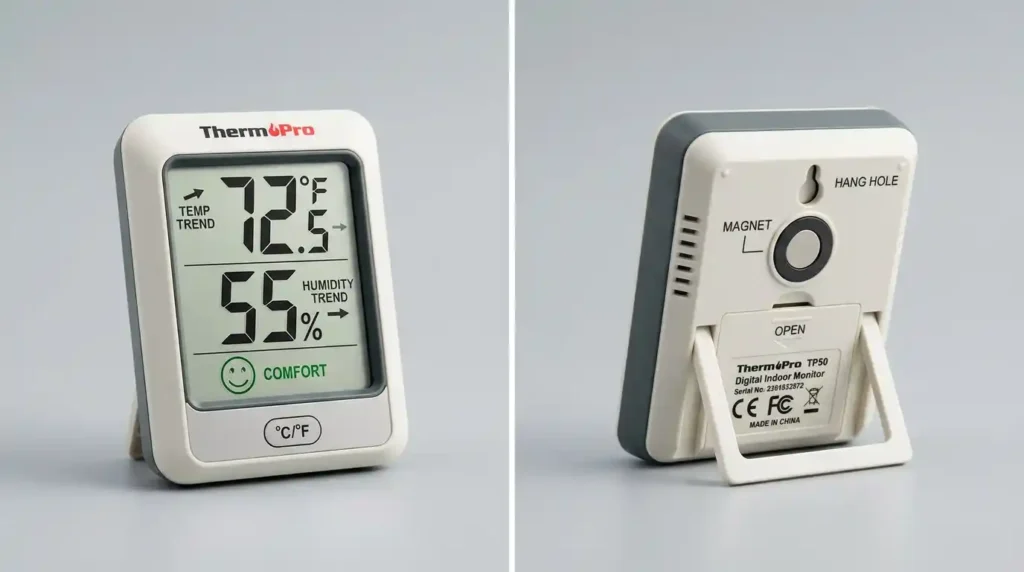
Budget Pick: The ThermoPro TP50 has held a spot in the under-$15 category for years, with a large, established user base and consistently high aggregate ratings.
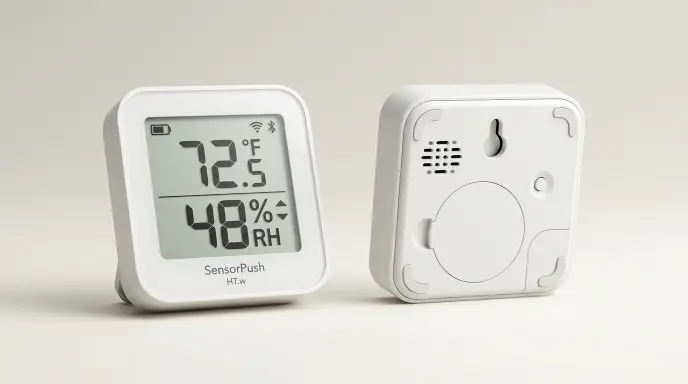
Premium Pick: The SensorPush HT.w is aimed at the high-end market, with mesh network capability and a reputation among reviewers for strong long-term drift resistance. Increase humidity for indoor plants.
Monitoring indoor humidity is not just about comfort; it is a defense mechanism. Humidity and pot choice work together. Low humidity can cause issues like spider mites and crispy leaves. How to Diagnose Indoor Plant Problems helps you identify whether humidity, pests, disease, or care mistakes are affecting your plant. Glazed ceramic pots hold moisture longer, which matters more in dry rooms. Our Guide to ceramic pots for different humidity conditions explains which pots work best in different humidity levels. For plant parents, proper humidity monitoring is essential for tropical species like Monstera and Calathea. If humidity drifts above 60%, you invite mold spores and dust mites to breed. If it drops below 30%, wood floors shrink, paint cracks, and static electricity builds. If you discover your home is too dry, there are simple ways to increase humidity for indoor plants.
Comparison Table: Top 7 Digital Hygrometers of 2026
| Rank | Model | Accuracy (mfr. spec) | Refresh Rate | Smart Features | Battery Life | Price Range |
|---|---|---|---|---|---|---|
| 1 | Govee H5100 | ±2% RH | 2 seconds | Bluetooth, App | 12 months | $13-$16 |
| 2 | ThermoPro TP50 | ±2-3% RH | 10 seconds | None | 18 months | $10-$14 |
| 3 | SensorPush HT.w | ±1.5% RH | 1 second | Wi-Fi, Mesh | 24 months | $60-$70 |
| 4 | SwitchBot Plus | ±3% RH | 4 seconds | Wi-Fi Hub, Alexa | 12 months | $15-$20 |
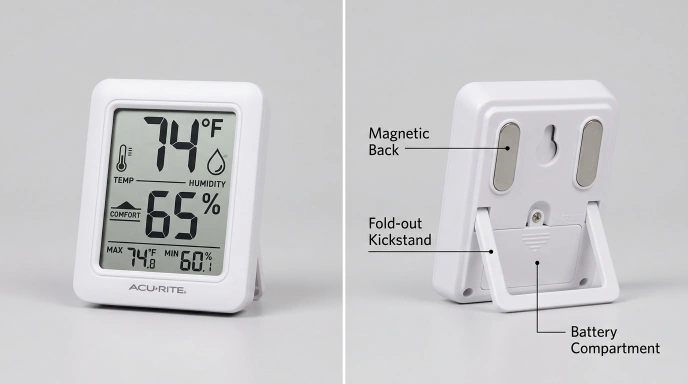
| 5 | AcuRite 01083 Pro | ±2% RH | 10 seconds | None | 24 months | $25-$30 |
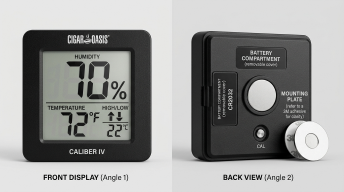
| 6 | Cigar Oasis Caliber IV | ±1% RH | 10 seconds | None | 36 months | $25-$35 |
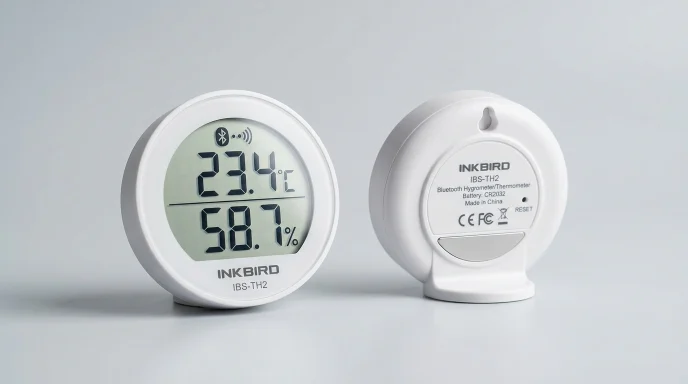
| 7 | Inkbird IBS-TH2 | ±2% RH | 2 seconds | Bluetooth, App | 12 months | $15-$18 |
How We Chose These Picks
This guide is built from manufacturer specification sheets, aggregated owner ratings across major retailers, and published accuracy standards for consumer humidity sensors — not from an in-house lab test. We haven’t personally run each of these units through a controlled calibration trial, so treat the accuracy figures below as the manufacturers’ stated specs rather than independently verified results. Where models have a large volume of consistent owner feedback (thousands of ratings clustering in the same range), we note that as a signal of real-world reliability.
If precise, laboratory-verified accuracy matters for your use case (say, cigar storage or a wine cellar), the most reliable way to confirm any unit’s real-world accuracy is to run your own salt calibration test after purchase: seal the hygrometer in an airtight bag with a saturated potassium chloride slurry, which stabilizes at 75.3% RH at 25°C (77°F), and compare the reading after 24 hours.
What We Compared:
- Stated accuracy: the ± RH tolerance each manufacturer publishes.
- Refresh rate: how often the sensor updates its reading, per the spec sheet.
- Connectivity and smart features: Bluetooth, Wi-Fi, mesh, and app capabilities as listed by the manufacturer.
- Battery life: manufacturer-stated runtime.
- Owner feedback patterns: recurring praise or complaints across a large number of verified purchases.
Detailed Reviews: Best Digital Hygrometers of 2026
1. Govee H5100 — Best Overall
Price: $13-$16
What Owners Like:
The Govee H5100 hits the sweet spot between accuracy, features, and price. Recent firmware updates added faster Bluetooth pairing and improved data export options. The 2-second refresh rate means the display reflects humidity changes close to real-time rather than a delayed average.
The companion app has evolved significantly. It supports custom alerts for specific humidity thresholds, historical graphs, and CSV data export. The app also includes a “Mold Risk Indicator” that calculates dew point and flags conditions that favor mold growth. Owners report the 20-day data log is useful for spotting overnight temperature dips, humidity spikes after watering, and seasonal drift. Understanding Vapor Pressure Deficit (VPD) for plant growth requires proper grow room temperature control alongside humidity management.
Common Complaints:
The LCD is not backlit, making it harder to read in dark rooms. Bluetooth range is limited to roughly 30 feet without obstructions, per user reports.
Ideal For: General home monitoring, greenhouses, basements, and anyone wanting app connectivity without spending over $20.
Bottom Line: A strong accuracy-to-price ratio on paper and in owner reviews, making it a sensible default pick for most homes.
2. ThermoPro TP50 — Best Budget
Price: $10-$14
What Owners Like:
The ThermoPro TP50 has been a bestseller for nearly a decade. It’s the simplest reliable option: no app, no Bluetooth, no complications — just a large, easy-to-read display.
The 10-second refresh rate is slower than premium models but adequate for most home use. The high/low memory function shows the extremes a space experienced over the past 24 hours, useful for spotting problem areas.
Common Complaints:
No smart features, no calibration adjustment. Some owners note the plastic housing feels lightweight and could crack if dropped on a hard floor.
Ideal For: Bedrooms, living rooms, offices, and anyone who wants a no-fuss sensor.
Bottom Line: Nothing flashy, but a long sales history and consistent ratings back up its reputation for just working.
3. SensorPush HT.w — Best Premium
Price: $60-$70
What Owners Like:
The SensorPush HT.w sits at the high end of consumer humidity monitoring. Its mesh network capability means sensors placed in a basement, attic, and garage can relay data through each other to reach a Wi-Fi router.
Its listed accuracy of ±1.5% RH and 1-second refresh rate are among the strongest specs in this roundup. The app provides professional-grade graphing, unlimited data history, and integration with weather APIs to compare indoor and outdoor conditions.
Manufacturer-stated battery life is 24 months on a single CR2477 coin cell.
Common Complaints:
Price is significantly higher than competitors, and initial setup requires a smartphone and some patience.
Ideal For: Wine cellars, cigar collections, server rooms, and anyone who needs tight accuracy with remote monitoring.
Bottom Line: A premium price backed by premium specs — worth it if you’re protecting valuable items.
4. SwitchBot Plus — Best for Smart Home Automation
Price: $15-$20 (plus optional Hub at $40)
What Owners Like:
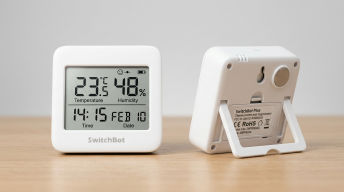
The SwitchBot Plus connects to the SwitchBot Hub, which bridges it to Wi-Fi. Once connected, owners can set up automation rules like:
- Turn on a humidifier when RH drops below 40%
- Turn on a dehumidifier when RH exceeds 60%
- Send an alert if temperature drops below freezing in the garage
It works with Alexa, Google Home, and Apple HomeKit, and IFTTT integration allows more complex automations.
Common Complaints:
The base unit lacks Wi-Fi without the Hub, adding cost if you don’t already own other SwitchBot products.
Ideal For: Smart home enthusiasts who want climate data integrated into their existing automation setup.
Bottom Line: The best choice if you want your hygrometer to actively control your environment rather than just report it.
5. AcuRite 01083 Pro — Best for Calibration
Price: $25-$30
What Owners Like:
The AcuRite Pro is one of the few units in this price range offering on-device calibration, letting you adjust the sensor’s offset if you notice drift or suspect the factory calibration was off.
Recent versions include a backlit display, a notable upgrade from earlier models. The magnetic backing and fold-out stand give multiple placement options.
Common Complaints:
No smart features, a smaller display than competitors, and a calibration process that uses small buttons some owners find finicky.
Ideal For: Wine cellars, libraries, and anyone who wants to verify and adjust their sensor’s accuracy.
Bottom Line: A solid choice for accuracy purists who want control over their sensor’s calibration.
6. Cigar Oasis Caliber IV — Best for Humidors
Price: $25-$35
What Owners Like:
The Caliber IV is a long-standing favorite among cigar enthusiasts. Its slim profile fits inside humidor lids without taking up storage space, and its listed accuracy of ±1% RH is the tightest spec in this roundup.
It offers digital calibration using the salt test method described above. The display is small but crisp, with a manufacturer-stated battery life of up to 36 months.
Common Complaints:
Too small for general room monitoring, no smart features, and the display isn’t backlit.
Ideal For: Cigar humidors, guitar cases, and small enclosed spaces where precision matters.
Bottom Line: If you store cigars, this is a category standard worth considering first.
7. Inkbird IBS-TH2 — Best for Data Logging
Price: $15-$18
What Owners Like:
The Inkbird IBS-TH2 has gained popularity among homebrewers, mushroom cultivators, and greenhouse operators. The Bluetooth app logs data continuously and can export to Excel for analysis.
Its 2-second refresh rate matches the Govee H5100 on paper. The IPX4 water resistance rating means it’s built to handle splashes and high-humidity environments.
Common Complaints:
The app interface is less polished than Govee’s, Bluetooth range is limited, and the display is small.
Ideal For: Grow tents, greenhouses, fermentation chambers, and anyone who needs to track humidity over time.
Bottom Line: A solid alternative to the Govee H5100 for specialized applications.
Buying Guide: How to Choose the Right Digital Hygrometer
Accuracy Ratings Explained
Manufacturers list accuracy as a percentage of Relative Humidity (RH). A ±3% RH means the actual humidity could be 3% higher or lower than the display reading.
Accuracy Tiers:
- ±1% RH: Laboratory-grade. Found in premium units like SensorPush and Caliber IV.
- ±2% RH: Professional-grade. Found in Govee, AcuRite, and ThermoPro.
- ±3% RH: Consumer-grade. Found in budget and generic models.
- ±5% RH: Not tight enough for any serious monitoring.
For most home use, ±2-3% RH is perfectly adequate. You don’t need laboratory precision to know if your basement is damp.
Sensor Types: Capacitive vs. Resistive
Capacitive Sensors:
- Measure changes in electrical capacitance as humidity changes
- More accurate and stable over time
- Recover quickly from condensation
- Found in all quality hygrometers
Resistive Sensors:
- Measure changes in electrical resistance
- Less accurate and prone to drift
- Can fail after exposure to high humidity
- Found in cheap units and novelty devices
Look for a unit with a capacitive sensor when possible. This information is usually listed in the specifications.
Refresh Rate: Why It Matters
The refresh rate determines how quickly the sensor samples the air and updates the display.
- 1-2 seconds: Premium performance. Captures rapid changes.
- 10 seconds: Standard performance. Adequate for most rooms.
- 60 seconds: Slow. May miss brief humidity spikes.
Fast refresh rates matter most in bathrooms, kitchens, and grow tents where humidity changes rapidly.
Calibration: Factory vs. User-Adjustable
Most budget hygrometers come factory-calibrated and cannot be adjusted. This is fine if the unit leaves the factory accurate, but sensors can drift over time.
User-adjustable calibration lets you correct the sensor using the salt test method described above. This matters most for:
- Cigar storage
- Wine cellars
- Museum-quality collections
- Laboratory use
If your hygrometer lacks calibration options and starts drifting, you’ll generally need to replace it.
Connectivity: Standalone, Bluetooth, or Wi-Fi
Standalone Units:
- No connectivity
- Simplest to use
- Cheapest option
- Best for single-room monitoring
Bluetooth Units:
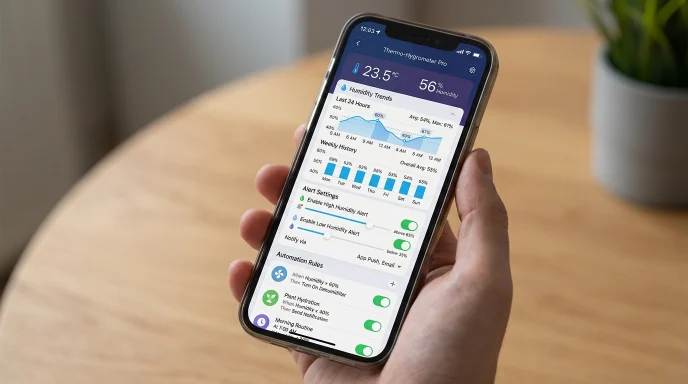
- Connect to phone within 30-100 feet
- Data logging and alerts
- Requires phone nearby
Wi-Fi Units:
- Connect to home network
- Remote monitoring from anywhere
- Automation integration
- Requires hub or built-in Wi-Fi
Choose based on how you plan to use the data. If you want to glance at a display, standalone is fine. If you want alerts and history, go smart.
Placement Guide: Where to Put Your Hygrometer
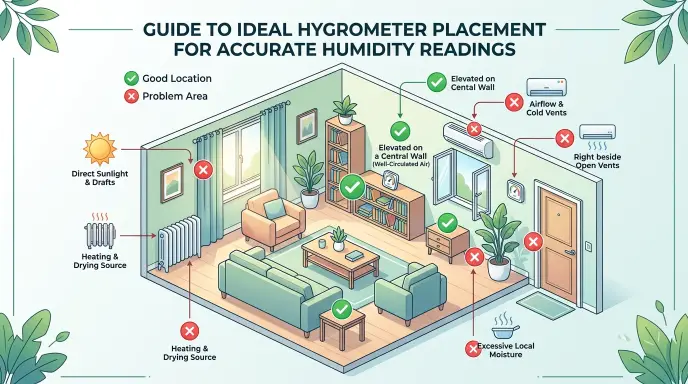
Ideal Placement by Room
| Room | Recommended Placement | Why |
|---|---|---|
| Nursery | 3-4 feet from crib, away from windows | Monitor baby’s breathing zone |
| Basement | 2-3 feet from floor, near exterior walls | Detect moisture intrusion early |
| Bathroom | Away from shower spray, near door | Track post-shower recovery |
| Kitchen | Near stove but not directly above | Monitor cooking humidity |
| Bedroom | Nightstand or dresser | Track sleeping environment |
| Grow Tent | Canopy level, away from lights | Monitor plant environment |
| Humidor | Inside lid or on shelf | Track cigar storage conditions |
Common Placement Mistakes
Placing near vents: Air from HVAC vents doesn’t represent room conditions. The sensor will show false readings as conditioned air blows directly on it.
Placing on exterior walls: Exterior walls are often colder or warmer than room air. This creates a microclimate that skews readings.
Placing in direct sunlight: Solar radiation heats the sensor, throwing off both temperature and humidity readings.
Placing near water sources: Sinks, aquariums, and plants create localized humidity that does not represent the room.
Frequently Asked Questions
What is a good indoor humidity level?
The Environmental Protection Agency (EPA) recommends keeping indoor humidity between 30% and 50%. Readings above 60% promote mold growth and dust mite proliferation. Readings below 30% cause dry skin, static electricity, and respiratory discomfort.
How accurate are cheap digital hygrometers?
Most budget hygrometers in the $10-$20 range claim accuracy of ±2-3% RH. Established, well-reviewed models like the ThermoPro TP50 and Govee H5100 have a strong track record of meeting that spec according to owner feedback and third-party comparisons. Generic no-name units from online marketplaces are more likely to fall short of their stated accuracy — running your own salt calibration test after purchase is the only way to confirm a specific unit.
Do digital hygrometers need calibration?
Factory calibration is usually accurate for the first 6-12 months. Over time, sensors can drift by 2-5%. It’s worth performing the salt test annually and either adjusting the unit (if possible) or noting the offset. For general home use, once a year is sufficient. For sensitive applications like cigar storage or wine cellars, calibrate every six months. Winter heating systems can dry out indoor air dramatically, so proper winter plant care includes monitoring humidity closely during colder months.
Can I use one hygrometer for multiple rooms?
Yes, but keep in mind that the sensor needs time to stabilize when moved. Allow 30-60 minutes for the reading to settle after relocating. For continuous monitoring, multiple inexpensive units are better than one expensive unit moved around. Different plants have different humidity requirements, so consider checking your plant watering schedule to understand individual species needs before moving sensors between rooms.
What is the difference between a hygrometer and a humidistat?
A hygrometer measures humidity and displays the reading. A humidistat controls a device (like a humidifier or dehumidifier) based on humidity readings. Some smart hygrometers can function as humidistats when paired with smart plugs or compatible appliances.
How long do digital hygrometers last?
With proper care, a quality digital hygrometer should last 5-10 years. The sensor may drift over time, but user-calibratable units can be corrected. Battery-powered units require periodic battery replacement.
Final Verdict
Based on manufacturer specs and aggregate owner feedback, here’s how we’d sort these seven picks:

Consider the Govee H5100 if:
- You want the best overall value
- You appreciate app connectivity and data logging
- You need accurate readings without spending premium prices
Consider the ThermoPro TP50 if:
- You want the simplest reliable option
- You do not need smart features
- You want to buy multiple units for different rooms
Consider the SensorPush HT.w if:
- You need the tightest accuracy spec in this roundup
- You want mesh network connectivity
- You are protecting valuable items
Consider the SwitchBot Plus if:
- You want automation integration
- You already use other SwitchBot products
- You want your hygrometer to control your environment
Consider the AcuRite 01083 Pro if:
- You want user-adjustable calibration
- You prefer a standalone unit
- You value long-term accuracy
Consider the Cigar Oasis Caliber IV if:
- You store cigars
- You need precise monitoring in a small space
- You want the tightest accuracy tolerance
Consider the Inkbird IBS-TH2 if:
- You need data logging for grow tents or fermentation
- You want Bluetooth connectivity at a budget price
- You need water resistance
Sources
This guide draws on manufacturer specification sheets, aggregated verified-purchase ratings, and general reference material on humidity sensing and indoor air quality. We did not conduct an in-house lab test of these units; where we cite an accuracy figure, it’s the manufacturer’s stated spec unless noted otherwise.
Reference Material:
- EPA Indoor Air Quality Guidelines
- Manufacturer specification sheets
- Salt test calibration protocol using potassium chloride slurry (standard method for verifying any hygrometer’s accuracy)
Disclosure:
Some links in this article may be affiliate links. We may earn a commission if you purchase through these links, at no additional cost to you. This does not influence our recommendations.