Potting soil isn’t just “dirt.” For plants grown in containers, the structure of the soil determines whether they thrive or slowly suffocate from root rot. Among the various soil amendments available, perlite and vermiculite are the two undisputed heavyweights of drainage and moisture management.
While they are both sterile, inorganic minerals with a neutral pH, they behave in opposite ways once mixed into a pot. Using the wrong one can lead to waterlogged roots, drowned seedlings, or dried-out plants.
This guide breaks down the real science, physical behaviors, and plant-specific rules of perlite and vermiculite to help you choose the perfect amendment for your indoor and outdoor garden.
| Soil Amendment | Core Material | Primary Function | Best For | Avoid For |
|---|---|---|---|---|
| Perlite | Expanded volcanic glass | Maximizes soil drainage and aeration | Succulents, cacti, orchids, aroids, hanging baskets | Moisture-loving plants, seed starting trays |
| Vermiculite | Soft, expanded clay mineral | Maximizes water and nutrient retention | Seed starting, rooting cuttings, ferns, calatheas | Desert plants, succulents, heavy long-term containers |
1. What Is Perlite? Origin and Key Characteristics
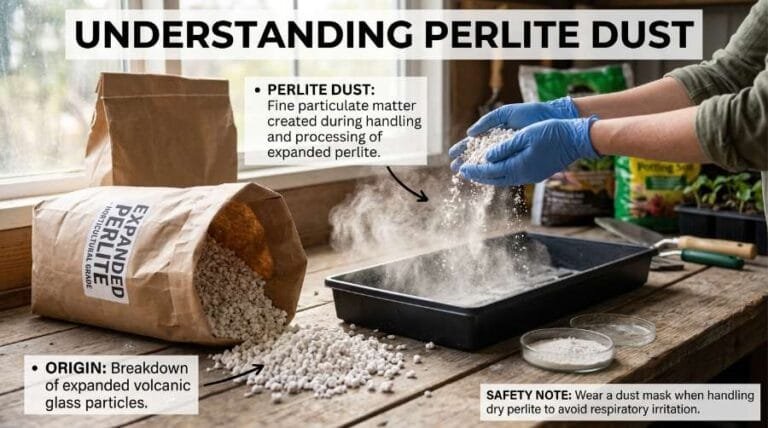
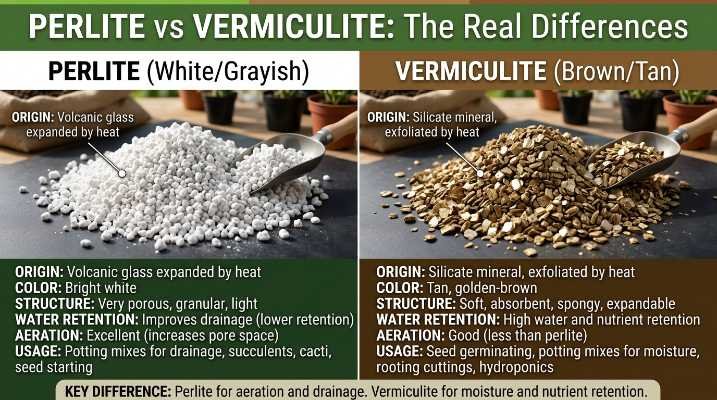
Perlite is not a synthetic material or plastic; it is a naturally occurring volcanic glass. It forms when lava cools rapidly and traps trace amounts of water (roughly 2% to 5%) inside its molecular structure.
To turn this raw ore into the white material we see in potting bags, manufacturers crush the rock and expose it to extreme temperatures around 900°C (1,650°F). This intense, rapid heating vaporizes the trapped water molecules inside the glass. The resulting steam forces the glass to expand up to 16 times its original size in a process nicknamed “volcanic popcorn.”
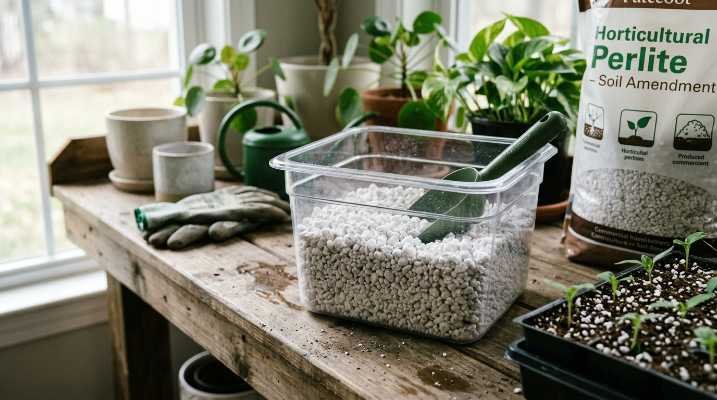
Key Characteristics of Perlite:
- Ultra-Lightweight: A liter of perlite weighs approximately 100 grams, making it exceptionally easy to handle and mix.
- Closed Internal Pockets: Because the expansion process seals its internal air pockets, perlite does not absorb water into its structure. Instead, it features a rough, micro-cracked surface that holds thin films of water on the outside.
- Brittle Structure: The expanded glass walls are very thin and fragile. Over time, physical pressure from roots, watering, and handling will crush these particles into dust.
- High Accessibility: It is incredibly cheap, widely available at every garden center, and a standard component in commercial potting soils.
2. What Is Vermiculite? Origin and Key Characteristics
Vermiculite is a group of hydrated laminar minerals (magnesium-aluminum-iron silicates) belonging to the phyllosilicate class of clay minerals. In its raw form, it resembles shiny, dark-brown mica flakes.
To prepare it for horticultural use, raw vermiculite is run through commercial furnaces at extreme temperatures between 1,150°C and 1,250°C (2,100°F to 2,280°F). This thermal treatment causes the water trapped between the mineral layers to vaporize instantly. The mineral exfoliates, expanding into lightweight, three-dimensional, golden-brown granules with a distinct accordion-like shape.
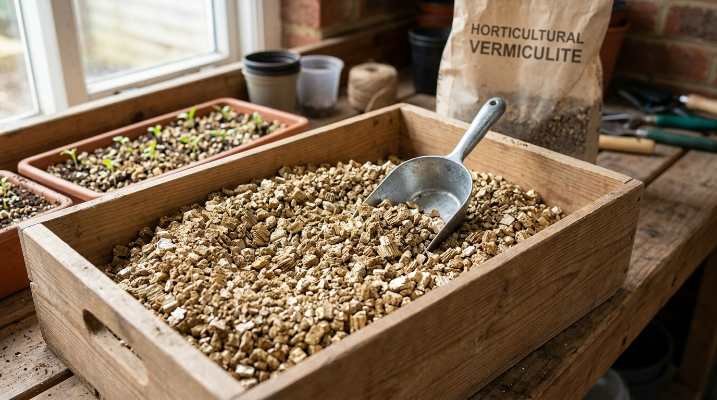
Key Characteristics of Vermiculite:
- Lightweight but Soft: A liter of exfoliated vermiculite weighs between 64 and 160 grams, depending on the particle size. It is extremely soft and sponge-like to the touch.
- Open Laminated Channels: The accordion-shaped granules contain thousands of open, interconnected layers that draw water directly into the mineral’s body, absorbing up to three to four times its own weight in liquid.
- High Nutrient Buffer (CEC): Because of its clay mineral origin, vermiculite has a very high Cation Exchange Capacity (CEC). It chemically binds and retains essential positively charged nutrients (like potassium, calcium, magnesium, and ammonium nitrogen), releasing them slowly to the plant roots.
- Golden-Brown Color: Unlike perlite’s stark white appearance, vermiculite’s natural golden-brown color blends seamlessly into dark potting soil.
3. Head-to-Head Comparison: Physical Properties
To understand how these amendments affect your potting soil, look at their technical specifications side-by-side:
| Physical Property | Horticultural Perlite | Horticultural Vermiculite |
|---|---|---|
| Material Class | Expanded Volcanic Glass | Expanded Silicate Clay Mineral (Phyllosilicate) |
| Bulk Density | ~100 grams per liter (Ultra-lightweight) | ~64 to 160 grams per liter (Lightweight) |
| Physical Appearance | Stark white, spherical, porous “popcorn” | Golden-brown, shiny, accordion-like pellets |
| Water Retention | Surface-level film only; sheds excess water | Heavy absorption; holds 3x to 4x its weight in water |
| Aeration Capacity | Extremely high; creates large oxygen macro-pores | Moderate; reduces open air space as it expands with water |
| Cation Exchange Capacity (CEC) | Near zero (no nutrient retention) | High (50 to 100 meq/100g); holds onto fertilizers |
| Durability | Brittle; degrades into fine dust in 18–24 months | Very soft; easily compresses under physical compaction |
| Average pH | Neutral (7.0 to 7.5) | Neutral to slightly alkaline (7.0 to 8.0) |
| Fluoride Risk | Can accumulate fluoride, posing tip-burn risks | Completely fluoride-free |
| Relative Cost | Inexpensive and universally available | Moderately priced; highly accessible |
See the differences between perlite and pumice in this guide
4. Why the Real Differences Matter in a Pot
While both materials lighten potting soil, their physical and chemical differences alter the root environment in opposite ways.
Cation Exchange Capacity (Nutrient Storage)
Fertilizing your plants is useless if the nutrients wash straight out of the drainage holes. Vermiculite possesses a high Cation Exchange Capacity (CEC) of 50 to 100 meq/100g. Its negative chemical charge attracts and holds positively charged plant nutrients—specifically potassium, calcium, magnesium, and ammonium.
Perlite has zero chemical charge and cannot hold nutrients. When you water, fertilizers slide off perlite’s glass surface. If you use a soilless potting mix made primarily of peat and perlite, nutrients leach rapidly. Adding vermiculite introduces a chemical buffer that stores fertilizer and feeds your plant roots over a longer period.
Water Retention: Drainage Channels vs. Water Sponge
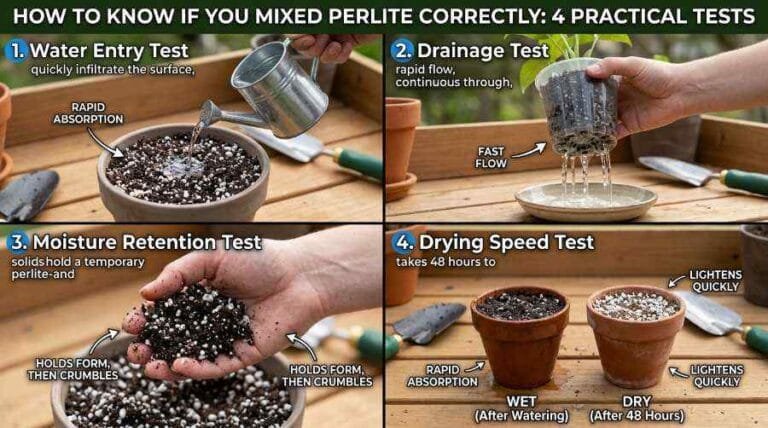
Perlite is physically hydrophobic on the inside; water only clings to its rough outer surface. It is designed to create wide, open air pockets in the soil, allowing gravity to pull excess water straight through the pot. This makes perlite the ultimate tool for preventing waterlogging and anaerobic root zones.
Vermiculite is highly hydrophilic. Its open accordion plates act like a series of capillaries, pulling water deep into the core of the particle. Instead of encouraging rapid drainage, vermiculite keeps the soil consistently damp. If added to a potting mix in high concentrations, it can hold onto water too long, suffocating the roots of plants that require dry cycles.
Soil Structure and Compaction Risks
Perlite particles are rigid. Even though they are brittle, they maintain their rough shape and keep the soil loose until they are physically crushed over two years.
Vermiculite is extremely soft and compressible. When saturated with water, vermiculite behaves like a delicate wet sponge. If you grow plants in large containers, the physical weight of the soil can squash vermiculite particles flat. Once compressed, vermiculite loses its aeration capacity entirely, creating a dense, soggy layer that invites root rot.
5. Which Amendment Is Best for Your Specific Plants?
Matching the amendment to your plant’s natural habitat is critical to preventing botanical stress.
Seed Starting and Propagation: Use Vermiculite
Germinating seeds require constant, uniform moisture to crack open and grow. Perlite dries out too quickly for shallow seed trays. Mixing vermiculite at 50% volume with peat moss or coco coir keeps the seed bed perfectly damp without requiring multiple watering cycles a day. Furthermore, vermiculite’s soft texture allows tender young roots to navigate the medium without damage.
Succulents, Cacti, and Bonsai: Use Perlite
Desert plants are highly susceptible to root rot if their growing medium remains damp. These plants need a dry-down period between waterings. Use perlite mixed at 30% to 50% volume to maximize drainage. Because vermiculite holds water like a sponge, it should never be added to succulent, cacti, or bonsai potting mixes.
Moisture-Loving Houseplants (Ferns, Calatheas, Begonias): Use Vermiculite
Ferns, peace lilies, calatheas, and begonias thrive in soil that remains evenly moist, resembling a damp forest floor. Mixing 10% to 20% vermiculite into their potting soil prevents the mix from drying out completely between waterings, protecting these sensitive plants from leaf-scorch and wilt.
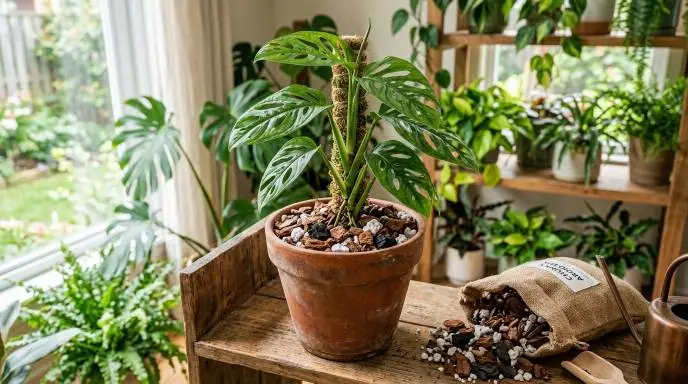
Climbing Aroids (Monsteras, Philodendrons): Use Perlite
Climbing tropical plants have thick aerial roots that require massive amounts of oxygen in the root zone. They need coarse, chunky mixes with large air spaces. Coarse perlite creates these macro-pores perfectly, whereas vermiculite is too dense and holds too much water around thick aroid roots.
Hanging Baskets and Outdoor Planters: Use a Hybrid Blend
Outdoor containers are exposed to direct sunlight and wind, causing them to dry out within hours during summer. Mixing both perlite and vermiculite into your outdoor pots provides the ideal balance: perlite keeps the hanging baskets light and airy, while vermiculite acts as an irrigation buffer, reducing the frequency of watering.
6. How to Substitute and Mix Perlite and Vermiculite
Can You Substitute One for the Other?
No, they are not direct substitutes. Because they have opposite effects on water retention, swapping them 1-for-1 can damage your plants:
- If you swap vermiculite in place of perlite in a cactus mix, the soil will remain waterlogged, inevitably rotting the roots.
- If you swap perlite in place of vermiculite in a seed-starting tray, the seeds will dry out and fail to germinate unless watered constantly.
The Hybrid Approach: The Perfect Potting Mix Recipe
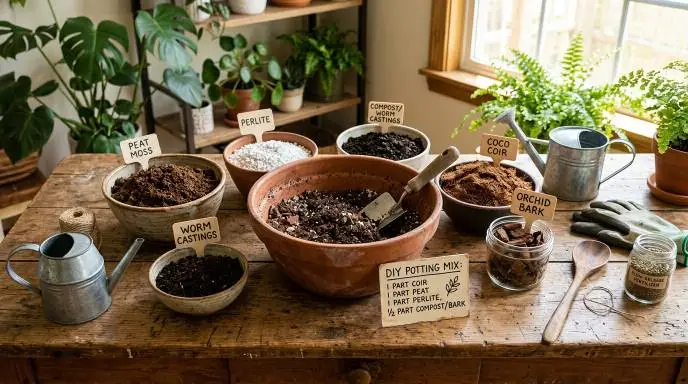
You do not have to choose just one. Combining perlite’s aeration with vermiculite’s nutrient-holding capacity produces a growing medium that offers the best of both worlds.
A Balanced, All-Purpose Container Soil Recipe:
- 60% Base potting substrate (peat moss or coco coir)
- 20% Coarse horticultural perlite (for drainage and aeration)
- 10% Medium horticultural vermiculite (for nutrient and moisture retention)
- 10% Quality compost or worm castings (for organic nutrition)
Read this perlite safety guide to handle perlite safely.
7. Myths vs. Realities: The Asbestos Controversy
The Myth: Vermiculite Is Dangerous to Use Because of Asbestos
The Reality: Historically, there was a real risk, but modern horticultural vermiculite is perfectly safe. From 1919 to 1990, the Libby Mine in Montana produced over 70% of the world’s vermiculite. Unfortunately, that mine contained a natural deposit of tremolite asbestos, which contaminated the vermiculite. That mine was shut down in 1990. \n\nToday, vermiculite is sourced from mines across South Africa, China, Brazil, and the southern United States under strict testing protocols. Modern horticultural vermiculite is certified asbestos-free and entirely non-toxic.
8. Safety and Handling Rules
Both dry minerals release fine dust particles that can irritate your respiratory system during mixing.
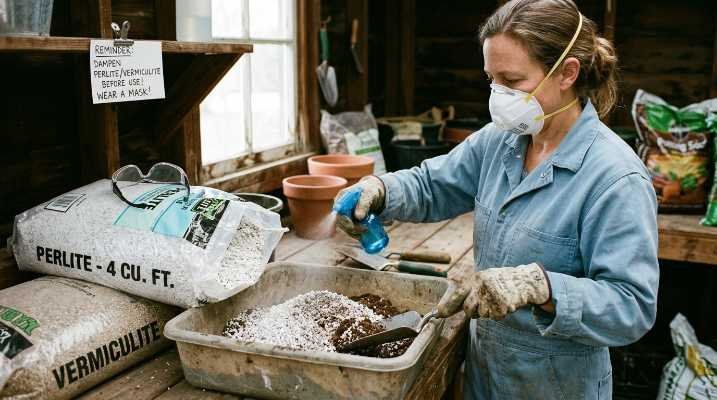
Dust Mitigation Steps:
- Dampen Before Use: Never scoop dry perlite or vermiculite from the bag. Open the bag, pour in one to two cups of clean water, and gently shake it to moisten the contents. Wet minerals produce zero airborne dust, making them perfectly safe to handle indoors.
- Wear a Mask: If mixing large volumes of dry material outdoors, always wear a simple dust mask to protect your lungs from physical irritation.
I learned this the hard way when I rooted pothos cuttings in straight perlite because that was all I had. Half of the cuttings dried out between mistings, and the roots grew slowly. The next time, I used more vermiculite. The mix stayed damp all day, and every cutting rooted without drying out.
9. Frequently Asked Questions
Does perlite cause leaf burn in houseplants?
Yes, but indirectly. Perlite can accumulate fluoride from municipal tap water and fertilizers over time. Sensitive indoor plants—like Spider Plants, Dracaenas, and Lilies—can absorb this accumulated fluoride, leading to brown, crispy leaf tips. Vermiculite does not accumulate fluoride in the same manner and is safer for fluoride-sensitive foliage.
Can I reuse vermiculite?
Unlike pumice, vermiculite is soft and degrades easily under physical handling. If you wash and scrub old soil to reclaim vermiculite, it will likely crumble. It is best to discard old vermiculite into your outdoor compost pile or garden beds rather than trying to reuse it in pots.
Why does my perlite float to the top of the pot?
Perlite is lighter than water, with a density of ~100g/L. Every time you top-water your plants, the perlite separates from the soil particles and floats to the surface. Vermiculite, while light, absorbs water into its core, keeping its wet density closer to the surrounding soil and preventing it from migrating upward.
The Verdict: Which One Should You Buy?
Buy Perlite If:
- You are potting succulents, cacti, bromeliads, or orchids.
- Your primary goal is to improve soil drainage and stop waterlogging.
- You are trying to lighten the physical weight of heavy hanging pots.
- You want a cheap, standard amendment to loosen heavy, compacted clay soils.
Buy Vermiculite If:
- You are starting seeds, rooting cuttings, or growing mushrooms.
- You want to increase water retention for moisture-loving ferns or begonias.
- You are growing leafy vegetables or outdoor container plants that dry out too quickly.
- You want to maximize your soil’s capacity to store and release fertilizers.
Choosing the right soil amendment is important, but plant problems can also come from pests, diseases, or care mistakes. How to Diagnose Indoor Plant Problems helps you figure out what’s really going on.