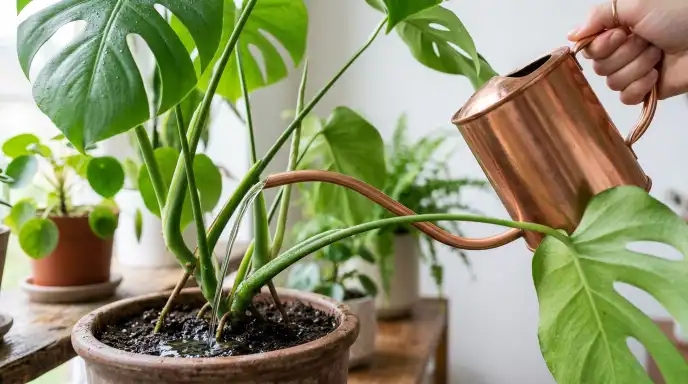
Stop guessing when to water your houseplants. Use a moisture meter instead.
Overwatering is the number one killer of houseplants, responsible for more plant deaths than pests, disease, or insufficient light combined. Read our full guide on overwatering vs. underwatering. A moisture meter helps with watering, but it won’t tell you if your plant has pests or disease. How to Diagnose Indoor Plant Problems covers the full diagnostic process. Yet most of us continue to water on a schedule rather than on demand, guessing whether the soil beneath the surface is bone dry or still soaking wet. You can water with confidence instead of anxiety. If you prefer a hands-off approach, check out self-watering pots.
A soil moisture meter removes that guesswork. This simple tool tells you, in seconds, whether the root zone is dry, moist, or wet. A moisture meter is an essential part of any indoor gardening tool kit.
This guide evaluates the best moisture meters for 2026, explains the difference between analog and digital meters, and shows you exactly what to look for before you buy.
Why You Need a Moisture Meter for Indoor Plants
Indoor plant soil rarely dries evenly. The top layer may feel dry to the touch while the root ball underneath remains soaking wet. Your finger can only reach an inch or two into the soil, but the bottom half of a large pot might still be saturated. A moisture meter tells you when to water, but the pot itself affects how often you need to check. Ceramic pots with different glazes dry out at different rates. Our Guide to ceramic pots and how they affect soil moisture readings explains which pots work best with moisture meters.
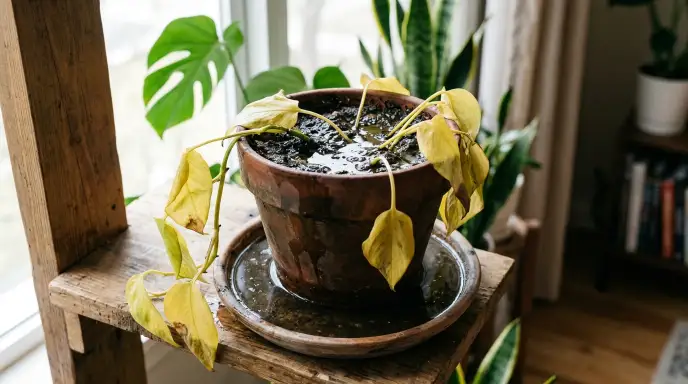
This surface dryness tricks many plant owners into adding more water when the lower soil has not finished draining. The result: root rot, drooping leaves, and a plant that slowly declines despite your best intentions. Learn more about preventing root rot.
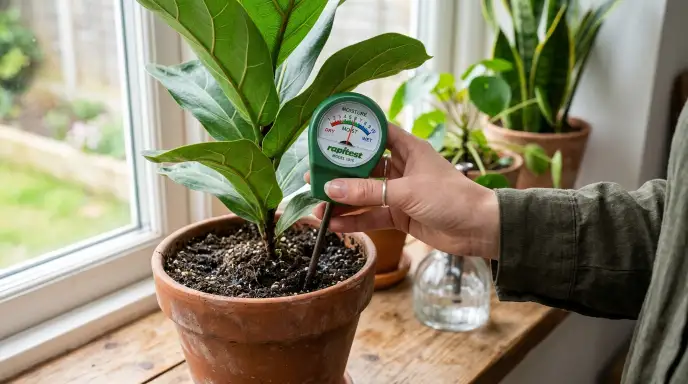
A moisture meter solves this by measuring moisture at the root level, where it actually matters. It helps you:
- Avoid overwatering, the number one cause of houseplant death
- Water only when plants actually need it
- Protect roots from rot and disease
- Remove the anxiety and guesswork from your watering routine
Pro Tip: A moisture meter works best as a second opinion, not as a strict watering schedule. Check the meter, lift the pot to feel its weight, and observe your plant’s leaves before deciding to water. To prevent fungus gnats, maintaining the right soil moisture is key. Our complete guide on preventing fungus gnats with proper watering explains exactly how dry the topsoil needs to be.
Analog vs. Digital Moisture Meters: Which Should You Buy?
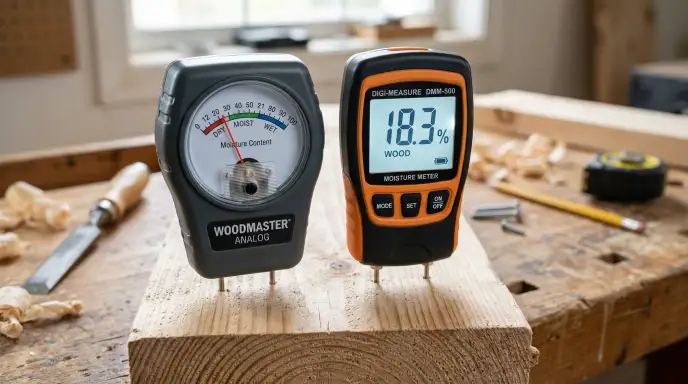
The first decision you will face is whether to buy an old-school analog meter or a modern digital one. For the vast majority of houseplant owners, the answer is simple: buy the analog.
Analog Moisture Meters (Best Choice for Most People)
Analog meters are the classic probes with a metal spike and a simple dial at the top. They look almost like meat thermometers, and they work without batteries.
How they work: The probe uses two different metals that generate a tiny electrical current when inserted into soil. Moisture acts as a conductor, pushing the needle toward “WET.” Dry soil cannot conduct, so the needle stays at “DRY.”
Why we love them:
- Cost: $8 to $15
- Zero maintenance: Just wipe the probe after each use
- No batteries: No replacements, no apps, no pairing issues
- Durability: They last for years if kept clean and dry
The catch: Readings are relative (“dry,” “moist,” “wet”) rather than precise percentages. But for houseplants, that is all you need.
Digital Moisture Meters (For Serious Hobbyists)
Digital meters display numerical readouts on an LCD screen, and some premium models connect to smartphone apps via Bluetooth.
Why some prefer them:
- Precise numerical readings for tracking moisture trends
- Some measure soil temperature and electrical conductivity (EC)
- App-connected models can send watering reminders
The catch:
- Require batteries, which always seem to die at the worst time
- Cost $25 to $80 or more
- Extra precision is unnecessary for most houseplant owners
- Cheap digital models are often less reliable than a good analog probe
Bottom line: Buy the $10 analog meter. Save the digital upgrade for when you are running a greenhouse.
What to Look for in a Soil Moisture Meter
Not all analog meters are created equal. Here is what separates a good one from a frustrating one.
1. Probe Length (Most Important)
This is the single most important specification. Your finger can only reach an inch or two into the soil, but a large pot might still be wet at the bottom. The right potting soil makes a difference; see our guide.
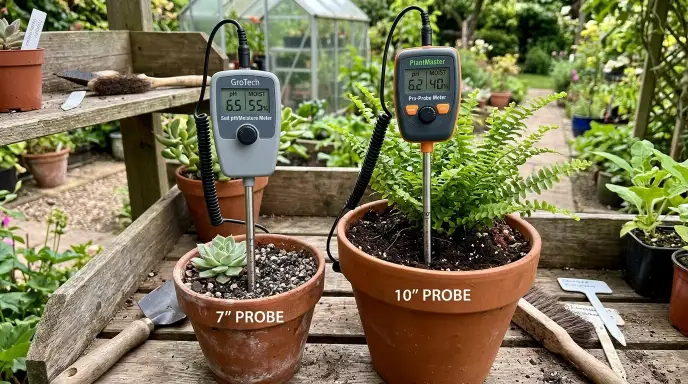
- Standard probes: About 7 inches. Good for most small to medium pots.
- Long probes: 8 to 10 inches. Essential for large floor plants and deep containers.
Recommendation: If you have any plants in pots larger than 8 inches deep, choose a meter with a probe at least 8 inches long.
2. Display Readability
A large, color-coded dial is easier to read than a small, cramped one. Some models feature an angled or bendable screen, which is especially helpful for floor plants where you do not want to bend down to read the dial.
3. Build Quality and Durability
Look for probes made from 304 stainless steel. They resist bending and corrosion. Cheaper metals corrode quickly, and once corroded, the readings drift and become unreliable.
4. Battery-Free vs. Battery-Powered
For most houseplant owners, battery-free analog meters are the better choice. They are simpler, more reliable, and never die at the wrong moment.
5. Extra Functions (3-in-1 Meters)
Some meters also measure soil pH and light levels. These can be helpful if you are diagnosing leaf burn from too much light or nutrient lockout from the wrong pH.
Caveat: The light sensor on most 3-in-1 meters is a basic photocell that only tells you “bright” versus “dim,” not precise measurements. For pure moisture accuracy, a dedicated single-function meter often performs better than a multi-purpose one.
Detailed Product Review (2026)
XLUX Soil Moisture Meter
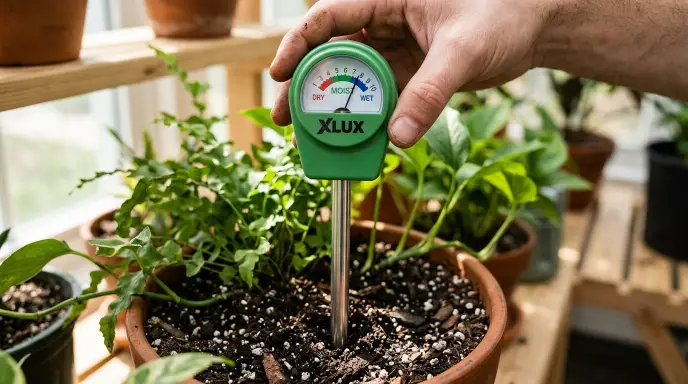
| Specification | Detail |
|---|---|
| Type | Analog (moisture only) |
| Probe Length | ~7 inches (standard) |
| Dimensions | 6W x 26H cm (approx. 2.4 x 10.2 inches) |
| Temperature Range | Up to 45°C (113°F) |
| Battery | None required |
| Mounting | Freestanding / Tabletop |
| Dial | 10-scale, color-coded (red-green-blue) |
Key Features:
- No batteries required — works immediately out of the box
- Single probe design — easier to insert into hard soil
- Expansive, easy-to-read dial — covers three ranges with ten increments
- Trusted brand — established since 2015 with over 70,000 verified reviews
- Works for both indoor and outdoor plants
Best For:
Most houseplant owners with standard potting soil in small to medium pots. The single probe is easier to insert into hard or compacted soil compared to dual-probe designs.
Limitations:
- Moisture only — no pH or light functions
- Struggles with chunky soil mixes (aroid blends, perlite-heavy mixes)
- Salt buildup from fertilizer can skew readings
- Some users report units failing after 6 months despite proper care
XLUX Long Probe Deep Use
| Specification | Detail |
|---|---|
| Type | Analog (moisture only) |
| Probe Length | 5.5 inches longer than standard probes (approx. 12.5 inches total) |
| Weight | 0.13 kg (4.6 oz) |
| Temperature Range | Up to 36°C (97°F) |
| Operating Humidity | 30–70% |
| Battery | None required |
| Mounting | Tabletop |
Key Features:
- Extra-long probe — designed specifically for deeper flower pots and large containers
- Measures moisture at the bottom of larger and deeper pots where standard probes can’t reach
- Three zones with ten scales for precise readings
- No batteries required
- Lightweight and easy to move between pots
Best For:
- Large floor plants (Monstera, Fiddle Leaf Fig, large Philodendrons)
- Deep containers over 8 inches
- Garden beds and outdoor planters
- Bonsai and deep-rooted plants
Limitations:
- Reading scale is basic — not highly precise
- Same conductivity limitations as standard XLUX — salt buildup skews readings
- Not ideal for shallow pots or small containers
- Probe needs careful handling to avoid damage
Dr.meter Soil Moisture Meter (S10)
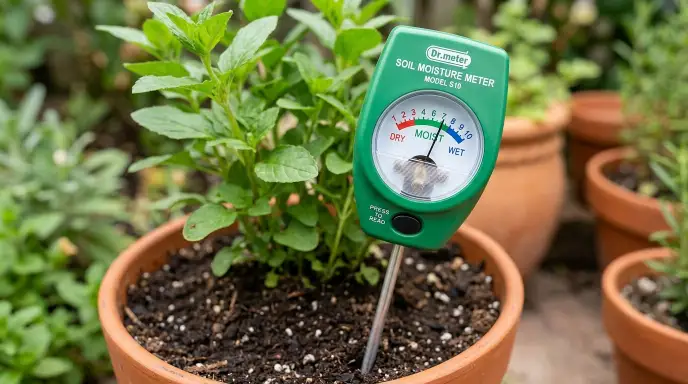
Key Features:
- Eight-inch metal stem penetrates to root level
- Color-coded reading system — red (dry), green (moist), blue (wet)
- Ten-range scale — 1-3 (dry), 4-7 (moist), 8-10 (wet)
- Single probe design — gentle on plant roots
- No batteries or electricity required
- Compact and portable
- Instructions and watering tips printed on the included pamphlet
- 30-day money-back guarantee and 18-month replacement warranty
Readings Guide:
- Range 1-3: Dry to slightly moist — for cacti, succulents, thick-leaved plants
- Range 4-7: Slightly moist to moist — for most plants (Begonia, Ficus, Philodendron, etc.)
- Range 8-10: Very moist — best for orchids
Best For:
Beginners and budget-conscious plant owners. Over 14,900 ratings with a 4.4/5 average.
Limitations:
- Useless in chunky soil mixes — reads “dry” even when recently watered
- Only works reliably in 100% compost or fine soil
- Some units are fragile and need careful handling
- Inconsistent accuracy reported by some users
VIVOSUN 3-in-1 Soil Tester
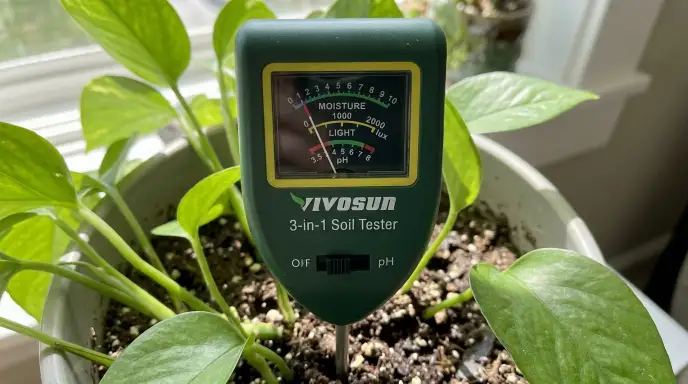
Key Features:
- Tests moisture, light, and pH in one tool
- One-button mode switching
- Battery-free and easy to use
- Compact 10.8-inch design — portable for indoor and outdoor use
- Durable construction
- Over 10,000 ratings from users
Best For:
Gardeners who want basic readings for moisture, light, and pH in a single tool.
Limitations:
- Moisture meter is not very accurate — often shows incorrect readings
- pH function does not work on most units — all soil reads the same
- Light meter often non-functional
- Dark panel makes the dial difficult to read
- Thick stickers raise concerns about root damage
- Some units stop giving readings after a month
SONKIR MS02 3-in-1
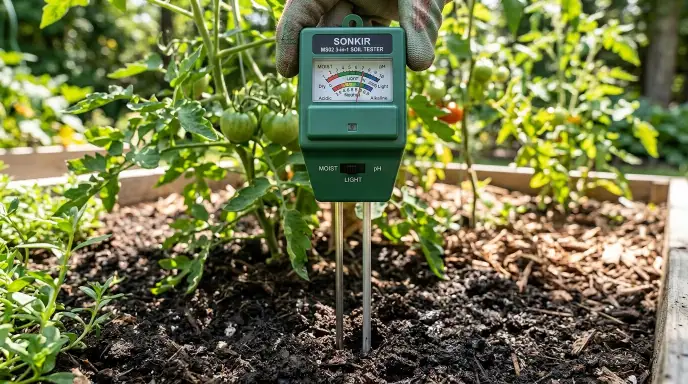
Key Features:
- 3-in-1 design — tests moisture, light, and pH
- Double-needle detection technology
- No batteries required
- Budget-friendly price point
- Over 46,000 ratings with a 4.1/5 average
- Works indoors and outdoors
- Scientific data monitoring — helps track changes in plant conditions
Best For:
Budget-conscious beginners who want a 3-in-1 tool for basic plant monitoring.
Limitations:
- pH readings are not accurate for precise soil chemistry
- pH needle often stuck at one number regardless of soil
- Probe can bend or break in hard soil
- Does not test liquids — only works in soil
- Needle sometimes does not move if soil is too dry
- Some units stop working after 4 months of use
- Light meter is directional and not very useful
Sustee Aquameter
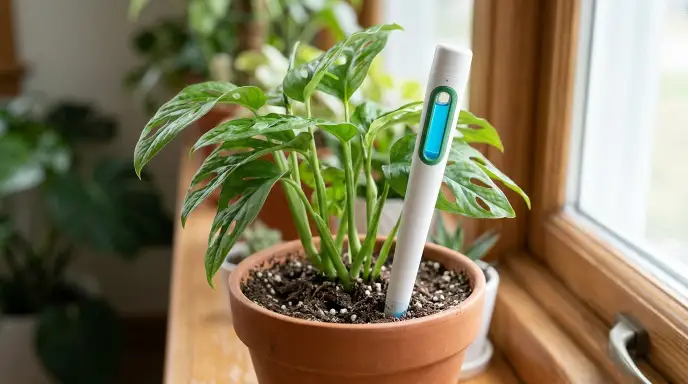
Key Features:
- Leave-in design — stays in the soil for continuous monitoring
- Visual color indicator — white = needs water, blue = has enough water
- Refillable core — replace every 6-9 months
- Award-winning design — Red Dot Design Award, Germany Design for Asia Award, Japan Good Designs Award
- Environmentally friendly
- No batteries required
- Made in Japan
- Slim, minimalist aesthetic — doesn’t detract from plant beauty
Best For:
- Travelers who need hands-off plant monitoring
- Those who want a visual cue without probing
- People with multiple plants who want quick visual checks
- Gifting to new plant parents
Limitations:
- Not a numeric readout — less precise than analog meters
- Quite expensive compared to analog probes
- Plastic parts may degrade in direct sun
- Some units fail after 3 to 6 months
- Can be wildly inaccurate — may not change color when needed
- In larger pots, may need multiple units for accurate readings
Best Soil Moisture Meters for Indoor Plants in 2026
Here are the top picks based on real-world performance, durability, and value.

| Product | Type | Best For | Key Feature |
|---|---|---|---|
| XLUX Soil Moisture Meter | Analog | Best Overall | Long probe, simple dial, battery-free |
| XLUX Long Probe Deep Use | Analog | Large pots and floor plants | Extra-long probe reaches deep soil |
| Dr.meter Soil Moisture Meter | Analog | Best Budget | Color-coded dial, no batteries needed |
| VIVOSUN 3-in-1 Soil Tester | 3-in-1 | Best Multipurpose | Moisture, pH, and light in one tool |
| SONKIR MS02 3-in-1 | 3-in-1 | Best Budget 3-in-1 | Moisture, pH, and light at low cost |
| Sustee Aquameter | Leave-in Sensor | Continuous Monitoring | Stays in soil, visual color indicator |
Quick Picks by Situation
| Your Setup | Best Choice |
|---|---|
| Most beginners and small collections | Simple analog probe (XLUX or Dr.meter) |
| Large floor plants and deep pots | Long probe model (XLUX Long Probe) |
| You want extra data like pH or light | 3-in-1 meter (SONKIR MS02 or VIVOSUN) |
| You travel frequently | Leave-in sensor (Sustee Aquameter) |
| Tiny nursery pots | Skip the meter and use pot weight and finger test |
Product Pros and Cons Comparison
Here is a detailed breakdown of the pros and cons for each product to help you make the right choice.
| Product | Type | Pros | Cons |
|---|---|---|---|
| XLUX Soil Moisture Meter | Analog (moisture only) | • Trusted brand since 2015 • Over 70,000 verified reviews • Clear 10-scale color-coded display • No batteries required • Single probe is easier to insert into hard soil • Gives immediate root-level readings | • Moisture only, no pH or light functions • Some units stop working after heavy use • Salt buildup or liquid fertilizer can cause false “wet” readings • Some users report units failing after 6 months despite proper care • Can give inconsistent or fluctuating readings in larger pots |
| XLUX Long Probe Deep Use | Analog (moisture only) | • Extra-long probe reaches deep into large pots and floor plants • Takes the guesswork out of watering • Simple, no batteries or setup required • Lightweight and easy to move between pots • Works for both indoor and outdoor plants • Excellent for deep-rooted plants and bonsai | • Reading scale is basic, not highly precise • Probe needs careful handling to avoid damage • Same conductivity limitations as standard XLUX; salt buildup skews readings • Not ideal for shallow pots or small containers |
| Dr.meter Soil Moisture Meter (S10) | Analog (moisture only) | • No batteries ever needed • Simple and easy to use • Affordable price point • Immediate dry/moist/wet readings • Over 14,900 ratings with a 4.4/5 average • Lightweight and easy to insert | • Useless in chunky soil mixes with perlite, pumice, or aroid blends; reads “dry” even when recently watered • Only works reliably in 100% compost or fine soil • Some units are fragile and need careful handling • Inconsistent accuracy reported by some users |
| VIVOSUN 3-in-1 Soil Tester | 3-in-1 (moisture, light, pH) | • Compact 10.8-inch design • Easy one-button operation • Battery-free • Combines three functions in one unit • Over 10,000 ratings • Good for both amateur and experienced gardeners | • Moisture meter is not very accurate and often shows incorrect readings • pH function does not work on most units; all soil reads the same • Light meter often non-functional • Dark panel makes the dial difficult to read • Thick stickers raise concerns about root damage • Some units stop giving readings after a month |
| SONKIR MS02 3-in-1 | 3-in-1 (moisture, light, pH) | • Tests moisture, pH, and light in one tool • No batteries needed • Budget-friendly price point • Easy to use for beginners • Over 46,000 ratings with a 4.1/5 average • Helps prevent overwatering and underwatering • Works indoors and outdoors | • pH readings are not accurate for precise soil chemistry • pH needle often stuck at one number regardless of soil • Probe can bend or break in hard soil • Does not test liquids; only works in soil • Needle sometimes does not move if soil is too dry • Some units stop working after 4 months of use • Light meter is directional and not very useful |
| Sustee Aquameter | Leave-in Sensor | • Leave-in design offers continuous monitoring • Compact and unobtrusive in pots • Visual, easy-to-read color indicator • Refillable with low running cost • No batteries required • Good for hands-off care and vacation monitoring • Refillable cores reduce waste | • Not a numeric readout, less precise than analog meters • Plastic parts may degrade in direct sun • Requires occasional refills to stay accurate • Some units fail after 3 to 6 months • Can be wildly inaccurate and may not change color when needed • Quite expensive compared to analog probes • In larger pots, may need multiple units for accurate readings |
Key Takeaways from the Pros and Cons Table
Here is what the table above tells you in plain English.
| Takeaway | Detail |
|---|---|
| Analog is best for most people | The XLUX and Dr.meter analog probes are affordable, reliable, and battery-free. They give you everything you need for under $15. |
| But analog meters have a blind spot | Both XLUX and Dr.meter struggle with chunky soil mixes (aroid blends, perlite-heavy mixes), and salt buildup from fertilizer can skew readings. |
| Skip the 3-in-1 meters | Unless you absolutely need pH and light readings, skip VIVOSUN and SONKIR. The pH function on budget 3-in-1 meters is widely reported as unreliable or completely non-functional. The moisture function works fine, but you are paying extra for features that do not deliver. |
| The XLUX Long Probe is for deep pots only | If you have large floor plants or deep containers, the extra-long probe is a game-changer. For standard pots, stick with the regular XLUX. |
| Sustee is a niche product | Great for travelers or those who want a visual cue without probing, but it is expensive, less precise, and prone to failure after a few months. |
| For 90% of plant owners, the $10 analog probe wins | The XLUX Soil Moisture Meter or Dr.meter S10 are the best choices for most houseplant collections. Simple, affordable, and they work. |
Quick Recommendation Summary
| Your Situation | Best Choice |
|---|---|
| You have standard potting soil in small to medium pots | XLUX Soil Moisture Meter or Dr.meter S10 |
| You have large floor plants or deep containers | XLUX Long Probe Deep Use |
| You want pH and light data (and accept the limitations) | SONKIR MS02 (moisture works, pH is unreliable) |
| You travel frequently or want hands-off monitoring | Sustee Aquameter (but keep expectations low) |
| You are growing in chunky aroid mixes or LECA | Skip the meter entirely and use pot weight and finger testing instead |
Now that you know which meter to buy, let’s talk about how to use it correctly so you get accurate readings every time.
How to Use a Moisture Meter Correctly
Using a moisture meter is simple, but placement and technique matter. Pair your moisture meter with a long-spout watering can for precision watering.

Step-by-Step Instructions
- Insert the probe slowly to about two-thirds of the depth of the root ball.
- Position it correctly. Place the probe halfway between the main stem and the side of the pot.
- Avoid the edge. Do not insert near the pot wall, or you will get a false reading.
- For large pots over 20 centimeters, take readings from 2 to 3 different spots and use the lowest one.
- Wait 30 to 60 seconds for the reading to stabilize before checking the dial.
Using a moisture meter helps you water correctly—especially important when nursing a sunburned plant back to health.
What the Readings Mean
Most meters use a 1 to 10 scale divided into three zones. The exact watering trigger depends on the plant.
| Plant Type | Water When Reading Shows |
|---|---|
| Cacti, succulents, ZZ plants, Sansevieria | 1 to 2 (bottom of dry zone) |
| Monstera, Philodendron, Pothos | 2 to 3 (dry zone) |
| Calathea, ferns, peace lilies | 4 to 5 (lower end of moist zone) |
| Carnivorous plants, bog species | Ignore the meter and keep constantly wet |
Common Mistakes to Avoid
1. Testing only the surface
The probe must reach root level, not just the top inch of soil.
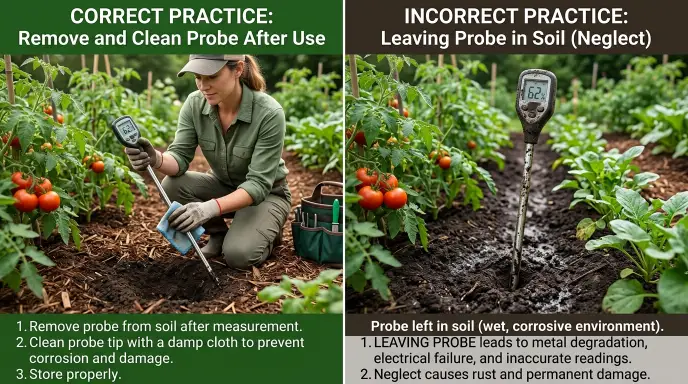
2. Leaving the probe in the soil
Insert, read, and remove. Leaving it in the soil corrodes the probe and ruins the meter. If your leaves are crispy, check our crispy leaves diagnosis guide.
3. Not cleaning the probe
Wipe the probe clean and dry after every use. Wet probes left in a drawer corrode quickly.
4. Relying on one reading
Soil moisture varies across the pot. Test multiple spots. Humidity affects how quickly soil dries; learn more about how to increase humidity for plants.
5. Testing in fertilized soil
Fertilizer buildup increases conductivity, so a heavily fed pot may read “moist” even when the soil is dry. During heatwaves, adjust your watering routine; learn how from this guide.
6. Testing in chunky soil mixes
Aroid mixes, Pon, and other inorganic media often read drier than they actually are because air pockets break the electrical path between the probes.
How to Care for Your Meter
- Wipe the probe clean and dry after every single use.
- Do not leave the meter in a pot between waterings. Constant exposure to fertilizer and moisture shortens its life dramatically.
- If your meter reads the same number no matter which pot you test, the probe has corroded, or the internal contact spring has failed. Replace it. Consumer meters do not allow calibration.
- Most cheap meters die within a month if left in soil. Remove immediately after reading.
Frequently Asked Questions About Moisture Meters
Do moisture meters actually work?
Yes. They measure electrical resistance or capacitance in soil to give you a reliable moisture reading. For standard potting compost, they are accurate enough for trends.
How accurate are soil moisture meters?
Analog meters provide relative readings like dry, moist, or wet that are accurate enough for houseplant care. Digital meters offer more precise data but are not necessary for most plant owners. Accuracy drops in chunky soil mixes or soil with high salt buildup.
Can I leave my moisture meter in the soil?
No. Insert, read, and remove. Leaving the probe in soil causes corrosion and ruins the meter.
Why are my moisture meter readings inconsistent?
Salt or fertilizer buildup in the soil can skew readings. Probe different areas of the pot for an average reading.
What is the best moisture meter for beginners?
The XLUX Soil Moisture Meter is the most popular choice. It is affordable ($10 to $15), battery-free, and has a simple color-coded dial.
Analog vs. digital: which is better?
Analog is better for most houseplant owners. It is cheaper, has no batteries, and lasts for years. Digital is only worth it for serious hobbyists or large collections.
Do moisture meters replace finger testing?
They complement finger testing by providing a deeper reading. Use both for the best understanding of soil conditions.
Key Takeaways
- Buy analog unless you are a serious hobbyist. Ten dollars gets you everything you need.
- Probe length matters most. Get 8 or more inches for large pots.
- Never leave the probe in soil. It corrodes and dies.
- Test multiple spots in each pot for an accurate reading.
- Clean the probe after every use. Wipe it dry.
- A meter is a second opinion, not a strict schedule. Use it alongside pot weight and leaf observation.
Ready to stop guessing? A $10 moisture meter is one of the best investments you can make for your houseplant collection. Pick one up today and start watering with confidence. New to houseplants? Start with our complete beginner’s guide.