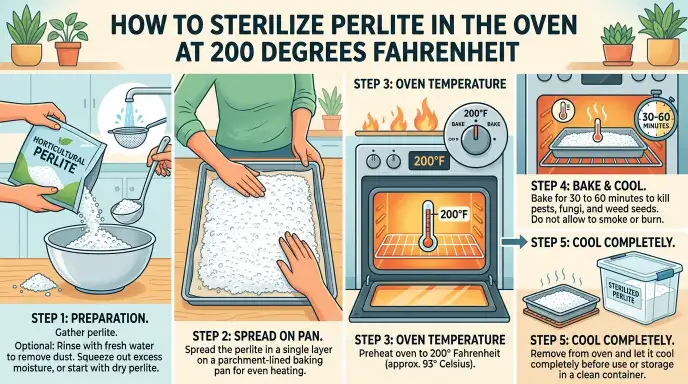
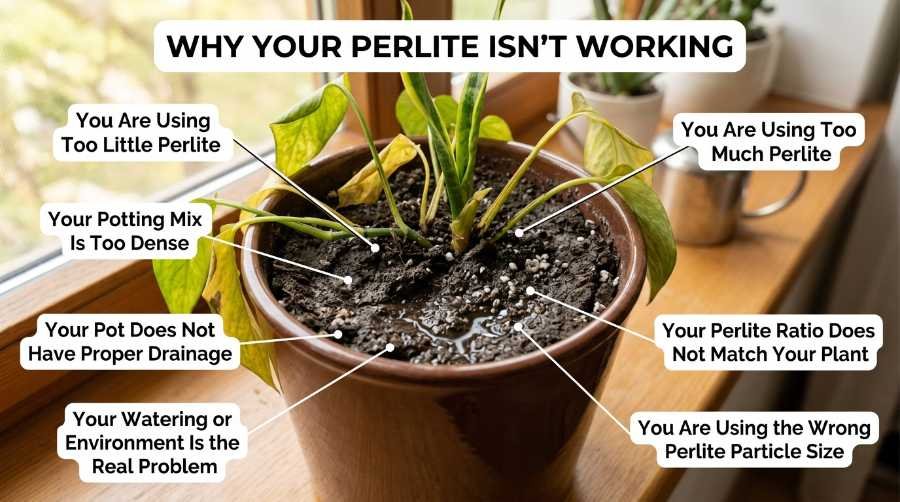
Perlite usually is not the real problem when a potting mix stays wet, dries too quickly, or still feels compact after you add it. The most common causes are using the wrong amount, choosing an unsuitable mix, poor drainage, the wrong particle size, or watering and environmental conditions that do not match the plant. Gather knowledge about the 6 best perlite potting mixes from this guide.
Perlite is a lightweight, porous material used mainly to improve aeration and drainage in potting mixes. It works by increasing pore space around roots, but it cannot correct every problem in a container by itself. A good growing medium still needs the right balance of air, moisture, drainage, and nutrient retention. Learn details about what perlite is from this guide.
If you already added perlite and your plant is still struggling, these seven mistakes can help you find the actual cause.
I learned this the hard way with a Monstera I repotted three years ago. I added a big scoop of perlite to the old, compacted potting soil, mixed it in lightly, and thought I was done. Two weeks later, the soil was still holding too much water. The perlite wasn’t the problem, the old soil was too compacted. I needed to break up the soil properly and mix the perlite throughout it.
Why Is Perlite Not Working?
Perlite is expanded volcanic material with a porous structure. In a potting mix, it helps create spaces where air can remain around the roots and allows excess water to move through the medium. It does not hold water and nutrients as well as materials such as vermiculite.
That means perlite should be viewed as one component of a growing medium, not as a complete solution for drainage problems.
For example, adding perlite to a pot without drainage holes will not solve the basic problem. Similarly, mixing a small amount of perlite into heavily compacted material may not change the root-zone structure enough to make a noticeable difference.
The better question is:
Is the entire potting system giving the roots the right amount of air and moisture?
That includes the potting mix, perlite ratio, container, plant, light, temperature, humidity, and watering habits.
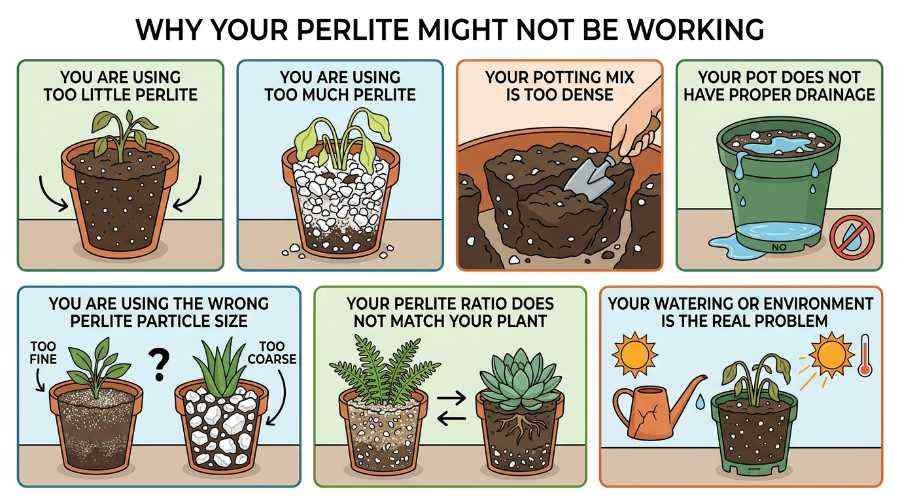
1. You Are Using Too Little Perlite
If you add only a small amount of perlite to a large volume of dense potting mix, the change in soil structure may be minimal.
The original mix may still compact around the roots and retain water for too long. Perlite needs to be distributed throughout the growing medium so it can contribute to the overall pore structure.
How to recognize this problem
Your mix may contain too little perlite if it:
- becomes dense after watering
- sticks together when squeezed
- stays wet for many days
- has very few visible coarse particles
- becomes compacted around the root ball
How to fix it
Do not simply add a layer of perlite on top of the pot. That does little to change the structure around the deeper roots.
Instead, incorporate perlite throughout the growing medium when you prepare or repot the plant.
There is no single perlite percentage that works for every indoor plant. Different plants and growing conditions require different balances of moisture retention and aeration. Extension recommendations themselves vary according to the plant and medium.
For exact ratios, see our guide to how much perlite indoor plants need.
2. You Are Using Too Much Perlite
More perlite does not automatically mean better drainage.
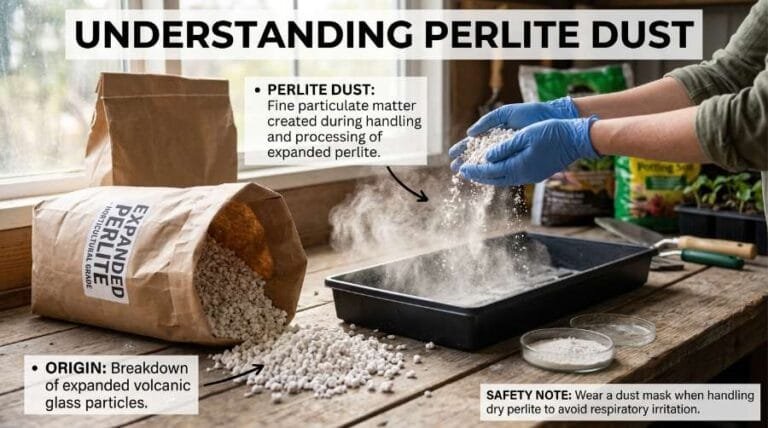
Perlite creates additional air space, but a very high proportion can make a growing medium lose moisture faster than a particular plant needs. Know about breathing perlite dust? Read this guide.
This can lead to:
- soil drying rapidly
- frequent wilting
- more frequent watering
- difficulty maintaining consistent moisture
- plants becoming stressed between waterings
Mississippi State Extension notes that perlite does not hold much water or nutrients compared with some other growing-medium components.
How to recognize too much perlite
If you water thoroughly but the mix becomes dry unusually quickly, first consider the complete growing environment.
A plant in bright light and a warm, dry room will naturally use water faster than the same plant in lower light and cooler conditions. Read this guide to know about handle perlite safely.
How to fix it
Do not automatically respond by watering more often.
First, determine whether the growing medium is too open for the plant. If it is, use a more balanced mix containing enough moisture-retaining material.
The goal is not maximum drainage.
The goal is appropriate drainage without leaving the roots excessively dry.
3. Your Potting Mix Is Too Dense
Perlite cannot completely compensate for a poor base material.
A good container medium needs enough pore space for root aeration while also retaining sufficient water and nutrients. University extension guidance consistently emphasizes this balance.
What makes a potting mix dense?
Common causes include:
- heavy garden soil
- compacted potting material
- very fine particles
- breakdown of organic components
- repeated compression
- an unsuitable homemade mix
Garden or field soil is particularly problematic in containers because it can retain too much water and provide too little pore space. NC State Extension recommends soilless substrates instead of ordinary field soil for container growing.
How to fix dense soil
If the existing mix has become badly compacted, repotting into a properly structured growing medium may be more effective than simply adding more perlite.
Depending on the plant, a mix may contain materials such as:
- potting mix
- coco coir
- peat-based material
- pine or orchid bark
- perlite
- vermiculite
The proportions should be adjusted according to the plant’s moisture requirements.
4. Your Pot Does Not Have Proper Drainage
This is one of the most important checks.
Perlite cannot compensate for a container that cannot release excess water.
A pot without a functional drainage hole can remain waterlogged even if the growing medium contains perlite.
The same problem can occur when a drainage hole is blocked or when a nursery pot sits in accumulated water inside a decorative container.
Check your pot for these problems
No drainage hole:
Excess water has nowhere to escape.
Blocked drainage hole:
Roots, compacted soil, or debris can restrict water movement.
Decorative outer pot:
Water can collect beneath the inner pot.
Standing water:
Roots can remain saturated after watering.
Illinois Extension recommends containers with adequate drainage and warns that poorly drained or oversized containers can keep soil excessively wet and increase the risk of root problems.
Wisconsin Extension similarly recommends drainage holes and explains that decorative containers can be used with a separate inner pot, provided the liner does not sit in standing water.
How to fix it
Use a container with a functional drainage hole. After watering, allow excess water to drain completely and empty the water collected in the saucer or outer container.
Do not put a layer of perlite at the bottom of the pot and expect it to solve poor drainage. The entire root-zone mix and the container’s drainage system matter.
5. You Are Using the Wrong Perlite Particle Size
Perlite is available in different particle sizes, and particle size affects the physical structure of a growing medium.
Larger particles can create larger air spaces, while finer particles produce a finer texture.
Why particle size matters
Suppose you have a dense, fine-textured potting mix. Adding appropriately sized coarse material can change its structure more noticeably than adding another fine component.
That is why choosing perlite simply because the package says “perlite” is not always enough.
How to fix it
Choose the particle size according to the purpose of the mix.
For general houseplant mixes, use horticultural perlite appropriate for container growing. Plants that need particularly high aeration may benefit from a more open, chunky structure.
Propagation mixes can require a different balance because developing roots need both moisture and oxygen.
The important point is that particle size affects the physical properties of the finished mix, so consider the other ingredients as well.
6. Your Perlite Ratio Does Not Match Your Plant
There is no universal perlite ratio for every indoor plant.
Different plants have different moisture requirements, and the same mix can behave differently depending on light, temperature, humidity, pot size, and airflow.
NC State Extension specifically notes that container mixes should be selected according to the needs of the plant and that different plants may require different combinations of materials.
Moisture-loving plants
Plants that prefer consistently moist conditions generally need more moisture retention than drought-tolerant plants.
An excessively open mix may dry faster than necessary.
Succulents and cacti
Succulents and cacti generally need faster drainage and greater air space than many foliage plants.
NC State Extension recommends greater air space for plants that are sensitive to root rot or prefer drier conditions.
Tropical houseplants
Many tropical foliage plants need a balance between moisture retention and aeration.
A mix that drains extremely quickly is not automatically better.
Propagation
Cuttings need enough moisture to support new root development without remaining continuously saturated.
The better question
Instead of asking:
“What is the perfect perlite ratio?”
Ask:
“How quickly should this plant’s root zone dry in my growing environment?”
That gives you a more useful starting point.
7. Your Watering or Environment Is the Real Problem
Sometimes perlite is working exactly as intended, but another factor is causing the problem.
The same potting mix can dry at very different rates depending on where the plant is located.
A plant beside a bright window may use water much faster than an identical plant in a dim room. Temperature, humidity, airflow, season, pot size, and plant size also affect drying speed.
If your soil stays wet too long
Check:
- drainage holes
- pot size
- soil density
- watering frequency
- light level
- temperature
- airflow
If your soil dries too quickly
Check:
- perlite proportion
- pot size
- light intensity
- temperature
- humidity
- airflow
- plant size
- root development
Do not water by the calendar
A schedule such as “water every seven days” ignores changes in the plant’s environment.
Instead, check the moisture of the growing medium and the plant’s condition before watering.
Oklahoma State Extension notes that mixes with higher amounts of perlite generally dry faster than mixes with more moisture-retaining materials. Know the correct watering method from this guide.
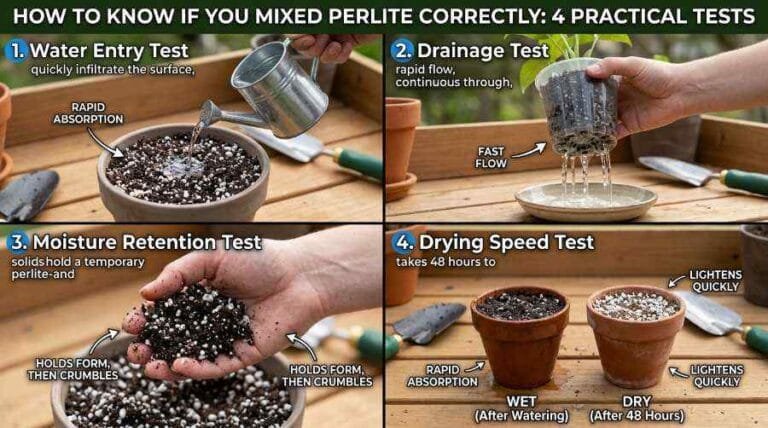
How to Find the Real Problem With Your Perlite Mix
Before changing your recipe, diagnose the complete container.
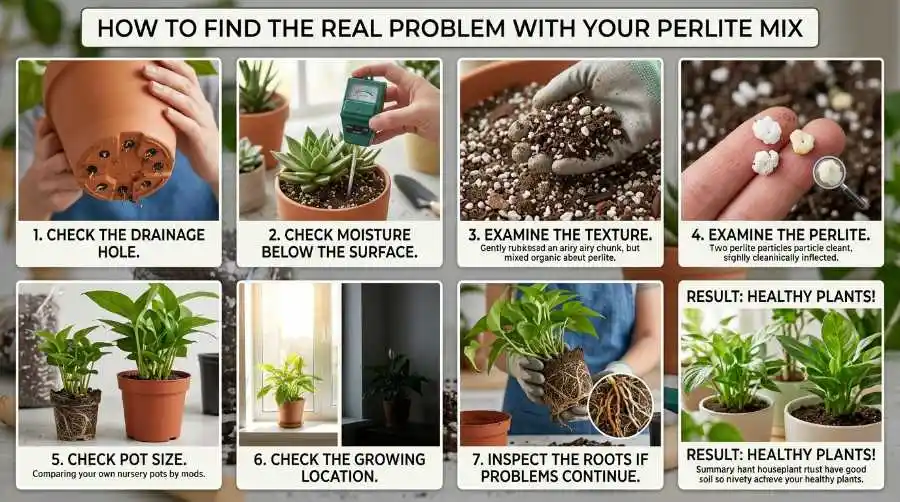
Step 1: Check the drainage hole
Make sure excess water can actually leave the pot.
Step 2: Check moisture below the surface
Do not judge the entire root zone from the surface alone.
The top may look dry while deeper soil remains wet. Read this to know how to check soil moisture.
Step 3: Examine the texture
Take a small amount of the mix and check whether it remains densely compressed.
A healthy container medium should have enough structure and pore space for roots.
Step 4: Examine the perlite
Ask:
- Is there enough throughout the mix?
- Is the particle size appropriate?
- Has the rest of the mix broken down?
- Has the medium become compacted?
Step 5: Check pot size
An oversized pot contains more growing medium and can remain wet longer.
Illinois Extension recommends moving up only one pot size rather than placing a small plant in a very large container. Read this article to learn details about the best indoor plant pots.
Step 6: Check the growing location
Consider:
- light
- temperature
- humidity
- airflow
Step 7: Inspect the roots if problems continue
If the plant continues to decline while the soil stays wet, the problem may have progressed beyond the potting mix.
Look for signs of unhealthy roots and address the cause of prolonged saturation.
Can Adding More Perlite Fix Waterlogged Soil?
Sometimes, but not always.
If the growing medium needs more aeration, adding an appropriate amount of perlite can improve its structure.
But if the pot has no drainage hole, adding perlite does not fix the fundamental problem.
If the existing mix is severely compacted or degraded, replacing it may be more effective.
And if the roots are already damaged, improving the mix alone will not instantly restore them.
The first step is to determine why the soil is staying wet.
Can You Add Perlite to Existing Potting Soil?
Yes, but the method matters.
Adding perlite only to the surface does not substantially change the structure of the deeper root zone. Know how to add perlite to potting soil in this guide.
If you are repotting, incorporate the perlite evenly throughout the new growing medium.
If an established plant is growing well, avoid disturbing the roots to add perlite. Instead, consider improving the mix during the next appropriate repotting.
For a severely compacted or degraded mix, replacing the growing medium may be the better solution.
Perlite vs. Pumice: Which Is Better?
None of these three wins outright. They’re all mineral additives, but they solve different problems, and the right pick depends on whether the plant in front of you needs more air around the roots or more moisture held near them.
| Perlite | Vermiculite | Pumice | |
|---|---|---|---|
| Main job | Aeration and drainage | Water and nutrient retention | Aeration and drainage |
| Weight | Very lightweight, can float | Lightweight, but doesn’t float as readily | Heavier, stays put in the mix |
| Water behavior | Holds very little water | Holds a lot of water and nutrients | Holds very little water |
| Structure | Rounded, porous particles | Flat, layered, spongy flakes | Irregular, rougher, denser particles |
| Longevity | Can break down and compact over repeated repotting | Breaks down faster than perlite or pumice | Generally the most durable over the long term |
| Best for | General aeration in most houseplant mixes | Moisture-loving plants, seed starting, humidity-sensitive cuttings | Succulents, bonsai, mixes that need to resist compaction for years |
| Watch out for | Floating to the surface if watered hard | Overwatering risk if used too heavily in a mix that doesn’t need it | Higher cost and heavier pots, less ideal for hanging plants |
When Perlite Is Not the Best Solution
Perlite is useful, but you do not need to use it in every potting mix.
Other materials can contribute to the structure of a growing medium, including:
- pumice
- coarse bark
- coco coir
- peat-based materials
- vermiculite
- commercial potting mixes
Each material has different properties. Learn the differences between perlite and pumice in this guide.
For example, vermiculite generally holds more water and nutrients than perlite, while bark can contribute larger structural particles and aeration. Also learn about perlite VS vermiculite in this guide.
The goal is not to build a mix around one ingredient.
The goal is to create a root environment appropriate for the plant.
The Bottom Line
If perlite is not giving you the result you expected, do not immediately add more.
Check these seven possibilities first:
- Too little perlite — the mix may remain dense.
- Too much perlite — the mix may dry too quickly.
- Dense potting material — the base mix may be the real problem.
- Poor drainage — trapped water cannot be solved with perlite alone.
- Wrong particle size — particle size affects the structure of the mix.
- Wrong ratio for the plant — different plants need different moisture and aeration balances.
- Watering or environmental conditions — light, temperature, humidity, airflow, and pot size change how quickly soil dries.
The best perlite mix is not the one that drains the fastest. It is the one that gives your plant enough air around its roots while retaining enough moisture for healthy growth.
Frequently Asked Questions
Why is my soil still wet after adding perlite?
The problem may be the container, pot size, dense growing medium, watering frequency, or growing environment rather than the perlite itself. Check whether the pot has a functional drainage hole and whether the deeper root zone is still wet.
Can too much perlite hurt indoor plants?
Too much perlite can make a mix dry faster than a particular plant requires. The appropriate amount depends on the plant, the other components in the mix, and the growing environment.
Does perlite improve drainage?
Yes. Perlite is commonly used to improve aeration and drainage by increasing pore space within a growing medium.
Is perlite good for root rot?
Perlite can help create a more aerated growing medium, but it does not cure root rot. If root problems are caused by prolonged saturation, the underlying drainage and watering problem must also be corrected.
Can you use perlite alone?
Perlite can be useful in some specialized growing and propagation applications, but it does not provide the complete combination of water retention, nutrients, and structure required by most indoor plants. It is generally used as one component of a growing medium.
Should you use fine or coarse perlite?
Choose the particle size according to the structure you want. Coarser particles generally provide larger air spaces, while finer particles create a finer texture. The best choice also depends on the other ingredients in the mix.
Does perlite stop working over time?
Perlite itself is relatively stable, but the overall potting mix can change as organic materials break down, roots fill the container, and particles settle. If an old mix becomes compacted, the problem may be the aging Growing medium rather than the perlite itself.