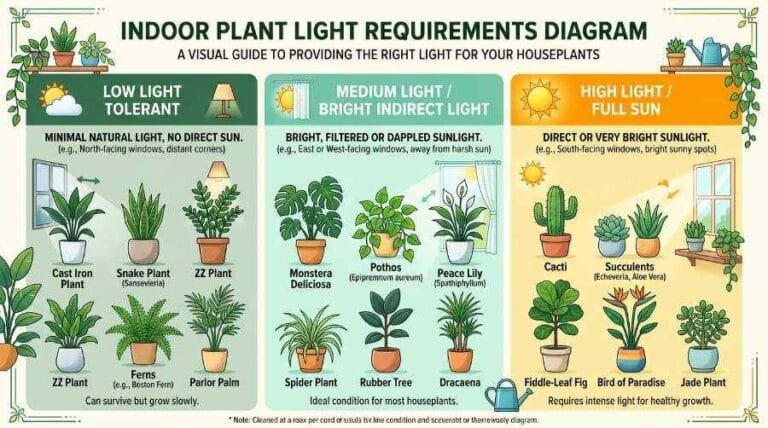
Low light for plants means roughly 50 to 250 foot-candles of light intensity, the kind of dim, indirect brightness you’d find a few feet back from a window, in a north-facing room, or under office fluorescents. Low-light plants are especially prone to sunburn. If yours gets too much sun, here’s how to fix a sunburned plant. It’s bright enough to comfortably read a book by, but nowhere near what most people picture when they think “good light” for a plant. Even low-light plants can develop leggy, stretched-out growth if the light drops too low. Learn how to fix leggy growth if your low-light plant starts stretching.
Here’s where a lot of confusion starts: low light does mean no light. There’s no houseplant, not even the toughest snake plant, that survives in a completely dark closet or windowless basement forever. What “low light plants” actually means is a group of species that evolved to tolerate, and in some cases genuinely prefer, dim conditions, usually because they originated as forest-floor plants growing under a thick canopy rather than out in open sun.
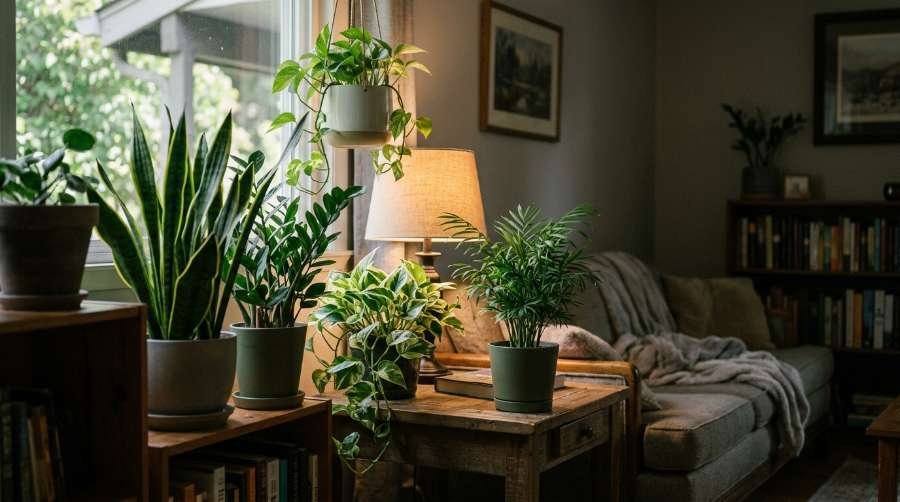
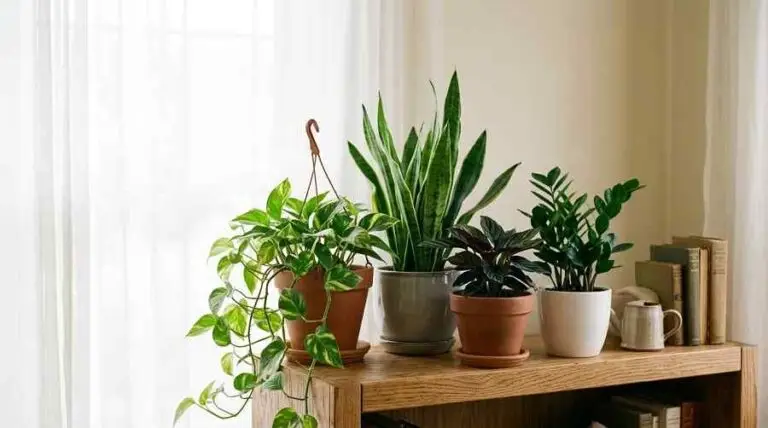
I once kept a pothos on a bookshelf in a windowless hallway, lit only by a hallway light a few hours a night. It survived almost a year, barely growing, before I moved it near a window and watched it finally take off.
This guide breaks down exactly what counts as low light, how to check if your own space qualifies, fifteen plants that handle it well, and how their care changes once they’re living in a dimmer spot.
What Is Low Light for Plants?
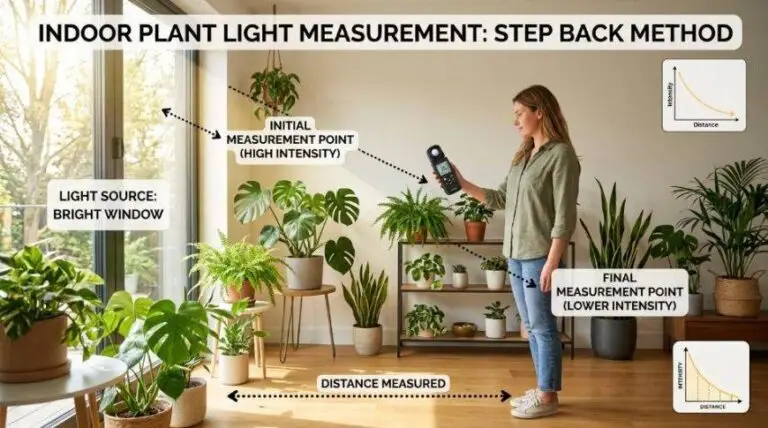
In horticultural terms, low light sits at roughly 50 to 250 foot-candles, or about 500 to 2,500 lux. For comparison, direct outdoor sunlight can hit 32,000 to 100,000 lux on a clear day, so even the upper end of “low light” indoors is a tiny fraction of what plants get outside. Follow this guide to learn about light measurement.
In practical, real-world terms, low light usually shows up in:
- North-facing windows, which never receive direct sun
- Spots several feet back from any window, regardless of direction
- Windowless offices or interior rooms lit only by fluorescent or LED bulbs
- Hallways, bathrooms without skylights, and stairwells
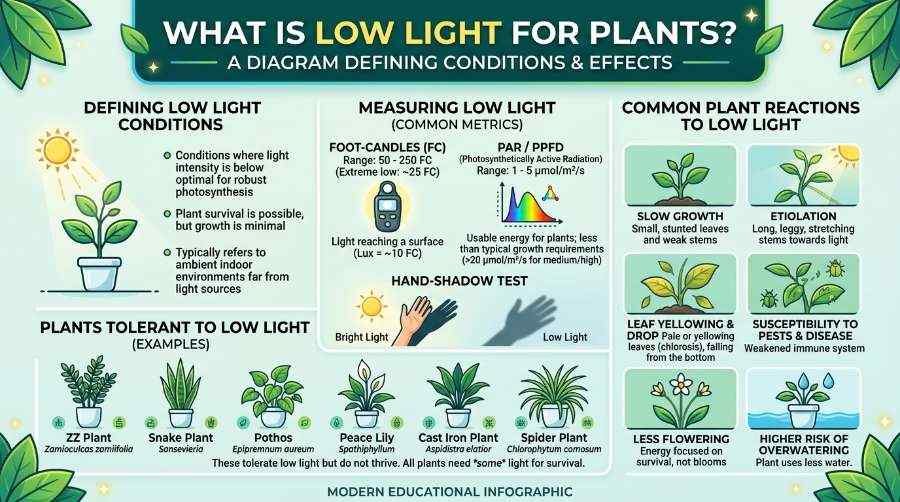
A simple gut-check: if you can comfortably read a paperback in that spot without turning on a lamp, it likely qualifies as low light. If you’d need to squint or the room feels genuinely dark, that’s closer to no usable light at all, which no plant can survive long-term. Window direction for a plant is also important. Know more about the best window direction from this.
Low Light Doesn’t Mean No Light
This is the single biggest misunderstanding people run into when shopping for “low light plants,” and it’s worth slowing down on.
Every plant, without exception, needs some light to photosynthesize and produce the energy it survives on. What separates a true low-light plant from one that simply can’t handle a dim spot is how efficiently it can produce that energy at lower intensities. Plants that evolved on rainforest floors, shaded by taller trees above them, developed larger, darker leaves specifically to capture as much of the limited light filtering down as possible. That evolutionary background is why species like pothos, snake plants, and peace lilies can get by on light levels that would slowly starve a succulent or a citrus tree.
There’s also an important distinction worth knowing before you buy:
- Low light tolerant plants will survive in dim conditions, but they won’t grow much, and they’re simply putting up with less-than-ideal light rather than thriving in it.
- Low light loving plants genuinely do better out of direct sun and can actually suffer, through scorched or bleached leaves, in bright conditions.
Most of the plants on popular “low light” lists, including this one, fall into the tolerant category rather than the loving one. Knowing which is which sets more realistic expectations for how much growth you’ll actually see.
How to Tell If Your Space Is Actually Low Light
Before picking a plant off this list, it helps to confirm your space really is low light and not something dimmer that even these tough species would struggle in.
- The shadow test. Hold your hand about a foot above a surface around midday. A soft, barely visible shadow usually signals low light. No shadow at all often means the space is too dark for sustained plant growth.
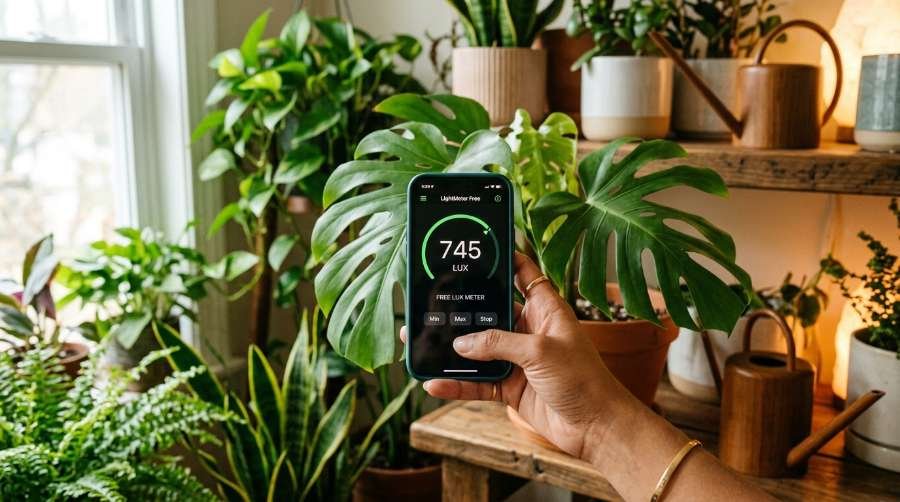
- Free lux meter apps. Several free smartphone apps estimate lux using your phone’s camera. They’re not laboratory accurate, but they’re reliable enough to compare one room against another in your home.
- Spots people commonly underestimate: hallways, bathrooms without a window, desks positioned a few feet from natural light, and any room with only north-facing windows.
If you want a deeper breakdown of light levels across every tier, not just low light, a full lux and foot-candle chart with measuring instructions is available in our Identify of rooms light level guide.
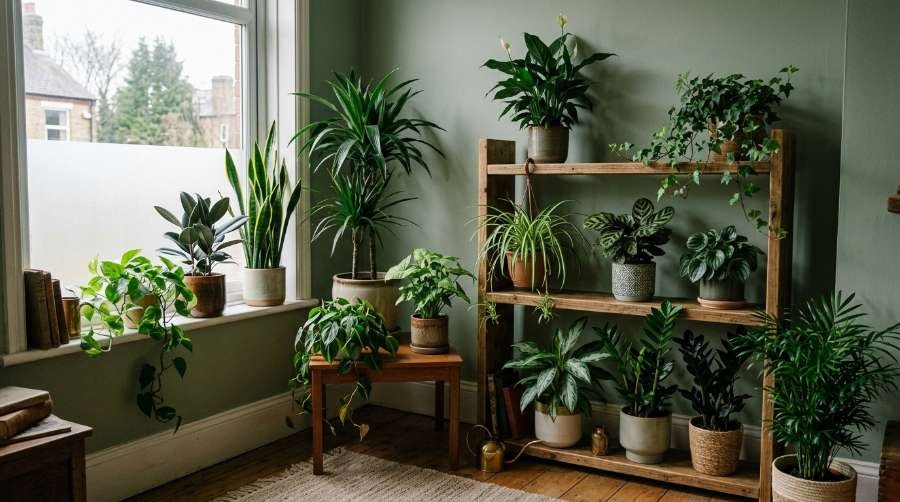
15 Houseplants That Thrive in Low Light
Each of these has genuine biological reasons for handling dim conditions well, along with one care note specific to keeping them in low light rather than bright rooms.
| Plant | Why It Handles Low Light | Care Note for Low Light Spots |
|---|---|---|
| Snake Plant | Thick, upright leaves store water and energy, reducing reliance on constant light | Water even less often than usual, growth slows significantly |
| ZZ Plant | Waxy leaves and underground rhizomes store water for lean periods | Extremely drought tolerant here, overwatering is the real risk |
| Chinese Evergreen | Patterned leaves evolved to capture filtered forest-floor light | Solid green varieties tend to tolerate lower light better than heavily variegated ones |
| Pothos | Fast-growing trailing vine adapted to low-light forest understories | Growth slows, and leaves may size down slightly compared to bright spots |
| Peace Lily | Broad, dark leaves suited to shaded conditions | Tolerates shade well but blooms far less without brighter indirect light |
| Dracaena (Janet Craig) | Dense, dark green foliage evolved for dim tropical understories | Prone to root rot in low light if watering isn’t scaled back |
| Cast Iron Plant | Extremely slow metabolism lets it persist on minimal light | Nearly indestructible, but expect very slow, steady growth |
| Parlor Palm | Naturally grows beneath a dense rainforest canopy | A classic low-light performer for hallways and offices |
| Calathea | Understory plant adapted to dappled, filtered light | Needs low light paired with higher humidity to really thrive |
| Philodendron | Heart-shaped leaves adapted to climb toward light gaps in shaded forests | Trailing varieties handle low light slightly better than climbing types |
| Peperomia | Small, thick leaves store water, reducing light dependency | Compact size makes it ideal for dim desks and shelves |
| Spider Plant | Adapts well to a range of light levels | Prefers brighter indirect light but tolerates low light reasonably well |
| Arrowhead Plant (Syngonium) | Naturally shade-adapted foliage | Leaf shape may stay more arrow-like rather than lobed in low light |
| English Ivy | Tolerates a wide range of indoor conditions | Variegated types may fade toward solid green in dimmer spots |
| ZZ Raven | Same water-storing structure as the standard ZZ, with dark purple-black leaves | Slightly slower to develop its deep color in very low light |
How Low Light Changes Plant Care
Placing a plant in a dimmer spot changes more than just how fast it grows. A few adjustments matter here.
- Watering: Plants use water more slowly when they’re photosynthesizing less, so overwatering becomes the top risk in low-light spots. Let soil dry out more between waterings than you would for the same plant in brighter conditions. Learn how to water correctly from this guide.
- Growth speed: Expect slower growth, smaller new leaves, and longer stretches between visible changes, even from genuinely tolerant species. This is normal, not a sign something is wrong.
- Fertilizing: Slower growth means lower nutrient demand. Feed low-light plants less often, and cut back or pause entirely during winter months when growth nearly stops. Follow this guide to learn details of fertilizer as a beginner.
- Watch for stretching: If a plant starts producing unusually long, thin stems reaching toward the nearest light source, that’s a sign it’s on the edge of what it can tolerate and could use a brighter spot.
Can You Improve a Low Light Spot?
If a space is borderline or a plant seems to be struggling, there are a few ways to boost the light it receives without moving to a different room entirely.
- Move it closer to the window: Light intensity drops sharply with distance, so even shifting a plant one or two feet closer to a window can meaningfully change what tier of light it’s receiving. The pot you choose affects how much light reaches the root zone and how quickly soil dries. Our Guide to ceramic pots for low-light houseplants helps you match pot type to your light conditions.
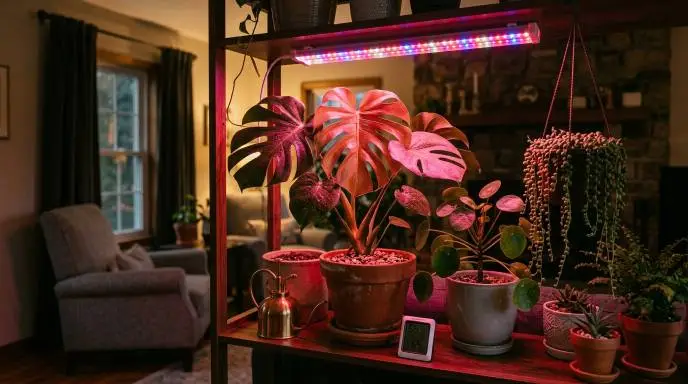
- Add a basic grow light: For rooms with no usable natural light at all, a simple full-spectrum LED grow light on a timer, running 12 to 16 hours a day, can sustain even plants that aren’t naturally low-light specialists. Learn about the best grow lights from this article.
- Rotate plants seasonally: If a spot is only low light during winter months, some growers rotate plants between a dimmer winter location and a brighter summer one rather than keeping them in the same place year-round.
Frequently Asked Questions
Is low light bad for plants?
Not inherently. Many species evolved specifically for low-light conditions and do fine there, though growth will generally be slower than in brighter spots.
What’s the difference between low light and no light?
Low light still provides enough usable brightness for photosynthesis, roughly 50 to 250 foot-candles. No light means true darkness, which no plant, regardless of species, can survive long-term.
Can low light plants live in a windowless room?
Some can, for a while, if the room has consistent artificial lighting such as office fluorescents or a lamp running several hours a day. Long-term, most still do better with either natural light or a dedicated grow light.
How do I know if my plant needs more light or if it’s fine in low light?
Watch for stretching, small pale new leaves, or a noticeable lean toward any light source. Steady, if slow, growth with normal-sized leaves usually means the plant is coping fine where it is.
Low light plants give you real options even in a dim apartment or a desk far from any window, as long as you match the species to the space and adjust watering and feeding once they’re there. For a full breakdown of indoor plant care, the complete indoor plant care guide covers that in more depth.