A few months ago, I walked past my kitchen window and noticed my pothos had started looking like a very sad, stringy version of its former self. Three feet of bare stem stretched between the soil and the first leaf. The leaves that remained were smaller than my thumb. I’d been watering it on schedule, giving it what I thought was plenty of light, and it was still slowly falling apart.
That’s how leggy growth gets most of us. Not all at once, but gradually, until one day you realize your once-full plant has turned into something that looks like it’s trying to escape the pot.
If that sounds familiar, you’re in the right place. This guide covers the five most common reasons plants become leggy, how to tell which one applies to your situation, and exactly what to do about it.
How to Fix Leggy Growth: The Quick Answer
If you just want the short version: fix leggy growth by moving the plant to brighter, indirect light and pruning back the stretched stems just above a node. Those two changes address the cause of legginess in the vast majority of cases. From there, the exact approach depends on what you’re growing:
- Move the plant closer to a bright, indirect light source, or supplement with a grow light if natural light isn’t enough
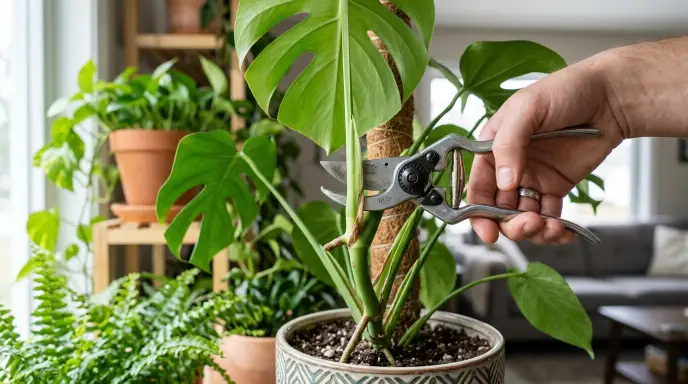
- Prune the stretched stems just above a node so the plant redirects energy into fuller, more compact new growth
- Adjust your fertilizer and watering habits if overfeeding or overwatering contributed to the problem
- Use a plant-specific fix for succulents, trailing vines, upright plants, or seedlings, since each responds differently
- Give it a full growing season, since new growth appears within a few weeks but a fully bushy shape takes longer
The sections below walk through each cause and fix in detail.
How to Tell If Your Plant Is Actually Leggy
Before you start pruning or rearranging your plant shelf, confirm you’re actually dealing with legginess and not just the plant’s normal growth habit.
Signs your plant is leggy:
- Long gaps between leaves along the stem (these gaps are called internodes, and they’ve stretched out)
- Thin, weak stems that flop over or need support to stay upright
- Leaves that are smaller and paler than they used to be
- A visible lean or “reach” toward a light source
- More bare stem than leaf coverage overall
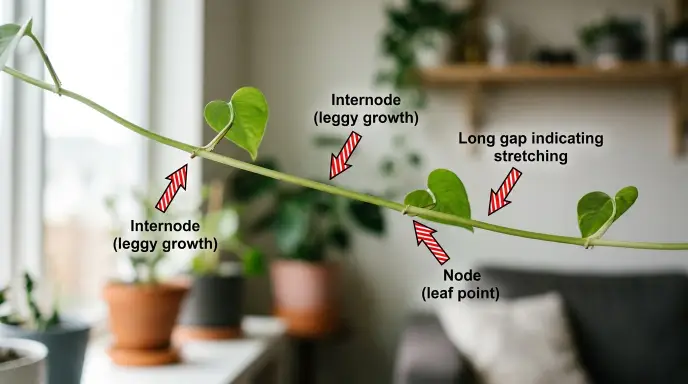
What legginess is not: some plants are simply tall by nature. Dracaena, yucca, and similar upright plants normally grow a bare trunk with foliage clustered near the top, and that’s just how they grow. Trailing plants like pothos naturally send out long vines with spaced-out leaves too. The real thing looks different: it shows up suddenly, or the stems are noticeably thinner and weaker than that plant’s normal growth.
If what you’re seeing doesn’t match this (spots, yellowing, wilting instead of stretching), you’re likely dealing with a different problem, not legginess.
Before you start pruning or rearranging your plant shelf, identify common houseplants from our Why are houseplants dying? sysmptomps guide.
The 30-Second Diagnosis: What’s Actually Causing It
Once you’ve confirmed the plant is leggy, figure out why. The fix depends on the cause.
Start here:
- Check the lean. If the plant is leaning or reaching toward a window, insufficient light is almost certainly the cause. If it’s stretching evenly in every direction with no lean, look at photoperiod (how many hours of light it gets each day) or fertilizer instead.
- Think back on recent changes. Did you move the plant? Add curtains or blinds? Is the season changing? Legginess can show up within two to three weeks of a change like this.
- Consider your feeding schedule. A high-nitrogen fertilizer paired with low light pushes the plant to grow quickly and weakly at the same time, which speeds up stretching.
Light deficiency is by far the most common cause of leggy growth. If you’re only going to check one thing first, check understanding your plant’s light needs. Leggy growth is often a light issue, but other problems can cause similar symptoms. How to Diagnose Indoor Plant Problems helps you distinguish between pests, diseases, and care mistakes.
Reason #1: Not Enough Light (The Most Common Cause)
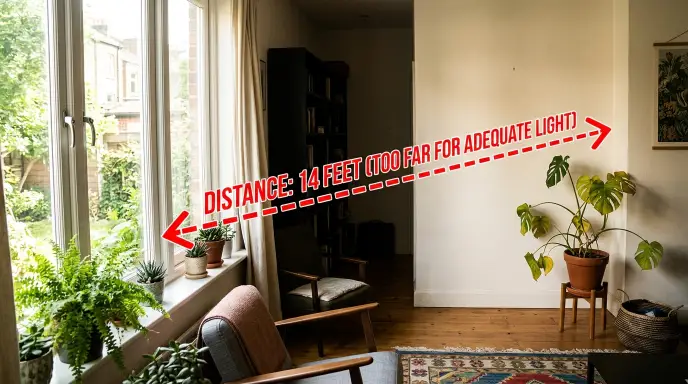
Most leggy growth starts here, so it’s worth understanding what’s actually happening inside the plant.
When a plant doesn’t get enough light, it produces more of a growth hormone called auxin, which speeds up cell elongation in the stem. In practical terms, the plant stretches itself upward and outward, betting it’ll find brighter light somewhere along the way. This is a real, documented response. For the full technical picture beyond this simplified version, a botanical source is worth checking.
Here’s what trips people up: light intensity matters more than light duration. A plant can sit in a spot that gets 16 hours of dim, gray daylight and still stretch, because the number of hours isn’t what matters most. What matters is how bright that light actually is where the plant sits.
Common light mistakes that lead to legginess:
- Placing the plant too far from the window (light intensity drops off fast with distance)
- North-facing windows, which get the least direct light of any exposure
- Sheer curtains or blinds that filter out a meaningful amount of light
- Seasonal shifts, since a spot that’s bright in summer can go dim by late fall
As a rough guide to light intensity, measured in lux:
| Light Level | Approximate Lux | What It Supports |
|---|---|---|
| Low light | Under 1,000 lux | Low-light tolerant plants only (snake plant, ZZ plant) |
| Medium light | 1,000 to 5,000 lux | Most common houseplants |
| Bright, indirect light | 5,000 to 10,000 lux | What most plants need for compact, non-leggy growth |
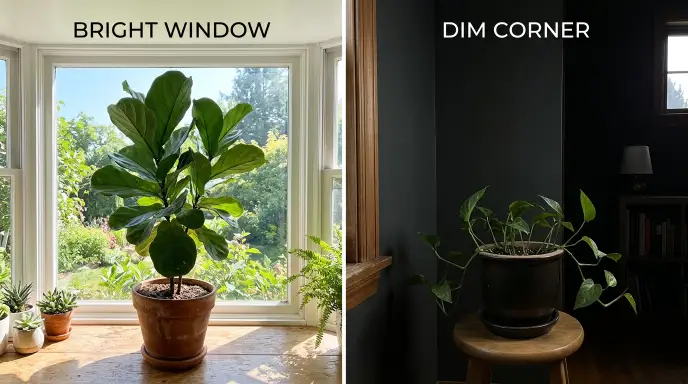
Treat these as broad approximations, not exact thresholds. A succulent needs far more light than a snake plant, so “enough” light depends heavily on what you’re growing. Use the table as a starting point, then check your specific plant’s needs. For precise numbers, a light meter or a phone light-meter app gives you a real reading for your space. Choosing the right grow light? Read our Grow light buying guide.
Reason #2: You’re Pruning Wrong (Or Not At All)
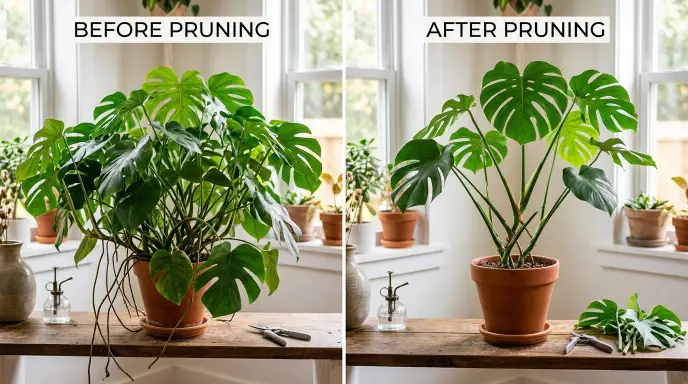
Here’s the part that stops a lot of beginners cold: the stretched-out stem your plant already has will never shrink back down. Once that section has grown long and thin, it stays that way for good. The only way to get a fuller-looking plant is to prune the leggy growth and let the plant produce new, more compact growth in its place.
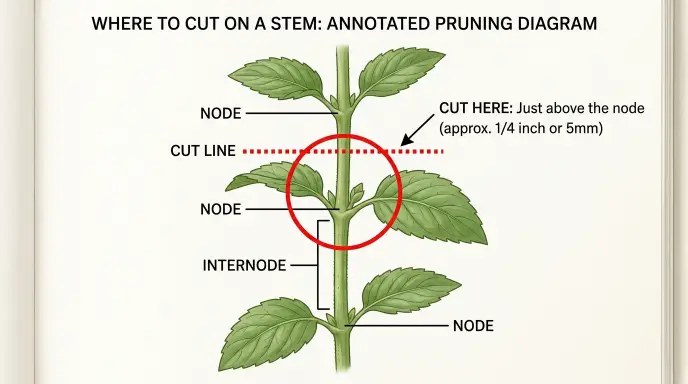
Cutting into a plant you’ve been nursing feels risky. It helps to understand why it works before you pick up the scissors.
Every stem has nodes, the small bumps or joints where leaves attach. Nodes contain meristematic tissue, a cluster of dormant growth cells waiting for a signal to activate. As long as the tip of the stem (the apical tip) is intact, it produces a hormone that suppresses those dormant nodes and keeps the plant growing mostly upward. Remove the tip, and that suppression goes away. The nodes below the cut wake up and start producing new side shoots. That’s the whole mechanism behind why pruning makes a plant fuller instead of smaller.
For vining houseplants with a healthy root system, you can often prune back quite hard. Some growers remove up to two-thirds of the plant’s growth in one session, though that figure is more aggressive than what many extension guides recommend, which tends to land closer to a third of the foliage at a time. If you’re attached to the plant, or unsure how it’ll respond, start with a more conservative cut, around one-third, and prune again later once you see new growth coming in.
How to prune:
- Use clean, sharp scissors or pruning shears (dirty blades can spread disease between cuts)
- Find a node on the stem
- Cut just above that node, angling the cut slightly rather than straight across
Hold off on fertilizing right after a hard prune. The plant is putting its energy into healing the cut and pushing new growth, and feeding it heavily at the same time can stress it rather than help it recover faster.
For seedlings and naturally bushy plants, pinching (removing just the growing tip with your fingers) is a gentler alternative to a full prune, and it triggers the same branching response on a smaller scale.
Common questions on this:
- Will cutting my plant kill it? For most common houseplants, no, not when it’s done correctly. Cut just above a node with clean tools on a plant that’s otherwise healthy and has a working root system, and it’s safe. Some species are more sensitive to hard pruning than others, so if you’re not sure how yours handles it, start light.
- Can I fix legginess without cutting? Not really. Staking a leaning stem holds it upright, but it doesn’t undo the stretching. For most plants, pruning is the actual fix.
Reason #3: The Wrong Environment (Temperature, Water, and Airflow)
Light and pruning solve most cases, but a few environmental factors can cause the problem on their own or make it worse.
Temperature:
Warmth generally promotes faster, more upward growth, which is part of why overly warm rooms contribute to legginess. After germination, most seedlings do better in slightly cooler temperatures than they needed to sprout, generally somewhere in the 60 to 70°F range during the day with cooler nights. That range shifts by species, though: tomatoes and peppers prefer it warmer, closer to 70 to 75°F, while cool-season crops like broccoli do better on the cooler end or below it. The principle holds across most plants: excessive warmth without enough light is what pushes weak, stretched growth. If a plant is stretching in a warm room, check the light situation first. Read our guide to know how much light plants need.
Watering:
Overwatering softens stem tissue and limits healthy root development, and a weak root system makes it harder for a plant to support compact, sturdy growth. Water from the base of the pot and let the top layer of soil dry out somewhat between waterings to encourage stronger stems. Read our guide to watering your houseplants correctly.

Airflow:
This one surprises a lot of beginners. Plants that get gentle physical movement, like a breeze or being brushed against, grow measurably sturdier stems as a mechanical response, sometimes called thigmomorphogenesis. The key word is gentle: a small fan on its lowest setting, positioned to create just a light sway rather than a steady blast, run for an hour or two a day works well. Gently brushing your hand over seedlings once daily has a similar effect. Strong or constant airflow can dry plants out or stress delicate seedlings, so aim for light stimulation, not wind exposure.

Spacing:
Seedlings grown too close together compete for the same light and stretch toward it. Thin them out early so each plant has its own space, and that competition goes away.
Reason #4: You’re Overfeeding (Fertilizer Mistakes)
A common misconception is that fertilizer can fix a leggy plant. It can’t, and in the wrong circumstances it makes things worse.
Fertilizer doesn’t compensate for a lack of light. If a plant isn’t getting enough light, feeding it more won’t change that. What fertilizer does do is accelerate growth, and a high-nitrogen fertilizer in particular pushes rapid leaf and stem production. Combine that with low light, and you get exactly the fast, weak stretching that defines legginess.
A few practical adjustments:
- Use a balanced fertilizer rather than a high-nitrogen one, and feed at a light, diluted strength.
- Feed only during the plant’s active growing season (typically spring through summer for most houseplants).
- Reduce or stop feeding in winter, when most plants slow down naturally.
Read our guide to learn about balanced fertilizer for houseplants. Also read, fertilizing best time.
Reason #5: Your Plant Type Needs a Different Approach
Not every leggy plant gets fixed the same way. The right move depends heavily on what kind of plant you’re dealing with.
Leggy Succulents
Succulents need direct, fairly intense sun, so when one gets leggy, it usually signals fairly severe light deficiency. Unlike some other plants, a stretched succulent stem is permanent. No pruning cut brings that section back to a compact form. If what you’re seeing doesn’t match this—spots, yellowing, or wilting instead of stretching—you’re likely dealing with a different problem. Our guide to houseplant pest control covers exactly how to identify and treat pest-related issues.
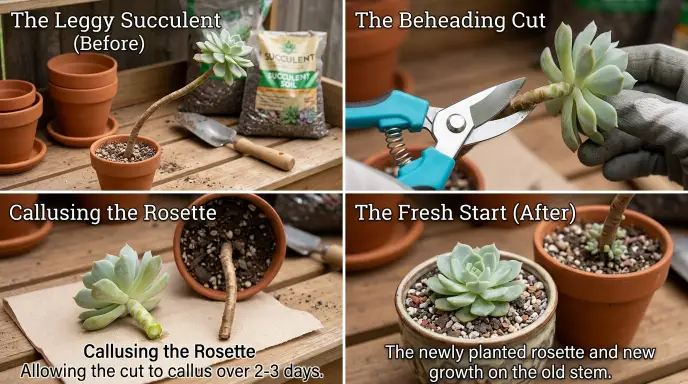
The fix is a process called beheading: cut off the top rosette, set the cut end somewhere dry and out of direct sun for two to three days so it calluses over, then plant the callused end in soil. It’ll root and grow into a new, more compact plant. The original stem left behind may also produce new growth from its base, depending on the species.
Leggy Trailing Plants (Pothos, Philodendron, Tradescantia)
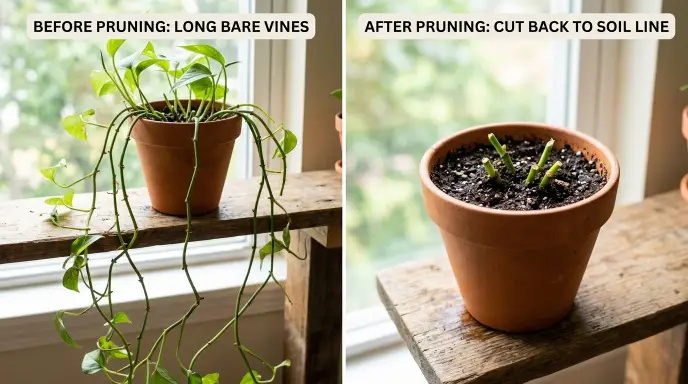
These respond well to a fairly aggressive prune. Cut the vines back to about 4 to 6 inches (10 to 15 cm) above the soil line.
Don’t throw away what you cut off: trailing plants root easily from stem cuttings placed in water, especially at the nodes, so you can propagate new plants from the leggy growth you removed.
Leggy Upright Plants (Dracaena, Yucca, Corn Plant)
Cut the main stem down to whatever height you want the plant to be. New side shoots typically emerge below the cut within a few weeks, giving the plant a fuller, more branched shape than it had before.
Leggy Seedlings (Tomatoes, Peppers, Herbs)
Seedlings that stretch too early need a different approach than mature houseplants.
For tomatoes, peppers, and other plants in that family (along with brassicas like broccoli and cabbage, and leeks), deep planting is an effective fix:
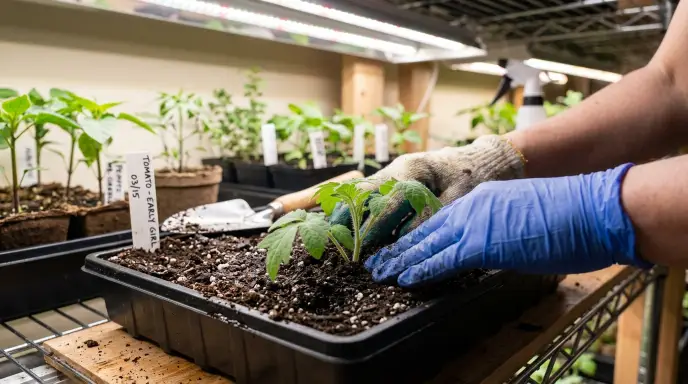
Bury the stem up to the lowest set of leaves when you transplant it. The buried stem grows roots along its length, which stabilizes a leggy seedling and gives it a stronger root system overall.
This doesn’t work for every seedling, though. Many herbs and flowering plants are sensitive to having their stem buried and may rot rather than root, though this varies by species (basil, for instance, often tolerates deeper planting better than more delicate herbs do). If you’re not sure whether a specific plant tolerates deep planting, check a source specific to that species before trying it.
For ongoing prevention, pinch the growing tips of seedlings every two to three weeks to encourage branching and keep growth compact from the start. Leggy growth is often a light issue, but other problems can cause similar symptoms. How to Diagnose Indoor Plant Problems helps you distinguish between pests, diseases, and care mistakes.
If Your Plant Doesn’t Fit These Categories
Most houseplants outside of the four groups above still respond to the same basic approach: improve the light first, then prune the stretched growth back to a node once you see the plant is getting enough light going forward. The general mechanism (better light plus a strategic cut) works across the vast majority of common houseplants, even ones not specifically named here. If you’re unsure how your specific plant handles pruning, look up care guidance for that species before making a hard cut.
The Grow Light Paradox: Why Plants Stretch Even With Lights
This one confuses a lot of people, understandably. You bought a grow light to fix the light problem, and the plant is still stretching. Here’s what’s usually going on.
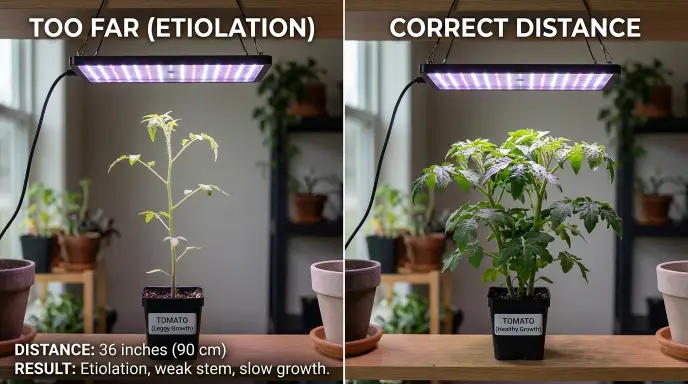
- The light is too far away. This is the most common cause of stretching under a grow light. Light intensity doesn’t drop evenly with distance, it falls off sharply the farther you move from the source (the inverse square law, if you want the technical term). A light that looks bright from a foot away can be providing very little usable intensity by the time it reaches a plant two or three feet below it.
- Not enough hours. Seedlings generally need around 14 to 16 hours of light per day, mature plants typically need 12 to 14. If the light runs on a shorter cycle than that, the plant may not get enough total exposure even when the intensity is fine.
- Wrong spectrum. Blue light, roughly in the 400 to 500 nanometer range, tends to suppress stretching, while red-heavy light without enough blue can encourage it. For exact spectrum recommendations on a specific grow light product, check the manufacturer’s specs or a horticultural lighting source rather than treating this as a precise rule.
- Uneven coverage. Plants at the edge of a light’s coverage area get less intensity than plants directly underneath it, and may stretch toward the brighter center.
The fix in most cases is straightforward: move the light closer, increase the daily hours, and confirm the spectrum is suited to plant growth rather than general room lighting. Read our guide on setting up grow lights properly.

How Long Will This Take? Realistic Timelines
Here’s what trips people up even after they’ve made all the right changes: recovery isn’t instant.
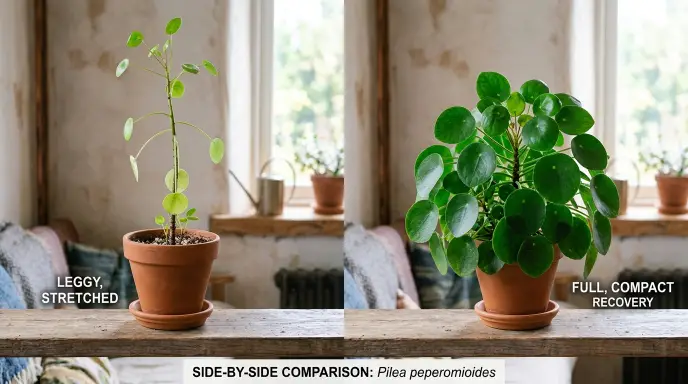
- New growth: Expect compact, healthier new growth within two to three weeks of fixing the light and pruning the leggy sections.
- Full recovery: Getting the plant back to a genuinely full, bushy shape usually takes a full growing season, not a few weeks.
- Right after pruning: The plant looks sparser than before for a while. That’s expected, not a sign something went wrong.
I pruned a leggy pothos that had been stretching across my kitchen window for months, half convinced I’d ruined it. It looked bare and a little sad for about three weeks. Then new growth filled in at nearly every node I’d cut above, and within a season it was fuller than it had ever been.
When to Give Up (And What to Do Instead)
Most leggy plants can be saved, but not always. It helps to know the difference before you spend weeks trying to rescue something better off restarted.
You can probably save it if:
- The stems are still firm rather than mushy or paper-thin
- There are healthy leaves somewhere on the plant, even if sparse
- You caught the legginess relatively early
It might be time to start over if:
- The stems are so thin they can’t support their own weight even with staking
- The plant has lost nearly all its lower leaves
- A succulent is so severely stretched that beheading would leave almost nothing usable behind
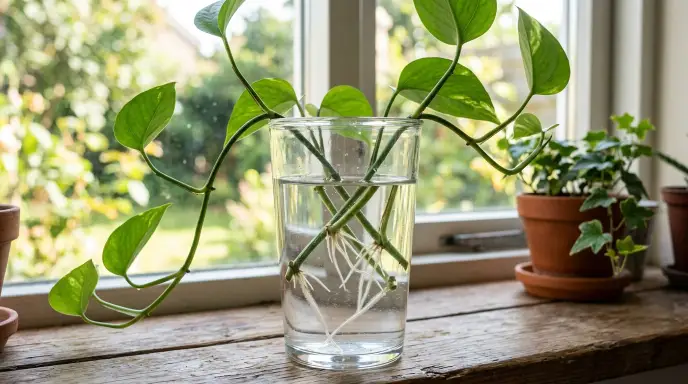
There’s a middle path that beats both fully saving and fully discarding the plant: propagation. Take cuttings from whatever healthy sections remain and root them, in water or soil depending on the species. You end up with fresh, compact new plants, often ones that look better than the original did before it got leggy.
How to Prevent Leggy Growth From Coming Back
Fixing the current problem doesn’t guarantee it won’t happen again, especially if the underlying light situation hasn’t actually changed. A few habits keep new growth compact once you’ve dealt with the stretched stems:
- Keep the plant in the brighter spot you moved it to; don’t drift it back toward a dimmer corner once it looks healthy again
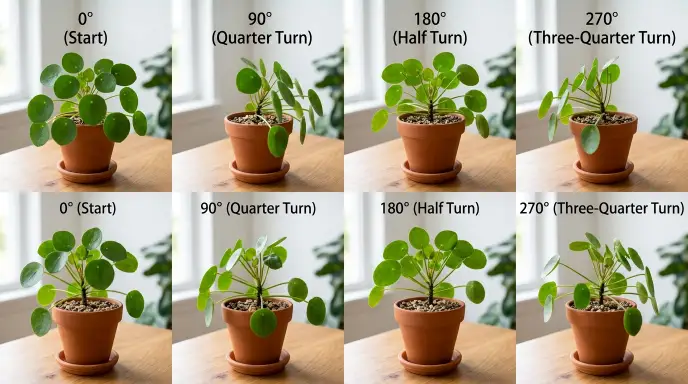
- Rotate the plant every week or two, so it grows evenly instead of leaning and stretching toward one side
- Prune lightly on a regular schedule (pinching growing tips every few weeks) rather than waiting for the plant to get leggy again before cutting
- Reassess the light in that spot each season, since a window that’s bright in summer can be noticeably dimmer by fall or winter
Read our guide on seasonal plant care to know how to care for plants in summer.
Frequently Asked Questions
Can leggy plants recover?
The existing stretched stems won’t shrink back, but pruning combined with better light restores a full look through new, compact growth.
What’s the fastest way to fix a leggy plant?
Move it to brighter, indirect light and prune the stretched stems just above a node. Those two changes address the cause in most cases, and you’ll typically see new growth within two to three weeks.
Why are my plants leggy even with grow lights?
Usually one of three things: the light sits too far from the plant, it’s not running enough hours per day, or the spectrum isn’t well suited to plant growth.
How close should grow lights be to seedlings?
A commonly cited range is 2 to 4 inches for LED lights during the first couple of weeks, though this varies by the light’s strength, so check the manufacturer’s guidance where possible.
Can overwatering cause leggy growth?
It can contribute to it. Overwatering softens stem tissue and limits root development, both of which make a plant more prone to weak, stretched growth.
Should I cut off leggy growth?
In most cases, yes. Stretched stems don’t shrink back on their own, and cutting just above a node triggers new growth from that point rather than harming the plant.
How do I stop my plant from getting leggy again?
Keep it in consistently bright, indirect light, rotate it regularly so it grows evenly, and prune lightly on an ongoing basis instead of waiting until it stretches again.
What is etiolation?
The scientific term for leggy growth: a plant’s stretching response to insufficient light.
The Bottom Line
Leggy growth almost always comes down to a light problem, solved with a pruning fix and sometimes a few environmental adjustments layered on top. It’s common, and it’s fixable in nearly every case if you’re patient with the recovery.
Diagnose the cause, apply the fix that matches your plant type, and give it a full growing season before judging the results.
If you want to know complete plant care tips, read our indoor plant care guide for beginners.