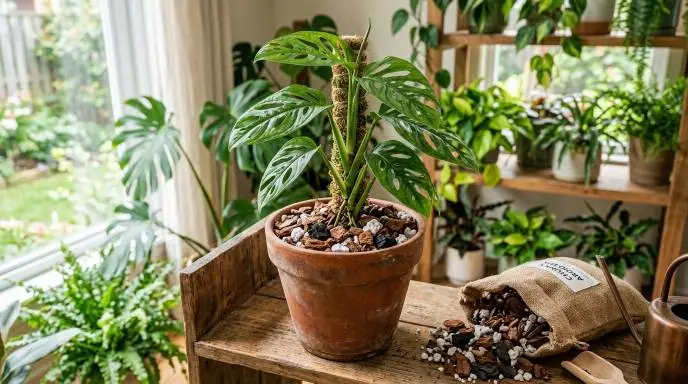
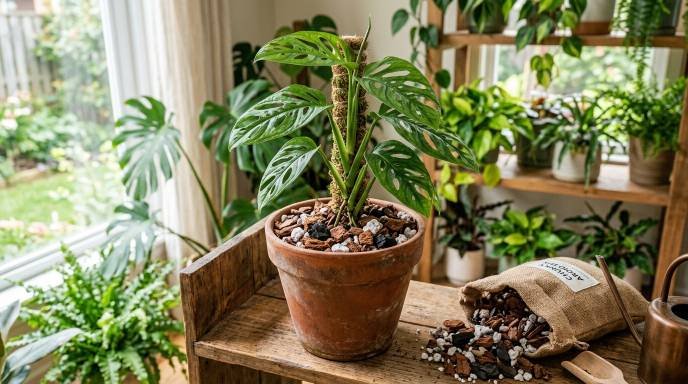
A chunky aroid mix needs roughly 40% to 50% aeration material (orchid bark and perlite) and 50% to 60% moisture-retaining base like coco coir. The standard home ratio is 3 parts orchid bark, 2 parts coco coir, 2 parts perlite, 1 part horticultural charcoal, and 1 part worm castings.
That ratio alone won’t tell you why it works, or how to adjust it when your Anthurium and your Pothos clearly don’t want the exact same mix. This guide covers both, and builds on the base formula from our DIY Indoor Potting Mix guide — chunky aroid mix is really just that same recipe, reshaped for aroids specifically. For the bigger picture on keeping any indoor plant healthy, see our Complete Beginner’s Guide to Indoor Plant Care.
My first Monstera sat in regular potting soil for six months, roots slowly rotting in silence, until I finally repotted it into bark and perlite. New roots showed up within two weeks. I haven’t touched standard potting soil for an aroid since.
What Is Chunky Aroid Mix? (Quick Answer)
Chunky aroid mix is a well-draining, airy growing medium built to copy how aroids actually grow in the wild: loosely rooted in decomposing bark and leaf litter, not packed into dense soil.
- Aeration material (orchid bark, perlite): roughly 40-50% of the mix.
- Moisture-retaining base (coco coir): roughly 50-60% of the mix.
- Goal: airflow around the roots, not water retention as the top priority.
Why Aroids Need a Chunky Mix in the First Place
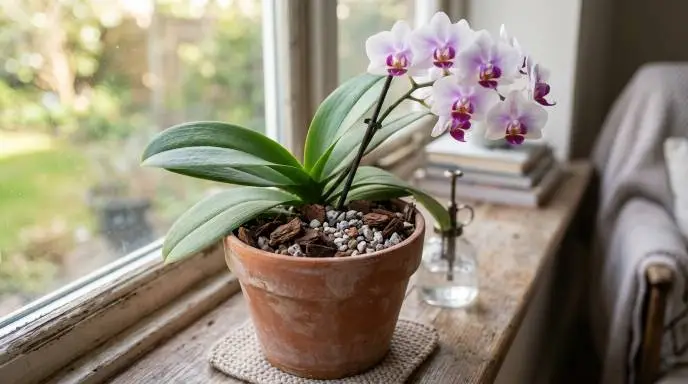
Most popular houseplant aroids (Monstera, Philodendron, Pothos, Anthurium) aren’t ground-rooted plants by nature. In the wild, they grow as epiphytes or hemi-epiphytes:
- Their roots anchor into loose bark, leaf litter, and crevices in tree bark.
- Air moves freely around the roots almost constantly.
- Water drains away fast after rain instead of pooling.
Standard potting soil does the opposite of all three. It packs down tightly around aroid roots, cuts off the oxygen those roots evolved to expect, and holds water far longer than a bark-based environment ever would. That combination is exactly what sets up root rot, which is why “regular soil” is one of the most common reasons aroid houseplants struggle indoors. If you’re already seeing soggy, slow-draining soil, our guide to fixing poor soil drainage covers the fix in more depth.
Every ingredient in a chunky mix exists to recreate that natural, airy environment.
Essential Ingredients and What Each One Actually Does
Orchid Bark
Creates large, irregular air pockets throughout the mix. It breaks down slowly, which is what keeps a chunky mix chunky for a year or more instead of collapsing into dense soil after a few months.
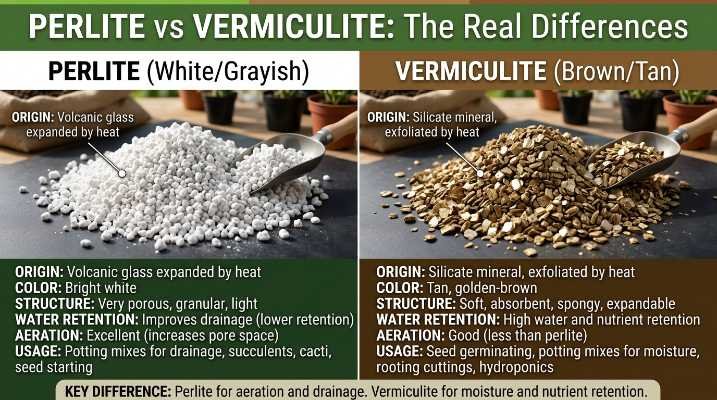
Perlite or Pumice
Both add drainage and lightness, but they’re not identical:
- Perlite is cheaper and widely available, but can float to the surface over time. Know about sterilize perlite from this article.
- Pumice is denser, won’t float, and holds up better long-term, though it’s often pricier and harder to find locally.
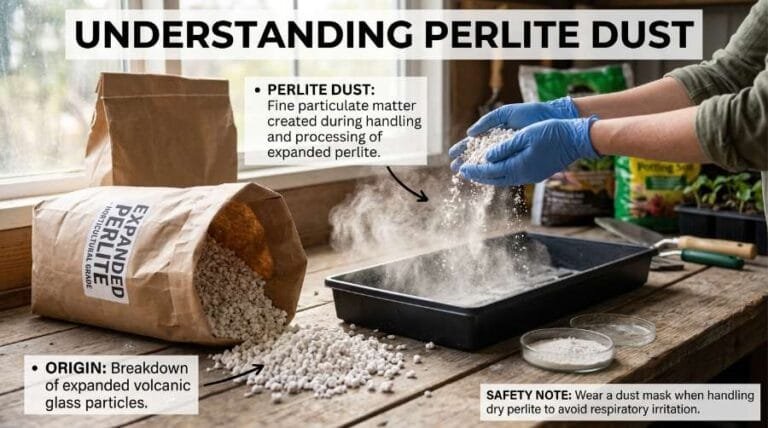
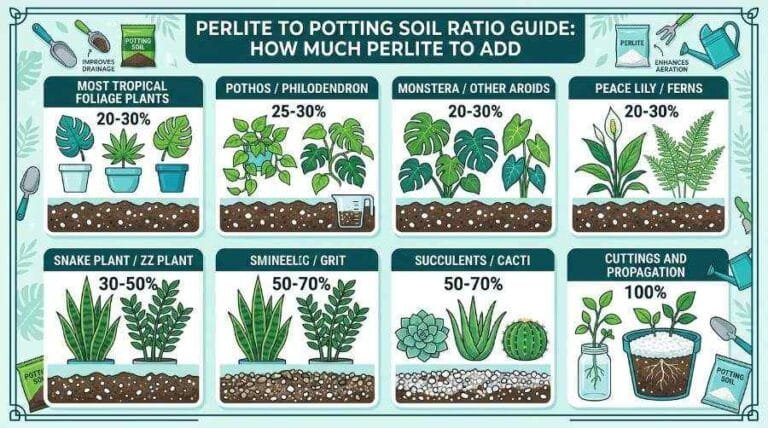
Handling dry perlite kicks up fine dust worth knowing about. See our breakdown of whether perlite dust is safe to breathe and how to handle it without irritation. Also see how to add perlite in potting soil
Coco Coir or Peat Moss
The moisture-holding base of the mix. Without it, a mix of pure bark and perlite would dry out too fast for most aroids to handle comfortably between waterings. If you’re deciding which one to use, our full coco coir vs. peat moss comparison breaks down the pH, nutrient, and structural differences between the two.
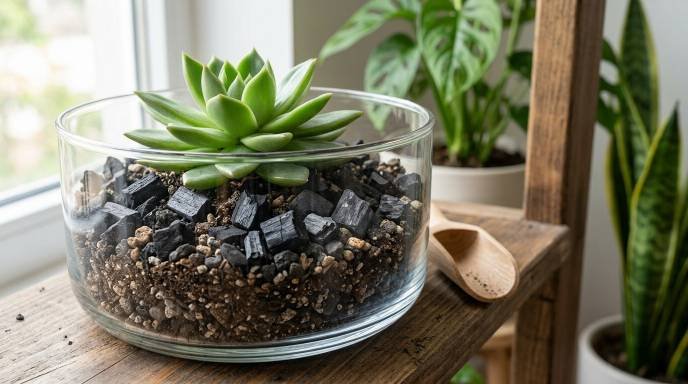
Horticultural Charcoal
Helps filter out impurities and reduce odor that builds up from occasional overwatering. Especially useful for plants that are prone to root issues.
Worm Castings
A gentle, slow-release source of nutrition. Unlike synthetic fertilizer, worm castings carry very little risk of burning roots even if you’re not precise with the amount.
The Standard Chunky Aroid Mix Recipe
| Ingredient | Parts | Purpose |
|---|---|---|
| Orchid bark | 3 | Air pockets, structure |
| Coco coir | 2 | Moisture retention |
| Perlite or pumice | 2 | Drainage, lightness |
| Horticultural charcoal | 1 | Filters impurities, reduces odor |
| Worm castings | 1 | Slow-release nutrition |
A “part” can be any consistent measurement, like a cup, a scoop, or a bucket, as long as you use the same one across all five ingredients.
Step-by-Step: How to Mix It
- Measure 3 parts orchid bark into a large tub or bucket.
- Add 2 parts coco coir, pre-rehydrated first if you’re using a compressed brick.
- Add 2 parts perlite or pumice, lightly dampened beforehand to cut down on dust
- Mix in 1 part horticultural charcoal.
- Blend in 1 part worm castings last, so it doesn’t clump before everything else is combined.
- Combine everything by hand until the color and texture look even, with no dry pockets or dense clumps.
- Moisten the finished mix slightly with water before potting. This settles everything and reduces dust while you work.
What Happens If Your Ratio Is Off
Too Chunky (Too Much Bark and Perlite)
- Dries out much faster than expected, meaning more frequent watering.
- Smaller or younger plants may not get consistent enough moisture to establish well.
Too Dense (Too Much Coir, Not Enough Aeration)
- Stays wet for too long, raising the risk of root rot.
- Undoes the entire point of switching to a chunky mix in the first place.
If you’re ever unsure which way to lean, err slightly chunkier and water more often. A too-dense mix is far more likely to cause root damage than a too-airy one.
Adjusting the Ratio by Plant Type
Monstera and Philodendron
The standard ratio works well as-is. Both are fairly forgiving of minor variation in the mix.
Anthurium
Add an extra half part of bark. Anthurium roots are especially sensitive to sitting in moisture, so leaning chunkier gives them the drainage margin they need.
Hoya
Lean chunkier overall and reduce the coco coir slightly. Hoyas are semi-succulent and prefer to dry out more between waterings than most other aroids.
Smaller or Younger Plants
Use slightly less bark and slightly more coir. Smaller root systems dry out faster in an overly chunky mix, since they don’t have the root mass to reach deeper moisture.
Where to Buy the Ingredients
- Perlite and coco coir: widely available at general garden centers and hardware stores.
- Orchid bark and horticultural charcoal: less commonly stocked at general retailers. More reliably found at nurseries specializing in orchids or houseplants, or through online plant-supply retailers.
- Worm castings: available at most garden centers, usually near the compost and soil amendment section.
If you mix your own soil regularly, bark and charcoal are the two ingredients worth ordering online in bulk, since they’re the hardest to find locally and the most likely to run you back and forth between stores.
How Long Does Chunky Mix Last Before Refreshing?
- Orchid bark and charcoal break down slowly, often lasting 1 to 2 years before needing replacement.
- Coco coir and worm castings break down faster and typically need topping up or refreshing at each repot.
Signs it’s time to refresh the mix:
- Water drains noticeably slower than it did when the plant was first potted.
- The mix has visibly compacted or lost its original chunky texture.
- Bark pieces have broken down into finer, soil-like particles.
FAQs
What is the best ratio for chunky aroid mix?
The standard, widely used ratio is 3 parts orchid bark, 2 parts coco coir, 2 parts perlite, 1 part horticultural charcoal, and 1 part worm castings, adjusted slightly depending on the specific plant.
Can I use regular potting soil instead of chunky mix?
It’s not recommended for most aroids. Regular potting soil compacts too densely around aroid roots, cutting off the airflow they need and increasing the risk of root rot. Know about best perlite potting mixes in this guide.
How often should I water plants in chunky mix?
Chunky mix dries out faster than standard potting soil, so most aroids in this mix need watering more frequently. Check by feel rather than a fixed schedule, since exact timing depends on pot size, light, and humidity. Our guide on how to check soil moisture without a meter covers three quick ways to test before you water.
Is chunky mix necessary for all houseplants?
No. Chunky mix is specifically suited to aroids and other plants adapted to grow in loose, airy material. Plants adapted to denser soil, like many ferns, generally do better in a standard or moisture-retentive mix instead.
Can I make chunky mix without orchid bark?
Bark is difficult to fully substitute because it’s the primary source of structural integrity and long-lasting air pockets. In a pinch, additional perlite or pumice can partially compensate, but the mix won’t hold its chunky texture nearly as long.
Key Takeaways
- Standard ratio: 3 parts orchid bark, 2 parts coco coir, 2 parts perlite, 1 part charcoal, 1 part worm castings.
- Chunky mix mimics how aroids grow naturally, prioritizing airflow over water retention.
- Adjust the ratio slightly by plant. Anthurium and Hoya both benefit from leaning chunkier than the standard recipe.
- Refresh bark and charcoal every 1-2 years; coir and worm castings break down faster and need topping up sooner.
Perlite or pumice which one is best? Learn from this guide.