Looking for the best self-watering pots 2026? If you’ve ever returned from a week away to a crispy fern or drowned a peace lily out of sheer good intentions, you already know why these systems are absolute game-changers. Self-watering pots solve the watering dilemma. Know about overwatering vs. underwatering in this guide.
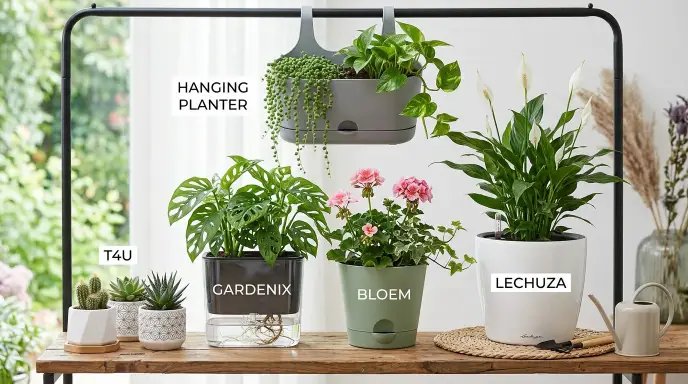
Based on manufacturer specs, verified owner reviews, and published comparisons, our top overall pick is the Gardenix Decor Self-Watering Pots (3-Pack)—thanks to its elevated inner pot, crystal-clear water-level indicator, and reliable 10-to-14-day refill window. For a budget-friendly alternative, the Bloem Ariana Self-Watering Planters deliver exceptional value, while the premium Lechuza Classico and Cubico justify their higher price tag with superior durability and sleek, long-lasting designs.
In this comprehensive buying guide, we break down every top-performing planter on Amazon right now, explain all five types of self-watering mechanisms, reveal which indoor plants thrive best, and share a foolproof buying guide to help you choose the right system without wasting a dime. (Just remember to double-check current Amazon listings, as prices and availability shift frequently). If you’re still deciding between terracotta, plastic, ceramic, and self-watering styles, start with our full guide: Best Indoor Plant Pots for Beginners in 2026. Self-watering pots work best with the right soil. Know about the best potting soil for indoor plants.
How We Chose These Picks
This roundup is built from manufacturer specs, published comparisons, and patterns across thousands of verified owner reviews for each planter — not an in-house lab test. We evaluated each product against five practical criteria that matter most for everyday use.
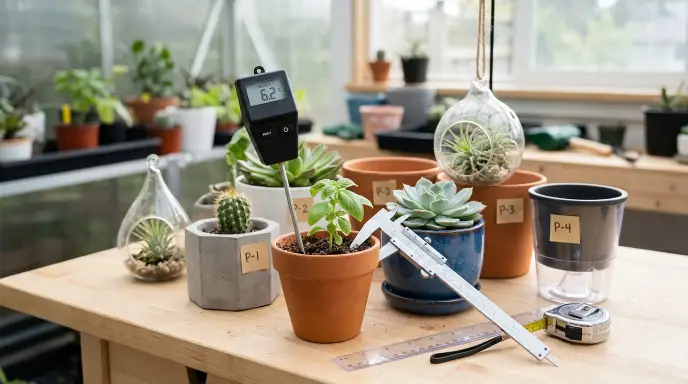
What we compared:
- Water Retention: How consistently each system is reported to keep soil moisture steady between refills, based on owner feedback for water-loving plants like Monstera and Peace Lily. You can track this yourself with a digital moisture meter.
- Wicking Efficiency: The wicking mechanism type (rope, ceramic cone, or capillary mat) and how prone it is to clogs or mineral buildup over time, per manufacturer info and owner reports. Well-aerated soil important for self-watering systems to wick properly. Learn how much perlite to add to potting soil for well-aerated soil.
- Refill Window: How many days each pot is reported to sustain healthy moisture before the reservoir runs dry. Top-rated models commonly deliver a 10-to-14-day window per owner reports, making them a good fit for busy plant parents.
- Root Health: Whether the design (elevated inner pot vs. plain reservoir) is built to keep roots from sitting directly in standing water, which is the main mechanism by which a poorly designed system can cause root rot.
- Algae & Mold Resistance: Opaque reservoirs (vs. clear plastic) are well-documented to resist algae growth better, since algae needs light to grow — a factor worth checking regardless of material.
Each product below is scored using manufacturer specs, published comparisons, and patterns across verified owner reviews — not a single source alone.
Quick Comparison: Top Self-Watering Pots on Amazon
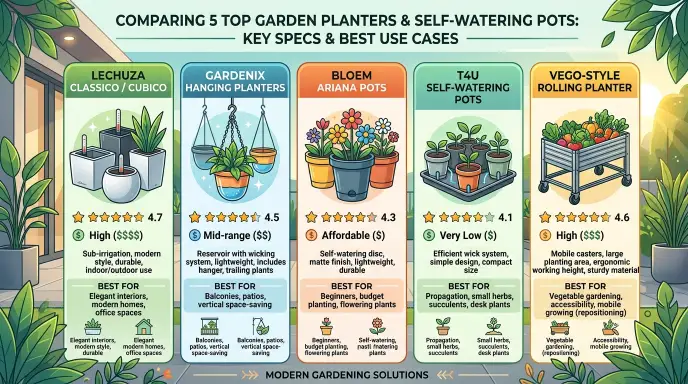
| Product | Best For | Price Range | Rating | Key Feature |
|---|---|---|---|---|
| Gardenix Decor (3-Pack) | Best overall | $20–27 (3-pack) | ~4.5★ (4,000+ reviews) | Elevated inner pot + water-level indicator |
| Bloem Ariana | Best budget | $6–50+ (by size) | ~4.4–4.5★ | Self-watering disk, UV-resistant resin |
| Lechuza Classico / Cubico | Best premium | $45–260+ (by size) | ~4.5–4.7★ | Precision float indicator, frost/UV-resistant |
| T4U Self-Watering Pots | Best value multi-pack | $20–45 (multi-packs) | ~4.4–4.7★ | Clear side window, dual-wick system |
| Gardenix Hanging (or similar) | Best hanging option | $20–40 | Varies | Reservoir built for trailing plants |
| Vego-style rolling planters | Best for vegetables | $80–150+ | Varies | Deep reservoir, rolling base |
Top Self-Watering Pots 2026 – Reviews & Pros/Cons
Here are our top picks for the best self-watering pots 2026 has to offer, compared on water retention design, wicking efficiency, build quality, and overall value. We’ve also added transparent Pros & Cons for every product to help you decide at a glance.
1. Best Overall: Gardenix Decor Self-Watering Pots (3-Pack)

This 3-pack is a safe starting point for most houseplants, with consistently high ratings for effectiveness, durability, and value across thousands of verified purchases. The elevated inner pot and crystal-clear indicator make it a foolproof choice for beginners and experienced plant parents alike.
Why it earned the top spot:
- Elevated inner pot keeps roots safely out of standing water—critical for preventing root rot.
- Clear water-level indicator removes all guesswork.
- Durable polypropylene resists leaks, cracks, and fading.
- Coco coir pellets included for better aeration and moisture distribution.
- Most users report a reliable 10–14 day refill window for typical indoor plants.
| Specification | Details |
|---|---|
| Typical Price | $20–27 for the 3-pack (~$7–9 each) |
| Size Range | Commonly 5–7-inch pots |
| Material | High-quality polypropylene (PP) |
| Colors | White, gray, terracotta, teal, purple |
| Amazon Rating | Usually 4.5 stars from 4,000+ reviews |
| Hanging Version | ~$20–25 (approx. 11 inches) |
Pros ✅
- Excellent value for a 3-pack with premium features.
- Elevated inner pot with legs ensures roots never sit in water.
- Clear, easy-to-read water-level indicator.
- Coco coir pellets included—saves you buying extra soil amendments.
- Lightweight yet durable for indoor/outdoor use.
Cons ❌
- Plastic feels slightly thin compared to heavy ceramic or resin planters.
- Colors may fade slightly if placed in direct, harsh sunlight for extended periods.
- Smaller 5–7-inch sizes may not suit large, deep-rooted plants.
Self-watering pots can create conditions ideal for fungus gnats. Learn why self-watering pots attract fungus gnats and how to prevent it.
2. Best Budget / Everyday Workhorse: Bloem Ariana Self-Watering Planters
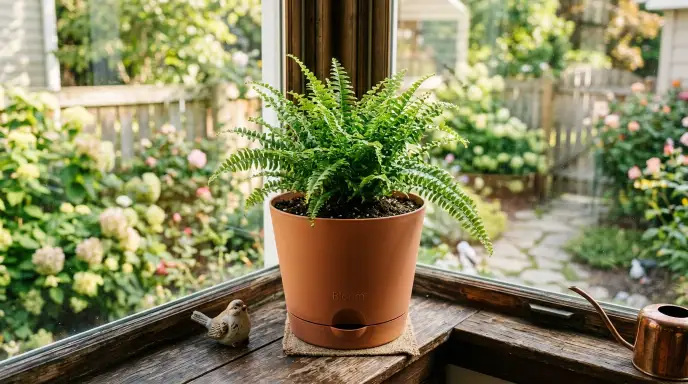
If you need several pots without breaking the bank, the Bloem Ariana delivers exceptional value. It holds up well indoors and on covered patios, making it a versatile workhorse for any plant collection.
Why it’s a top budget pick:
- Thick UV-resistant resin withstands outdoor conditions.
- Built-in self-watering disk creates a hidden reservoir.
- Optional knockout drainage holes provide outdoor flexibility.
- Wide range of sizes and colors at budget-friendly prices.
| Specification | Details |
|---|---|
| Typical Price | 6-inch: $6–12 / 8-inch: $10–16 / 10–12-inch: $15–30 / 16–20-inch: $30–50+ |
| Material | Durable plastic resin/polypropylene |
| Special Features | Self-watering disk/grid, UV-resistant, sealed bottom for indoor use, optional knockout drainage holes |
| Amazon Rating | Typically 4.4–4.5 stars |
Pros ✅
- Unbeatable price point—among the cheapest reliable self-watering planters on the market.
- UV-resistant resin won’t crack or fade quickly in sunlight.
- Knockout drainage holes let you convert to traditional outdoor pots.
- Wide color and size variety to match any decor.
Cons ❌
- Water-level indicator is less precise—no float, just a general reservoir disk.
- Plastic can warp slightly in extreme heat (above 90°F).
- Smaller sizes (6-inch) have a tiny reservoir, requiring more frequent refills.
3. Best Premium: Lechuza Classico or Cubico
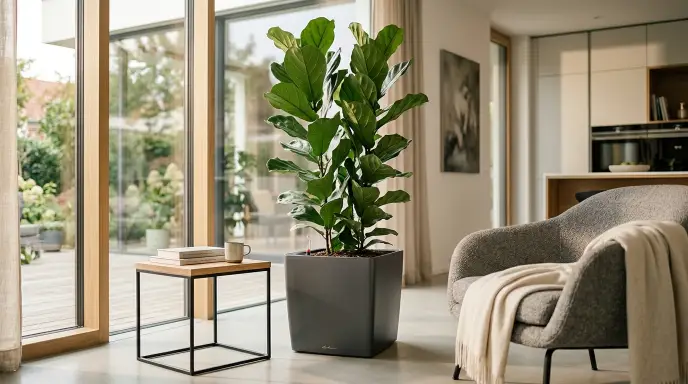
Lechuza is the gold standard for sub-irrigation planters. The higher price is justified by German engineering, superior materials, and a float-style indicator that is clearer and more reliable than anything in the budget tier.
Why it’s worth the premium:
- Precise float-style water-level indicator—no guessing.
- High-quality German engineering with impeccable build tolerances.
- Excellent sub-irrigation system promotes deep, healthy root growth.
- Long-lasting UV- and frost-resistant plastic—built to last for years.
- Reservoirs often last 1–2 weeks or longer, even for thirsty plants.
| Specification | Details |
|---|---|
| Typical Price | Classico 21 (~8-inch): $45–65 / Cubico 30: $50–120 / Cubico 40 (tall): $150–260+ / Balconera (window-box): $40–80 |
| Material | High-quality polypropylene (frost- and UV-resistant) |
| Planter Form | Classico = round / Cubico = square/cubic / Balconera = rectangular |
| Special Features | Float-style water-level indicator, removable liner, drainage plug, LECHUZA-PON substrate option |
| Amazon Rating | Usually 4.5–4.7 stars |
Pros ✅
- Float indicator is the most accurate on the market—no second-guessing.
- Removable inner liner makes repotting effortless.
- Frost- and UV-resistant—safe for year-round outdoor use.
- Sleek, modern designs that elevate any interior.
- Compatible with Lechuza-Pon (semi-hydroponic substrate) for advanced growers.
Cons ❌
- Significantly more expensive than budget alternatives.
- Heavy, especially when filled with soil and water—difficult to move.
- Lechuza-Pon substrate sold separately (adds to upfront cost).
- Limited color options compared to budget brands.
4. Best Value Multi-Pack / Graduated Sizes: T4U Self-Watering Pots
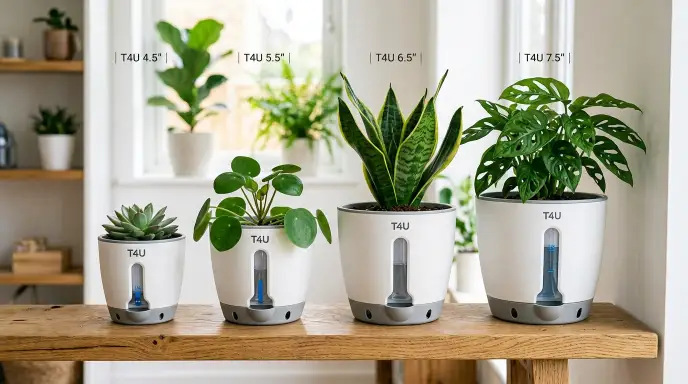
Ideal for beginners or plant collectors who need multiple sizes at once, T4U offers strong per-pot pricing with visible water-level windows and dual-wick systems for consistent moisture delivery.
Why it’s a great multi-pack choice:
- Clear side water-level windows for easy monitoring.
- Dual-wick systems in many models ensure even moisture distribution.
- Mixed-size sets cover everything from small herbs to larger houseplants.
- Excellent per-pot value compared to buying singles.
| Specification | Details |
|---|---|
| Typical Price | 4–6-inch multi-packs (4–6 pots): $20–30 / Mixed 5-pack (6″+8″+9″+10″+12″): $30–45 |
| Material | Polypropylene (PP) plastic (UV-resistant) |
| Special Features | Visible water-level window, cotton wick system, dual-layer reservoir, side-fill port on many models |
| Amazon Rating | Commonly 4.4–4.7 stars |
Pros ✅
- Clear side window lets you see the exact water level without guessing.
- Dual-wick system provides redundancy if one wick fails.
- Graduated sizes cover all your plant needs in one purchase.
- Side-fill port makes refilling easy without disturbing the topsoil.
- Lightweight and easy to move around.
Cons ❌
- Cotton wicks rot faster than nylon or ceramic alternatives—expect to replace them after 6–12 months.
- Water-level windows can become cloudy or covered in algae if not cleaned regularly.
- Plastic feels cheaper and thinner than Gardenix or Lechuza.
- Not recommended for outdoor use despite being labeled UV-resistant—prone to cracking in freeze-thaw cycles.
Other Strong Options Worth Mentioning
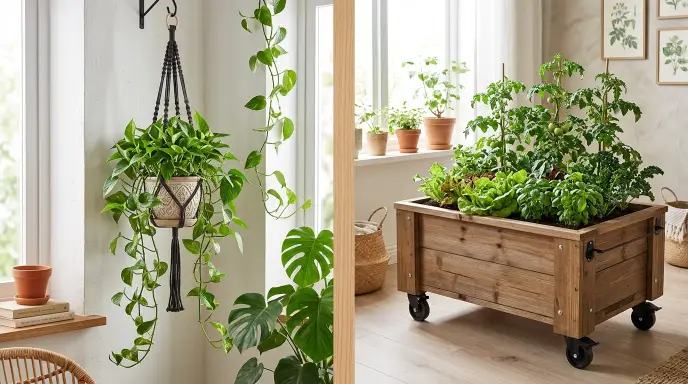
If your needs fall outside standard indoor pots, consider these specialized picks:
| Style | Options | Price Range | Pros ✅ | Cons ❌ |
|---|---|---|---|---|
| Hanging Self-Watering Pots | Gardenix hanging styles or similar | $20–40 | Great for trailing plants like pothos or string of pearls; saves shelf space. | Smaller reservoirs; need more frequent refills (5–7 days). |
| Large Rolling Planters for Vegetables/Tomatoes | Vego-style self-watering vegetable planters | $80–150+ | Deeper reservoirs handle thirsty crops; wheels for easy mobility. | Bulky; expensive; requires outdoor space and heavy soil. |
Final Verdict on the Best Self-Watering Pots 2026
| Category | Winner | Key Reason |
|---|---|---|
| Best Overall | Gardenix Decor 3-Pack | Best balance of features, value, and reliable 10–14-day refill. |
| Best Budget | Bloem Ariana | Unbeatable price with durable UV-resistant resin. |
| Best Premium | Lechuza Classico/Cubico | German engineering, float indicator, and long-lasting build. |
| Best Multi-Pack | T4U Self-Watering Pots | Excellent graduated sizes for beginners with visible water windows. |
Still undecided? Jump to our Complete Buying Guide below to match your specific plant type and room size with the perfect self-watering planter.
Self-Watering Pots 2026 – Complete Buying Guide (What to Look For)
Not all self-watering pots are created equal. To help you choose the best self-watering pots 2026 for your specific plants and lifestyle, here are the 7 critical factors you must evaluate before clicking “buy.”
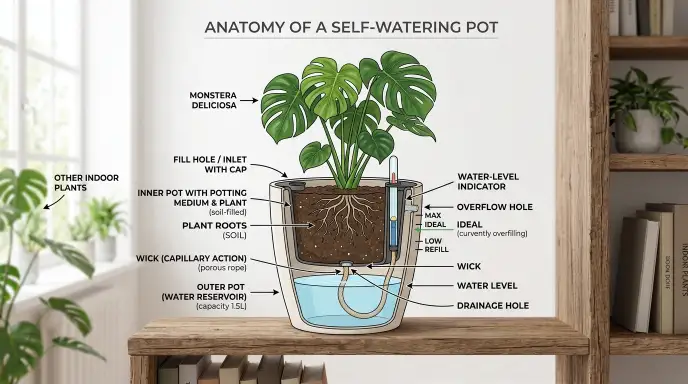
1. Water Reservoir Size & Refill Interval
The larger the reservoir, the less frequently you need to refill. For small herbs (basil, mint), a 0.5-liter tank lasts 5–7 days. For large plants like fiddle-leaf figs or monsteras, look for 1.5–2.0 liters to achieve that 10–14-day sweet spot. Check the product specs carefully—many budget options cut corners on reservoir capacity. temperature/humidity affect how often you need to refill the reservoir. Use a digital hygrometer to check humidity.
2. Wicking System Material
The wick is the heart of any automatic watering planter. Most use nylon or polyester ropes (durable, mold-resistant), while premium brands like Lechuza use specialized ceramic cones or capillary mats. Avoid cotton wicks—they rot and clog within months. For the best results, pair your planter with a well-aerated potting mix.
3. Water-Level Indicator (Non-Negotiable!)
This is arguably the most important feature. A clear, visible indicator (floating disc, transparent window, or float valve) tells you when to refill without guessing. If a planter lacks this, skip it—you’ll end up overfilling or underfilling, defeating the purpose of a self-watering flower pot.
4. Material: Plastic vs. Ceramic vs. Metal
- Plastic (e.g., Gardenix, Bloem): Lightweight, affordable, and retains moisture well. Look for BPA-free, UV-stabilized plastic to prevent cracking.
- Ceramic (e.g., Lechuza Classico): Heavy, durable, and aesthetically pleasing. Provides better temperature stability for roots but comes at a premium price.
- Metal/Stainless: Rare for sub-irrigation planters—avoid unless double-lined, as metal heats up quickly and can cook roots.
Always choose opaque reservoirs (dark or solid colors). Clear plastic allows light in, triggering algae growth.
5. Drainage & Overflow Protection
Even with self-watering, excess water must have an escape route. Look for an overflow hole positioned just below the rim. Without it, heavy rain or accidental overfilling will drown your plant. This is a common flaw in cheaper “self-watering” knockoffs. Even with a self-watering system, plants can still develop issues. How to Diagnose Indoor Plant Problems helps you identify whether yellow leaves, brown spots, or wilting are from pests, disease, or other causes.
6. Pot Depth & Root Space
Shallow-rooted plants (succulents, snake plants) do fine in 5–6 inch pots. Deep-rooted plants (tomatoes, monsteras, peace lilies) require at least 8–10 inches of depth. Always size up—a cramped root system will stress the plant regardless of how good the self-watering mechanism is.
7. Aesthetics & Placement
Function matters, but so does style. Consider where the pot will live:
- Indoor floor plants: Go for tall, tapered designs (Lechuza Cubico).
- Windowsills or shelves: Compact, round designs (Bloem Ariana) fit perfectly.
- Hanging baskets: Ensure the reservoir is securely sealed to prevent leaks.
Still unsure? Drop a comment below with your plant type and room size, and we’ll help you pick the perfect top self-watering planter in 2026 for your space.
What Is a Self-Watering Pot?
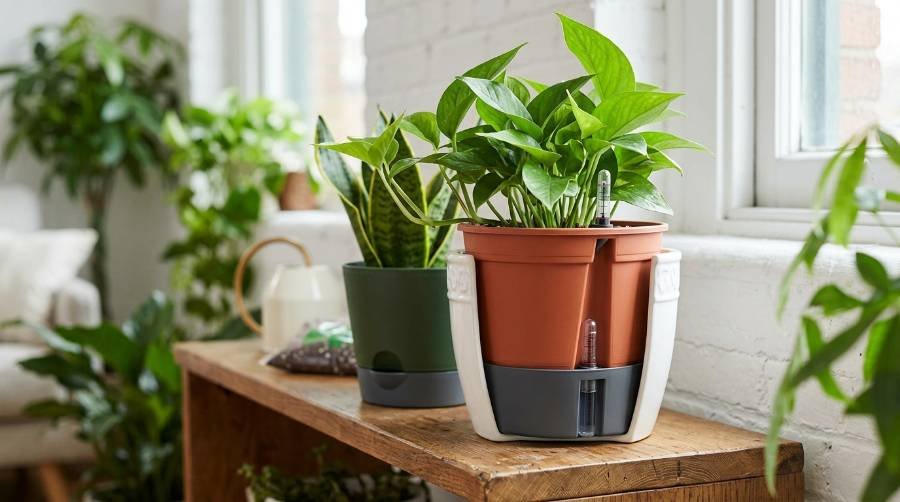
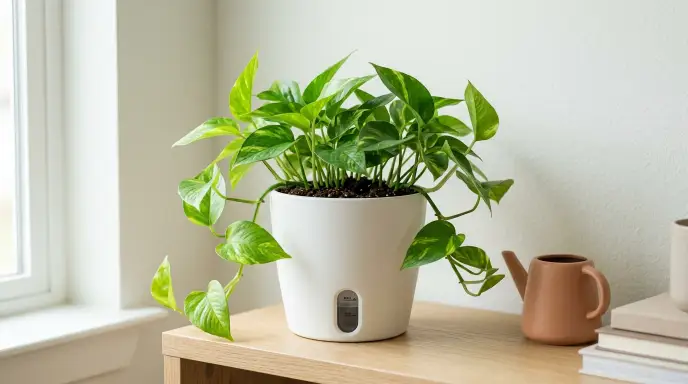
A self-watering pot is a container with a built-in water reservoir, usually located below or beside the root zone, that supplies moisture to the soil gradually instead of all at once. Most designs include a few consistent parts:
Reservoir:
The water storage chamber, usually in the base of the pot
Wick or capillary connection:
Fabric, rope, or a raised soil column that pulls water from the reservoir into the soil above
Soil barrier or false bottom:
Keeps roots from sitting directly in the water
Overflow hole:
Prevents the reservoir from flooding the soil during rain or overfilling
Water level indicator:
A float or window that shows how much water remains, so you’re not guessing
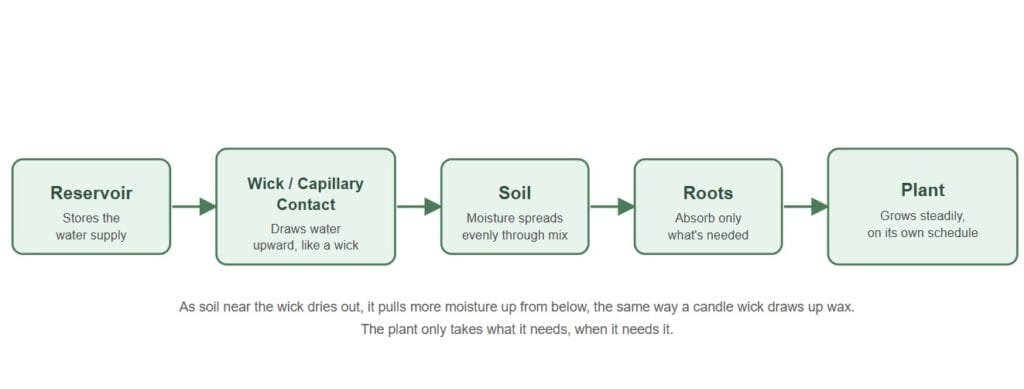
This is why these systems tend to produce steadier growth than manual watering on a fixed schedule: the plant pulls water on its own terms instead of getting flooded all at once.
Most systems work best with a well-aerated potting mix that still wicks moisture. Very light, fast-draining mixes made for succulents don’t transfer water well in these systems. It also helps to top-water thoroughly the first time you plant, so the soil fully connects to the wick before you start relying on the reservoir alone.
The Real Benefits of Self-Watering Pots
Prevents overwatering:
The plant draws water on its own terms instead of getting flooded
Reduces underwatering damage:
There’s a buffer of stored water even if you forget for a week
Saves time:
No daily or every-other-day watering routine
Ideal for travel:
Many setups go one to three weeks between refills, depending on size and plant
Healthier root systems:
Steady moisture reduces the stress cycle of bone-dry to soaking wet
Less water waste:
Water goes into a closed reservoir instead of running through and out the bottom
Cleaner indoor gardening:
Fewer saucers of standing water and less risk of overflow onto furniture or floors
Self-Watering Pots: Pros and Cons
No system is right for every plant or every person, and the honest downsides matter as much as the upside.
Pros
- Consistent moisture supports steadier growth for humidity- and water-loving plants.
- Fewer watering sessions, good for busy schedules and travel.
- Lower risk of underwatering stress.
- Can help reduce issues like blossom-end rot in tomatoes, which is often linked to inconsistent watering.
- Less mess than saucers and manual watering.
Cons
- Not ideal for drought-tolerant plants like succulents and cacti, which need the soil to dry out between waterings.
- Reservoirs need occasional cleaning to prevent algae and mineral buildup.
- Cheap or low-quality wicks can clog, degrade, or stop drawing water properly over time.
- If ignored, they can still overwater a plant that isn’t suited to constant moisture.
- Outdoor versions need to handle UV exposure, heavy rain, and freezing without cracking or overflowing.
Types of Self-Watering Pots People Actually Use
There are two useful ways to categorize these pots: by the watering mechanism inside, and by the material or form factor. Most buyers end up choosing based on both: the mechanism affects performance, and the material affects where it fits in your home or yard.
By Watering Mechanism
Wick-based systems:
A cotton, nylon, or acrylic wick runs from the reservoir up into the soil. Simple, inexpensive, and common in budget plastic pots.
- Best for: small to medium houseplants, herbs, starter setups
- Watch for: wicks that degrade or clog after a year or two of mineral buildup
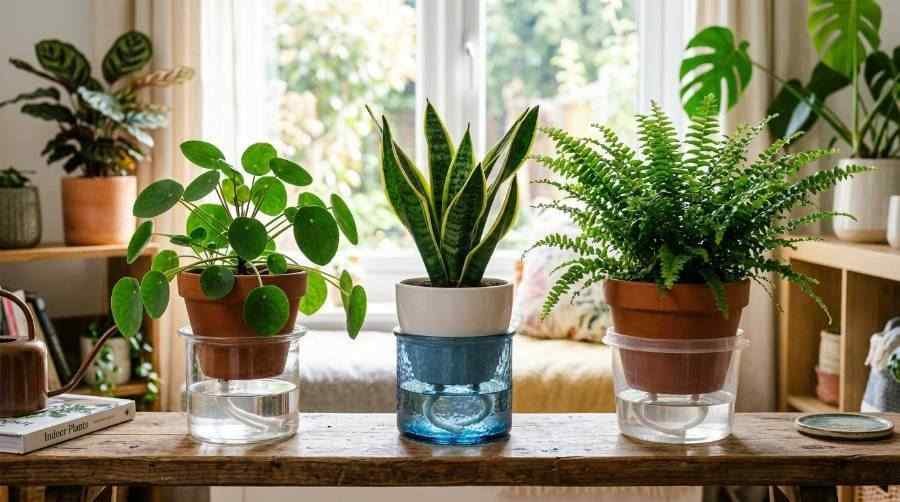
Reservoir / sub-irrigation planters (SIPs):
A raised inner pot or false bottom sits above a water chamber, and soil pulls moisture up through direct contact rather than a fabric wick. This is the most common commercial design, and it’s what products like Gardenix, Bloem, and Lechuza are built around.
- Best for: larger houseplants, patio containers, anything you want to leave alone for a week or two
- Watch for: make sure it has an overflow hole; some cheaper versions don’t
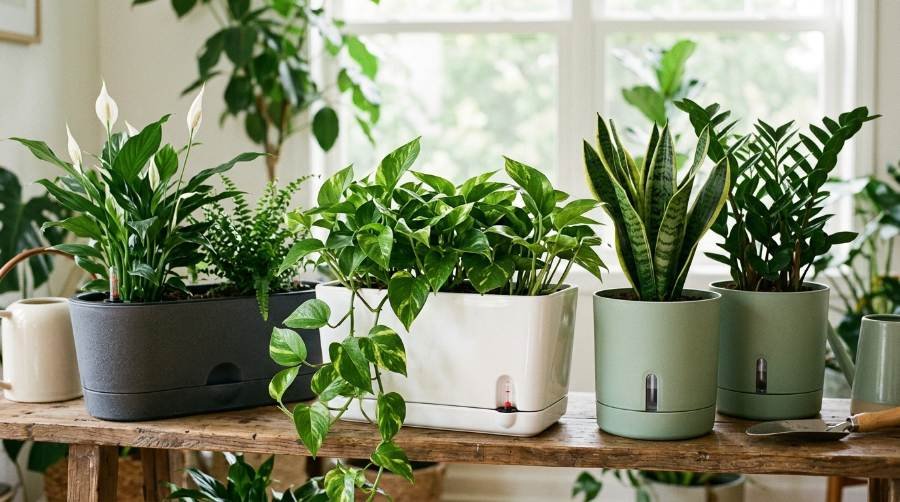
Capillary mat systems:
A moisture-wicking mat sits under multiple pots at once, drawing water up into each container from below.
- Best for: people growing many small plants or starting seed trays
- Watch for: less practical for single decorative pots
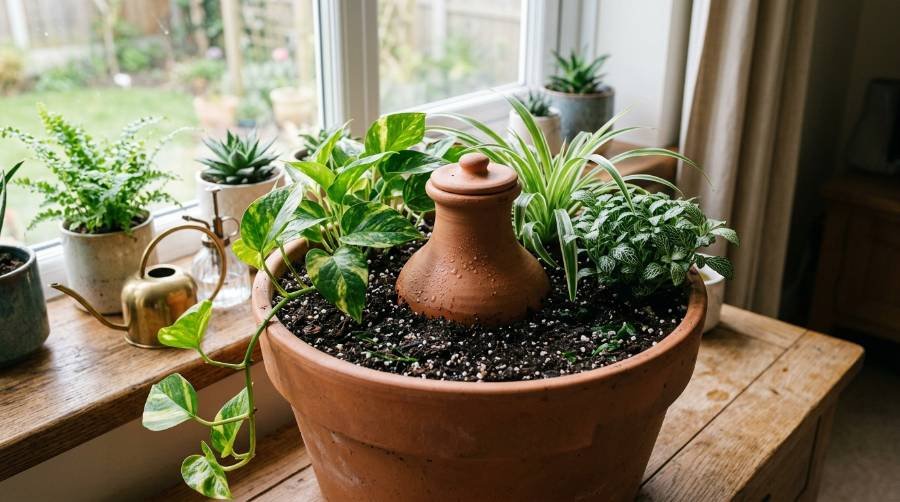
Olla / buried terracotta irrigation:
An unglazed clay vessel is buried in the soil and filled with water, which seeps slowly through the porous clay directly to root level. This is one of the oldest irrigation methods in the world, still widely used in vegetable gardens.
- Best for: raised beds, outdoor vegetable gardens, tomatoes
- Watch for: not practical for small indoor pots; needs garden-bed space
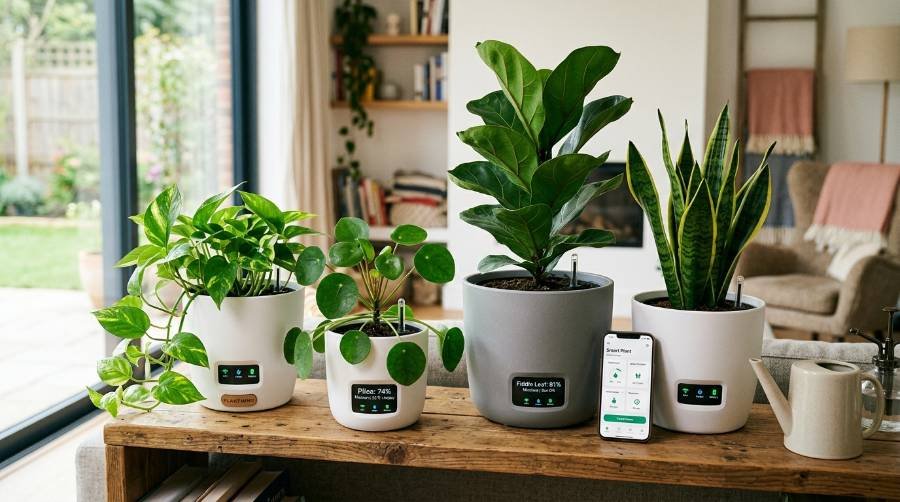
Smart / app-connected pots:
Sensor-driven systems that monitor soil moisture and trigger a small pump, often paired with a phone app.
- Best for: tech-forward buyers, people who want alerts rather than a visible indicator window
- Watch for: higher price point and a battery or power source to maintain
Self-watering inserts:
A wick-and-reservoir insert that goes inside a favorite decorative pot you already own, turning it into a self-watering system.
- Best for: keeping a specific ceramic or ornamental pot without buying new ones
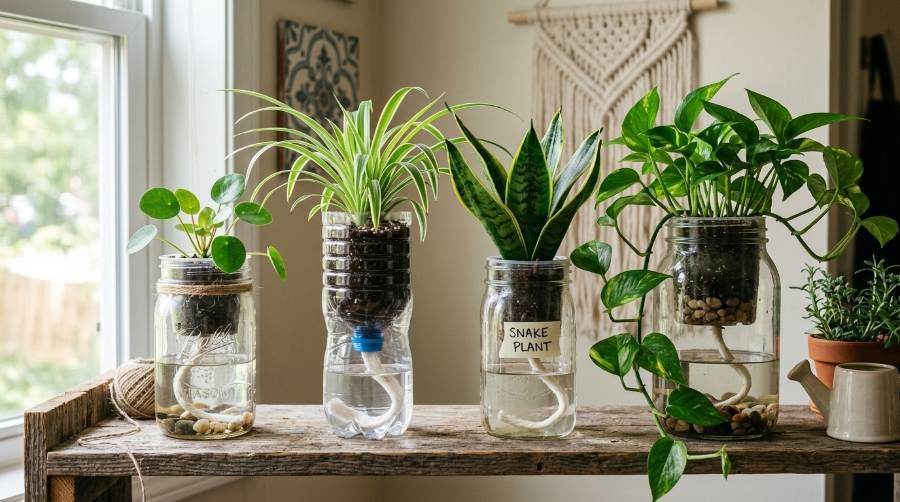
DIY self-watering pots:
A plastic bottle or two-container setup: one holds soil, one holds water, connected by a wick or the bottle neck itself.
- Best for: budget growers, classroom projects, testing the concept before buying a commercial version
By Material and Form Factor
| Type | Best For | Watch For |
|---|---|---|
| Plastic | Most houseplants, budget-friendly, lightweight | Can look less decorative |
| Ceramic | Living rooms, gift-worthy displays | Heavier, pricier, cracks if it freezes outdoors |
| Terracotta | Herbs, outdoor beds, breathable roots | Porous walls can dry reservoirs faster |
| Glass | Countertop herbs, propagation displays | Limited to small plants only |
| Metal | Modern/industrial decor, outdoor durability | Can heat up in direct sun |
| Fabric/felt grow bags | Raised beds, balconies, root aeration | Less structured, not for delicate decor |
| Resin | Outdoor patios, UV resistance | Can fade over years of sun exposure |
| Concrete | Large statement planters, patios | Very heavy, harder to move |
| Wood | Rustic or natural-style decor | Needs a liner to avoid rot |
| Hanging planters | Trailing plants like pothos or string of pearls | Reservoir size is usually small |
| Window box/balcony rail | Herbs, small flowers, tight spaces | Needs secure mounting hardware |
Which Plants Actually Thrive in Self-Watering Pots
Not every plant wants constant moisture, so matching the plant to the system matters more than the system itself.
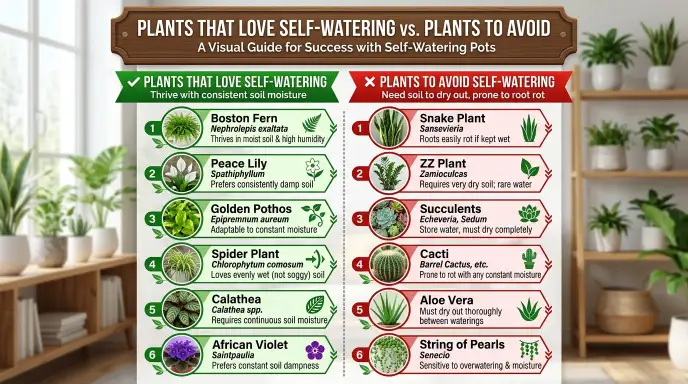
Plants that generally do well:
- Pothos
- Peace lily
- Spider plant
- Philodendron
- Calathea
- Ferns
- Monstera
- Herbs (basil, mint, parsley)
- Tomatoes and other consistently thirsty vegetables
Plants to avoid or use cautiously:
- Succulents and cacti: they need the soil to dry out fully between waterings.
- Snake plant and ZZ plant: both are drought-tolerant and prone to root rot in constant moisture.
- Orchids: most varieties need airflow around their roots, not a wet base.
- African violets: better suited to bottom-watering trays than a constant reservoir, since crown rot is a common risk. Learn about low light indoor plants in this guide.
Who Should (and Shouldn’t) Buy One
Self-watering pots make the most sense for busy professionals, frequent travelers, beginners who tend to underwater, apartment dwellers without a yard to garden in, and anyone growing herbs or vegetables that want steady moisture.
They make less sense for succulent and cactus collectors, gardeners who like full control over the wet-dry cycle for specific plants, and anyone unwilling to clean a reservoir every so often; skipping that step is where most complaints about these systems come from.
How to Choose the Right Self-Watering Pot
- Match the material to the location:
Ceramic and glass suit indoor display; resin, concrete, and UV-stable plastic hold up outdoors. - Check the reservoir size against your travel habits:
A larger reservoir means a longer stretch between refills. - Look for a water-level indicator:
A float window removes almost all the guesswork, especially for beginners. - Confirm there’s an overflow hole:
Without one, a hard rain or an overfilled reservoir can drown the roots. - Size the pot to the plant’s mature size:
Not its current size, since a plant that outgrows its pot loses the benefit of the reservoir system. - Consider the decorative style you actually want:
Modern, rustic, minimalist, or boho finishes are all available across most of these mechanisms. - Weigh budget against longevity:
A cheap wick system may need replacing within a year; a well-built sub-irrigation planter like the Lechuza line can last many years.
| Type | Best For | Maintenance Level | Typical Price Range |
|---|---|---|---|
| Wick-based plastic | Small houseplants, starters | Low | $ |
| Sub-irrigation planter | Most houseplants, patio pots | Low–Medium | $$ |
| Olla/terracotta | Garden beds, vegetables | Medium | $ |
| Fabric grow bag | Raised beds, balconies | Medium | $ |
| Smart/app-connected | Tech-forward growers | Medium | $$$ |
Self-Watering Pots vs. Other Watering Methods
| Method | Maintenance | Water Usage | Root Health | Best For |
|---|---|---|---|---|
| Self-watering pot | Low | Efficient | Steady, if plant-matched | Busy schedules, travel |
| Regular pot + saucer | High | Wasteful (runoff) | Prone to wet-dry swings | Attentive daily waterers |
| Bottom watering | Medium | Efficient | Good for rot-prone plants | African violets, seedlings |
| Wick watering (standalone) | Low | Efficient | Good for small pots | DIY setups, single plants |
| Watering globes | Medium | Inefficient over time | Inconsistent | Short trips only |
| Cachepot (decorative outer pot) | High | Same as regular pot | No real improvement | Style over function |
Wick watering is really just a simplified version of what’s built into most commercial self-watering pots. The difference is that a dedicated system usually pairs the wick with a proper reservoir, indicator, and overflow protection, instead of a jar and a piece of string.
How to Set Up and Use a Self-Watering Pot Correctly
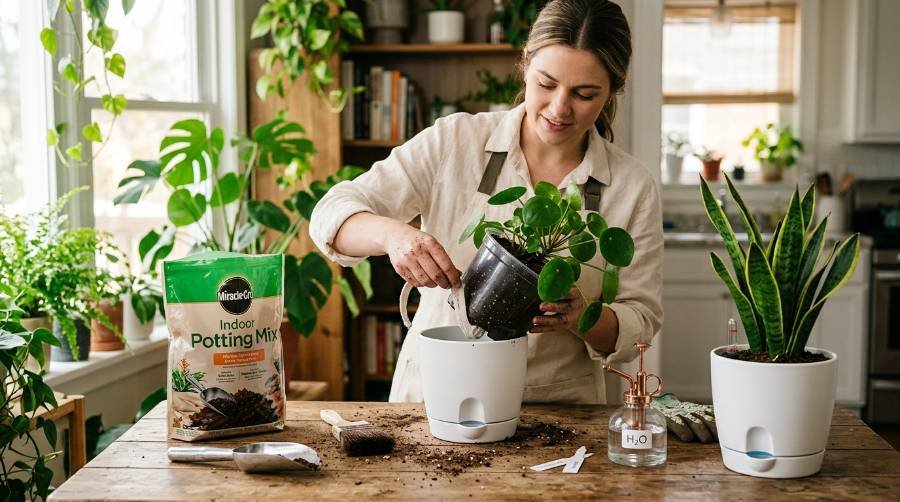
- Add a well-aerated potting mix that still holds and transfers moisture. Avoid ultra-fast-draining succulent mixes unless the plant needs one.
- Top-water thoroughly the first time so the soil fully connects to the wick or reservoir before you rely on it alone.
- Fill the reservoir to the indicated line, not above the overflow hole.
- Check the water indicator weekly at first, until you learn how quickly your specific plant and pot combination draws water down.
- Let the reservoir run low occasionally rather than topping it off constantly. This mimics a natural dry-down cycle and helps prevent root rot in moisture-sensitive plants.
Common mistakes to avoid:
- Overfilling the reservoir past the overflow line
- Using a soil mix too dense or too fast-draining for the wicking system
- Ignoring drainage and letting water stagnate for months
- Never cleaning the reservoir, which allows algae and mineral deposits to build up
- Skipping the initial top-watering step, which can leave the wick disconnected from the soil
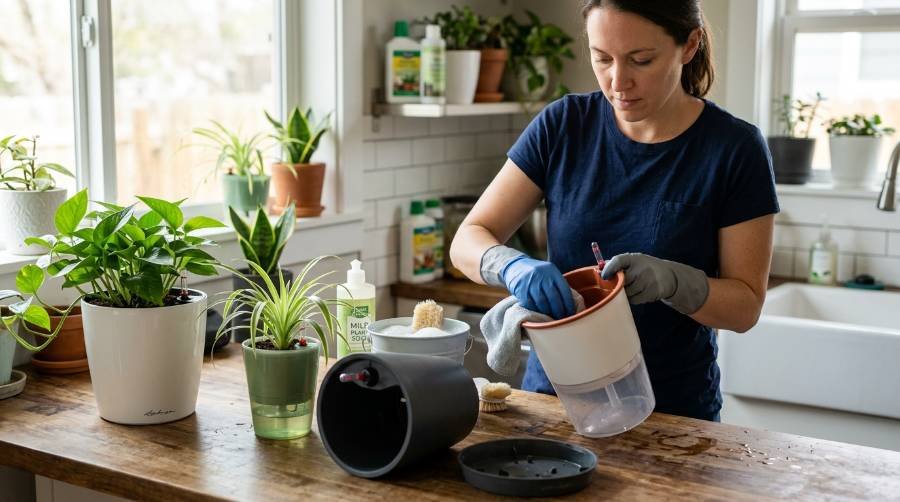
Cleaning and Maintenance
- Weekly:
Check the water level and top off if needed. - Monthly:
Empty and rinse the reservoir to prevent algae buildup, especially in bright rooms. - Seasonally:
Deep-clean with a mild vinegar-water rinse to remove mineral deposits, and inspect wicks for wear or clogging. For outdoor pots, drain fully before the first freeze to prevent cracking.
Frequently Asked Questions About Self-Watering Pots 2026
Got questions about the best self-watering pots 2026 has to offer? We’ve compiled the most common queries from plant parents just like you. Each answer is based on manufacturer specs, verified owner reviews, and general horticultural research.
Do self-watering pots really work?
Yes—when used with the right plants. Self-watering pots work through capillary action: a wick or porous material draws water from a hidden reservoir up into the soil, releasing moisture only when the soil dries out. This mimics how plants naturally absorb water from the ground, resulting in steadier, healthier growth compared to manual watering on a rigid schedule. However, they work best with moisture-loving plants like ferns, pothos, and peace lilies—not drought-tolerant succulents or cacti.
How often do you need to refill a self-watering pot?
Refill intervals typically range from 1 to 3 weeks, depending on three factors: reservoir size, plant type, and room temperature/humidity. Verified owner reviews for the Gardenix Decor 3-pack commonly report a reliable 10-to-14-day refill window for medium-sized indoor plants. Smaller 6-inch pots (like the Bloem Ariana) may need refilling every 5–7 days, while large Lechuza models with 2-liter reservoirs can easily stretch to 2–3 weeks between fills.
Can self-watering pots cause root rot?
They can—if you choose the wrong plant or never let the reservoir run low. Plants that prefer dry soil (succulents, cacti, snake plants) are especially at risk because their roots aren’t adapted to constant moisture. However, for tropical houseplants like monsteras, calatheas, and ferns, a well-designed self-watering planter with an elevated inner pot (like the Gardenix) actually prevents root rot by keeping roots out of standing water while still providing consistent hydration. Why is my houseplant dying? Read this guide.
Are self-watering pots good for outdoor plants?
Absolutely—as long as they are built for the elements. Look for UV-resistant and frost-resistant materials (polypropylene resin is ideal) and ensure the pot has an overflow hole to handle heavy rain. The Bloem Ariana (with its knockout drainage holes) and Lechuza’s outdoor-rated lines are both excellent choices for patios, balconies, and covered porches. Avoid cheap clear-plastic planters outdoors—they degrade quickly in sunlight and promote algae growth.
What’s the difference between a self-watering pot and a regular pot with a saucer?
A saucer is passive; a self-watering pot is active. A regular pot with a saucer simply catches excess water that drains out after you water from the top. It does not actively supply moisture back to the plant. In contrast, a true sub-irrigation planter has a built-in reservoir that continuously feeds water upward through capillary action, meaning your plant drinks on its own terms—not just when you remember to water. Read our how to water plants correctly guide to know about watering.
Can I make a self-watering pot at home?
Yes, a basic DIY version is possible using two nested containers and a cotton or nylon rope wick. However, homemade systems often lack critical features like overflow protection, accurate water-level indicators, and elevated inner pots that prevent root rot. Commercial options like the best self-watering pots 2026 (Gardenix, Lechuza, T4U) are designed with these safeguards built-in, making them far more reliable and beginner-friendly than any DIY hack.
Can I fertilize plants in a self-watering pot?
Yes—but with caution. Use a diluted liquid fertilizer (at half-strength) or slow-release granules specifically formulated for consistent-moisture systems. Avoid pouring concentrated fertilizer directly into the reservoir, as it can accumulate and burn roots. Instead, apply diluted fertilizer to the topsoil and allow it to gradually work its way down through the wicking system. For best results, flush the reservoir with plain water every 4–6 weeks to prevent salt buildup. Learn how to fertilize indoor plants in this guide.
Do self-watering pots attract mosquitoes?
They can—but well-designed models prevent this. Mosquitoes breed in stagnant, open water. The best self-watering planters feature sealed reservoirs with narrow fill tubes, which block mosquitoes from accessing the water. However, if you leave the reservoir uncovered or forget to refill for weeks, standing water can become a breeding ground—especially outdoors. To stay safe, always choose pots with opaque, sealed reservoirs and change the water monthly.
What size self-watering pot should I buy?
Always size up based on your plant’s mature size—not its current one. A tiny pot can stunt root growth and require constant refilling, while an oversized pot holds excess water that may never be absorbed. As a rule of thumb:
Small herbs/succulents: 4–6 inches
Medium houseplants (peace lily, pothos): 6–8 inches
Large floor plants (monstera, fiddle-leaf fig): 10–14 inches
For multiple plants: Multi-packs like the T4U graduated 5-pack (6″ to 12″) are excellent value.
Which plants thrive best in self-watering pots?
Moisture-loving tropicals and fast-growing foliage plants perform best. Top choices include ferns, peace lilies, pothos, philodendrons, monsteras, calatheas, and spider plants. Avoid succulents, cacti, snake plants, and ZZ plants—they prefer dry soil and are prone to root rot in constant moisture. For the best humidifiers for houseplants, check out our guide to the best humidifiers for houseplants.
Final Verdict – Which Self-Watering Pot Should You Buy in 2026?
Based on manufacturer specs, published comparisons, and patterns across verified owner reviews, here is our verdict on the best self-watering pots 2026 has to offer:
| Your Priority | Our Top Recommendation | Why? |
|---|---|---|
| Best Overall (The Crown) | Gardenix Decor 3-Pack | Unbeatable balance of features (elevated inner pot, clear indicator, 10–14-day refill), quality, and value at ~$7–$9 per pot. Perfect for 90% of houseplant owners. |
| Best Premium / Long-Term Investment | Lechuza Classico or Cubico | German engineering, precise float indicator, and frost/UV resistance. The gold standard for sub-irrigation planters—worth every penny for statement plants and outdoor use. |
| Best Budget / Bulk Purchase | Bloem Ariana | Reliable UV-resistant resin at an unbeatable price point ($6–$16). Ideal for outfitting multiple pots on a tight budget. |
| Best Multi-Pack (Beginners) | T4U Mixed 5-Pack | Graduated sizes with visible water windows and dual-wick systems—excellent for learning the ropes without breaking the bank. |
The real return on these pots isn’t just convenience—it’s the steadier, healthier growth that comes from giving your plant water on its own terms instead of yours. Pair your new planter with a high-quality potting mix and a reliable watering tool. Check out our guide to the best long-spout watering cans for precision hydration when top-watering is still needed.
Still unsure which self-watering pot is right for you? Drop a comment below with your specific plant type, room size, and lighting conditions, and our team will personally recommend the perfect self-watering planter for your space!